
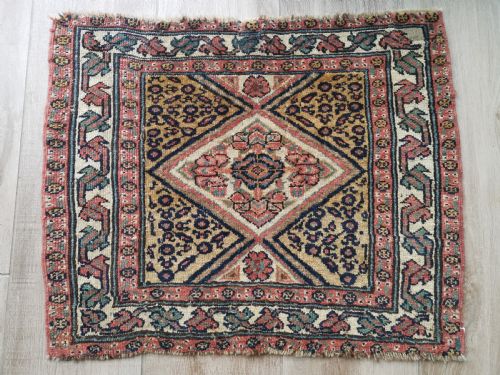
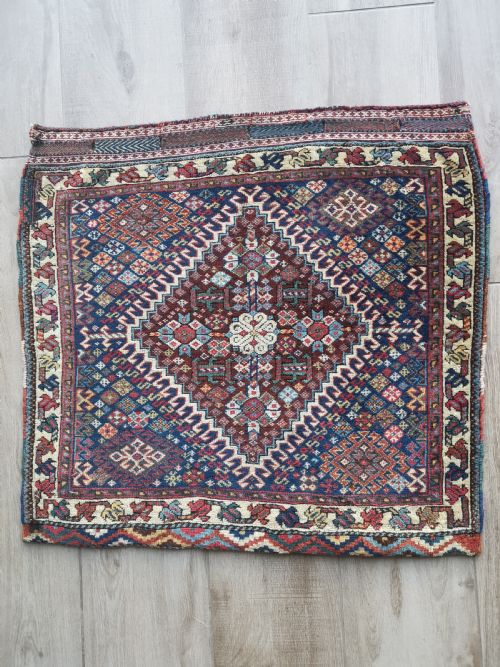


Persian Cushion Cover Face
A persian cushion cover face brings nomadic craft into a room, offering rich tribal patterns woven by hand over a century ago.
Persian Cushion Cover Face
A persian cushion cover face originates from the functional storage bags, saddlebags, and cargo carriers made by nomadic and tribal confederations across Persia. Rather than decorative items made for export, these textiles served practical daily purposes within tribal camps before being repurposed into modern cushions and pillows.
The pieces seen on this page span the late nineteenth century and the early twentieth century, encompassing work from groups such as the Qashqai, Shahsavan, Afshar, Khamseh, Baluch, Kurdish, and Jaf tribes. Many examples survive as single bag faces or half-bag faces, harvested from larger storage containers or Khorjin saddlebags once the original backs wore away.
Makers utilised traditional regional motifs including boteh patterns, geometric arrangements, birds, and dragons, woven in distinct tribal formats. The resulting textile art brings an authentic piece of nomadic heritage into contemporary interiors as functional floor or sofa cushions.
Evaluating Quality
The standard of a piece depends heavily on the fineness of the weave and the clarity of the tribal design. Tighter knots and precise geometric execution distinguish superior examples from standard utilitarian work.
Depth and saturation of the natural dyes play a major role in visual impact. Luminous, well-preserved wool combined with complex iconography, such as birds or dragons, elevates a textile above simpler geometric compositions.
Listings feature pieces from the nineteenth and early twentieth centuries, spanning the 1870s to the 1920s.
The Persian Cushion Cover Face Glossary
- Bag face
- The decorative front panel of a nomadic storage bag or saddlebag. It preserves the primary woven art while the plain weave back often wore away.
- Soumak
- A flat-weave technique where coloured weft threads wrap around the warp threads in a continuous brocading motion. This method creates a sturdy textile with a textured, herringbone-like appearance on the surface.
- Boteh
- A traditional teardrop or almond-shaped motif with a curved upper end. It appears frequently in tribal Persian textiles and represents a stylized bush, leaf, or floral spray.
- Khorjin
- The traditional Persian term for a double saddlebag used by nomads for transport and storage. Many surviving cushion covers originate from these paired bags.
- Nomadic
- Pertaining to pastoral tribes who migrate seasonally with their livestock across Persia. Their textiles reflect portable arts designed for life on the move.
Persian Cushion Cover Face: Frequently Asked Questions
What is a bag face?
A bag face is the decorative front panel cut from a larger nomadic storage bag or saddlebag. These panels were preserved for their intricate weaving while utilitarian plain weave backs deteriorated.
They function today as decorative textile art and cushion covers, retaining the authentic patterns created by nineteenth-century weavers.
How were these bags used?
Nomadic tribes utilised these woven containers for storing household goods, bedding, and provisions during seasonal migrations. Double saddlebags carried belongings across pack animals while stationary bags kept camp items organised.
Over time, damaged or separated panels were adapted into cushions and pillows for domestic interiors.
How do I tell different tribes apart?
Tribal attribution relies on specific colour palettes, structural techniques, and recurring geometric or figurative motifs. For instance, Shahsavan pieces often feature Soumak work with birds or dragons, while Qashqai designs lean towards rich madder reds and intricate medallions.
Reference materials and regional provenance help identify whether a piece originates from Fars, Khorassan, or Northwest Persia.
How do I clean an antique cushion face?
Antique wool textiles require gentle care to preserve natural dyes and hand-spun fibres. Professional specialist cleaning is recommended over standard domestic methods.
Regular light vacuuming with a low suction attachment helps remove surface dust without damaging the vintage foundation.