


Tribal Saddlebag Face
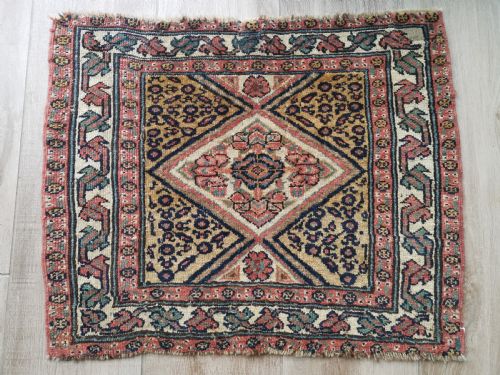
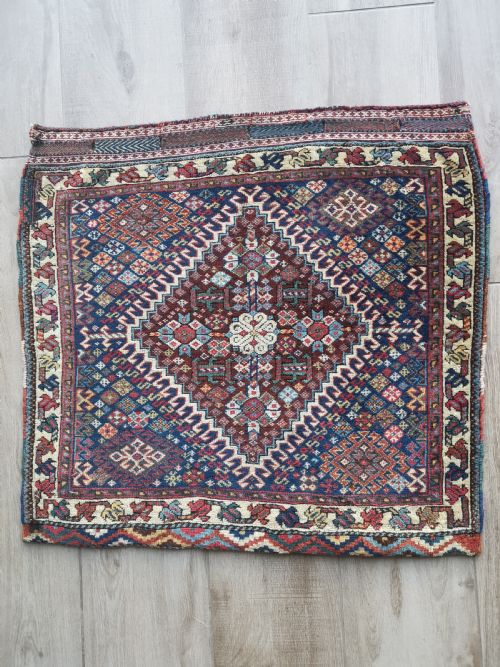
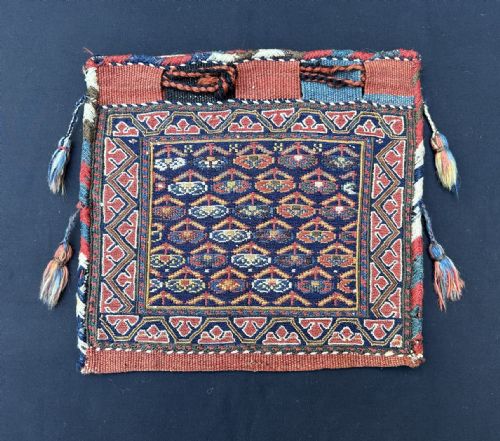
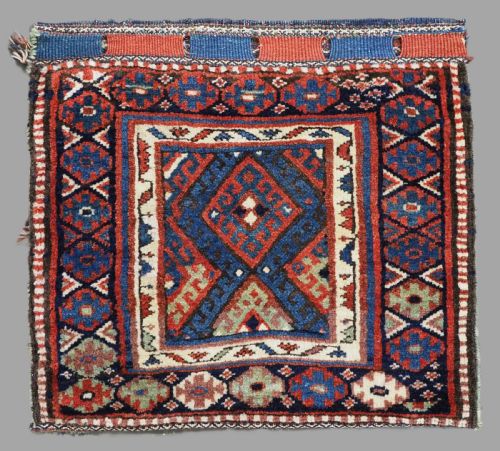
When you search for a tribal saddlebag face, you are looking at the front panel of a nomadic animal pack.
Tribal Saddlebag Face
A tribal saddlebag face represents the front panel of a traditional animal transport pouch woven by nomadic groups in Persia and surrounding regions. These fragments survive from the nineteenth and early twentieth centuries, reflecting the material culture of tribes such as the Qashqai, Shahsavan, Afshar, and Jaf Kurd.
Most examples found on this page are half-bags or single faces separated from their original paired format, though complete bags with plain weave backs also appear. The formats range from square panels featuring central medallions to elongated storage bags and banded weft work designs.
The regional origins trace across specific territories, including the Fars province, Azerbaijan, and Luristan. Each piece carries the distinct geometric vocabulary and tribal motifs characteristic of its maker's confederation.
Evaluating quality
Quality rests in the handling of the wool and the clarity of the dye work. Lustrous, luminous wool retains its handle and depth of colour far better over generations of use.
The precision of the weave and the crispness of the tribal motifs distinguish finer examples from standard work. Finer knotting density and well-balanced proportions elevate a panel within its regional type.
Nomadic weavers packed entire households into these bags every spring, trusting a few pounds of wool to haul the family copper pots.
The Tribal Saddlebag Face Glossary
- Khorjin
- The traditional Persian term for a double saddlebag used by nomadic tribes for transport and storage. These were often split over time, leaving single bag faces.
- Soumac
- A flat-weave technique where coloured weft threads wrap around the warp threads in a herringbone pattern. This method creates a durable, textured surface without a cut pile.
- Boteh
- A stylised floral motif resembling a pear or almond shape, frequently found in Afshar and Persian tribal designs. It represents a recurring symbol across regional weaving traditions.
- Medallion
- A central decorative motif placed in the field of the textile. Tribal weavers arranged geometric or hooked polygons to anchor the composition.
- Plain weave
- A simple alternating over-and-under interlacing of warp and weft threads. This technique forms the unpatterned backs of complete bags.
Tribal Saddlebag Face: Frequently Asked Questions
What is a tribal saddlebag face?
A tribal saddlebag face is the decorated front panel of a nomadic storage pouch. These panels were sheared or cut from larger paired saddlebags used on pack animals.
Today, they survive as standalone textile fragments valued for their compact tribal designs and historical weaving techniques.
How were these bags originally used?
Nomadic groups utilised these double pouches draped across horses, donkeys, or camels for household transport. They stored personal belongings, provisions, and bedding during seasonal migrations.
When the bags wore out along the connecting bridge, the faces were often separated and preserved independently.
How should I display a bag face at home?
These square or rectangular panels adapt well to wall mounting using a subtle fabric sleeve and velcro system. Their robust construction also allows them to be placed on low-traffic surfaces as small decorative mats.
Keeping them away from direct sunlight preserves the natural dyes used by the original makers.