


Japanese Ceramic Koro
These japanese ceramic koro are traditional lidded incense burners shaped by Japanese artisans for ritual and display, sought for their intricate hand-painted detail.
Japanese Ceramic Koro
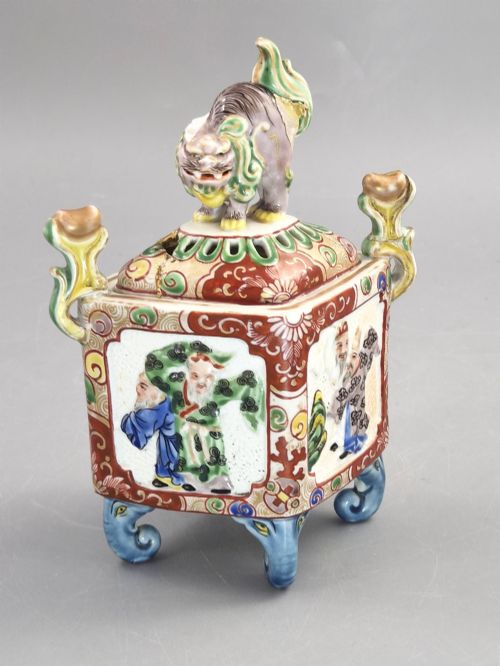
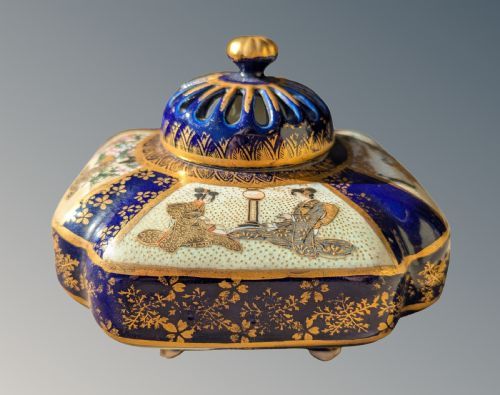
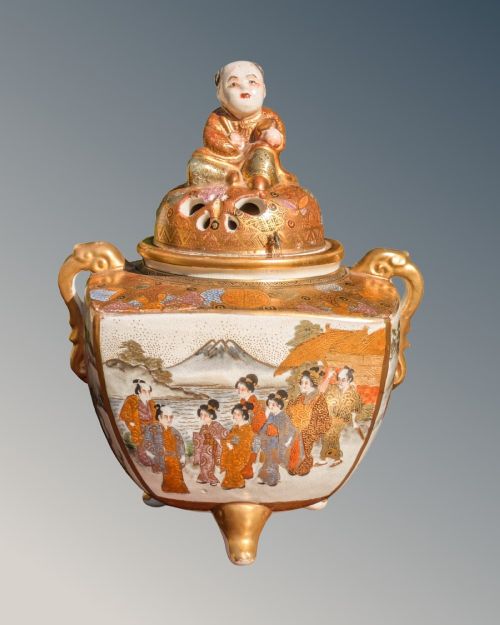
A japanese ceramic koro is an incense burner designed with a removable cover, frequently supported on feet and topped with a sculptural finial. These vessels emerge predominantly from the nineteenth century, spanning the Edo and Meiji periods into the early twentieth century.
The forms range from compact miniature burners to large lidded vessels and footed bowl burners. Many examples incorporate traditional motifs such as the shi-shi lion or elephant head feet alongside decorative vase formats.
How they were made
Makers utilised porcelain and earthenware as the primary ceramic bodies, shaping them into detailed vessels before applying glaze and colour. Cobalt underglaze provides deep blue tones, while enamel paints build rich surface patterns.
Gold leaf, gilt, and gilding add metallic highlights across many pieces, often accentuating specific motifs and rims. Sculpted elements and reticulated pierced work demand advanced forming techniques prior to firing.
Listings demonstrate materials spanning porcelain, earthenware, bronze, enamel, gold leaf, and cobalt underglaze across the nineteenth and early twentieth centuries.
What varies in quality
The refinement of the painted decoration dictates the distinction between standard vessels and superior works. Precision in brushwork, particularly within complex Satsuma and Imari designs, separates ordinary production from master output.
The execution of sculptural additions like the karashishi finial or pierced reticulation influences overall merit. Potter marks and specific workshop signatures further distinguish individual achievements.
Kinkozan·Kizan·Kotobuki-do·Shizan
The Japanese Ceramic Koro Glossary
- Koro
- An incense burner, typically featuring a body, a pierced or fitted cover, and often raised on feet. These vessels served both practical burning functions and decorative roles.
- Satsuma
- A type of earthenware originating from Satsuma Province, characterised by a crackle-glaze finish and detailed polychrome enamel painting combined with gold highlights.
- Imari
- A style of Japanese porcelain featuring a distinct palette dominated by underglaze blue, iron red, and gilt detailing over a white background.
- Meiji Period
- The era in Japanese history spanning from 1868 to 1912, noted for a flourishing of decorative arts intended for both domestic and international markets.
- Shi-Shi
- A mythical guardian lion depicted frequently as a sculptural finial atop the cover of a burner.
- Reticulated
- Work featuring an openwork or pierced lattice design created in the ceramic body before firing.
Japanese Ceramic Koro: Frequently Asked Questions
What is a koro used for?
A koro functioned traditionally as an incense burner within Japanese interiors, designed to hold aromatic materials beneath a ventilated lid.
Over time, many of these vessels transitioned into purely decorative objects valued for their intricate craftsmanship and artistic presence.
How do I identify a Satsuma koro?
Satsuma pieces generally display a characteristic pale earthenware body covered in a finely crackled transparent glaze.
They rely heavily on intricate enamel painting enriched with gold leaf and gilt detailing to depict figures, florals, and traditional scenes.
What is the difference between Imari and Satsuma?
Imari pieces utilise a porcelain body decorated primarily in cobalt underglaze blue, iron red, and gold, resulting in a harder and crisper finish.
Satsuma pieces utilise an earthenware body with a softer crackle glaze designed to receive dense polychrome enamels.
How should I display a koro at home?
These lidded vessels suit placement on stable surfaces such as cabinets, sideboards, or mantelpieces where their detailed painting can be appreciated.
Because many include a separate cover and delicate sculptural finials, positioning them away from high-traffic areas ensures safety.