


Japanese Porcelain Censer
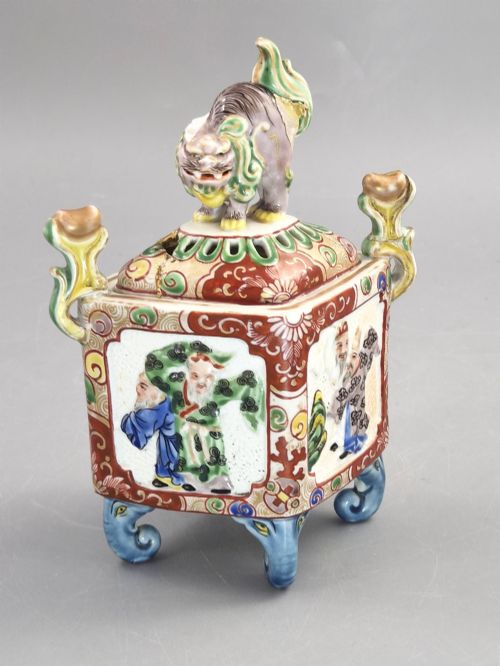
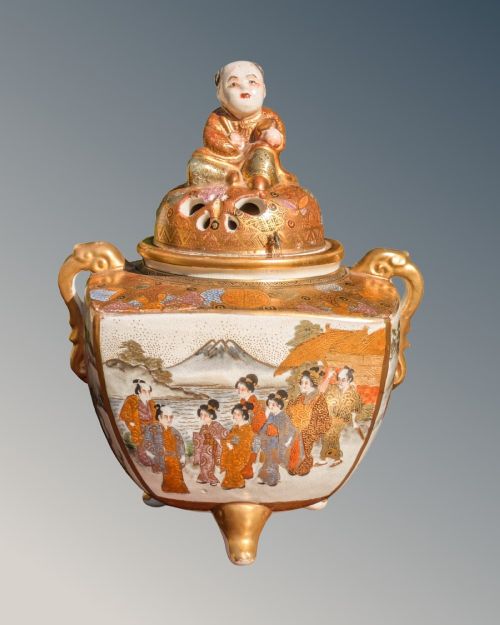
These Japanese porcelain censer pieces are traditional incense burners formed in porcelain, earthenware, and Imari styles that bring historic East Asian craftsmanship into a room.
Japanese Porcelain Censer
A Japanese porcelain censer typically takes the form of a lidded vessel or koro, often supported on three feet and finished with a sculpted finial such as a lion or mythical beast. These pieces appear across several eras, including the Edo and Meiji periods, taking shapes like tripod bowls, treasure ships, and elephant-headed vessels.
The most common examples on this page date from the nineteenth century, particularly the Meiji period, alongside Edo period and Edwardian specimens. Makers utilised traditional decorative vocabularies, ranging from Imari palettes to Satsuma earthenware and Kutani enamel work.
Materials and construction methods
Potters shaped these bodies from porcelain and earthenware, applying cobalt underglaze, enamel colours, and gold leaf or gilding to the surface. Many vessels incorporate reticulated panels or sculptural elements moulded separately before being attached to the main body.
Japanese Porcelain Censer Retail Price Guide 2026
Typical asking prices for japanese porcelain censer among the pieces listed under this phrase on Sellingantiques today, from the lower quarter to the upper quarter. They describe what is for sale here now, not the wider market.
Listings feature porcelain, earthenware, and bronze materials spanning the Edo, Meiji, and Edwardian periods.
Distinctions in execution and detail
Quality rests in the crispness of the modelling, particularly on sculptural elements like dragon motifs, lion finials, and tripod feet. Finer vessels display precise brushwork in the enamel and gilding, with well-balanced proportions and sharply defined reticulated work.
The presence of artist signatures, distinct family crests such as the Shimazu badge, and documented kiln origins like Arita or Kyoto distinguish standard decorative items from masterworks. The application of gold leaf and cobalt underglaze shows varying degrees of control, separating routine production from superior studio output.
Kizan
The Japanese Porcelain Censer Glossary
- Koro
- An incense burner, typically featuring a body, a pierced cover for releasing smoke, and small supporting feet. These vessels form the central category of this search.
- Meiji Period
- The era in Japanese history spanning from 1868 to 1912, known for intense artistic production and export to Western markets. Many listed items originate from these decades.
- Imari
- A style of Japanese porcelain featuring a palette of cobalt blue, iron red, and gold, produced in the town of Arita. This aesthetic dominated export wares across multiple centuries.
- Satsuma
- A type of Japanese earthenware characterised by a crackle glaze and elaborate overglaze enamel and gilt decoration. These pieces frequently depict figurative scenes and temple lions.
Japanese Porcelain Censer: Frequently Asked Questions
What is a koro?
A koro is a traditional Japanese incense burner designed with a removable pierced lid to let scented smoke escape into a room. These vessels usually sit on three legs and feature sculptural handles or finials.
Potters shaped them in porcelain or earthenware, decorating the exterior with enamel, cobalt, and gold leaf. They served both ritual functions in temples and decorative roles in domestic interiors.
How do I identify a Meiji period censer?
Meiji period censers often display dense enamel work, gilded details, and distinctive sculptural elements like dragons or lions. The era spans from 1868 to 1912, aligning with the opening of trade with Western markets.
Examination of the base may reveal maker signatures, studio marks, or family crests such as the Shimazu badge. The styles from this window range from Satsuma earthenware to Kutani porcelain.
What is the difference between Imari and Kutani?
Imari porcelain relies on a palette of underglaze cobalt blue combined with iron red and gold, often featuring geometric and floral panels. The style originated in Arita and focuses on strong contrast.
Kutani ware typically employs a richer, more painterly overglaze enamel scheme, sometimes incorporating figurative scenes or animal shapes like treasure ships. Both traditions produced lidded vessels for burning incense.
Where should I display an antique censer?
These lidded vessels suit stable surfaces such as sideboards, mantelpieces, or display cabinets where their detailed surface work remains visible. Because many pieces feature delicate gilt or enamel highlights, positioning them away from direct sunlight helps preserve the colours.
Collectors often place tripod bowls and animal-form burners where viewers can inspect the sculpted feet and pierced covers from multiple angles.