


Japanese Porcelain Koro
These japanese porcelain koro incense burners are vessels of craft and ceremony, offering a tactile piece of far eastern history for your interior.
Japanese Porcelain Koro
When you search for japanese porcelain koro, you are examining lidded vessels made for burning incense, originating primarily from the nineteenth century. These pieces encompass forms from the Edo and Meiji periods, showcasing the rich decorative traditions of their makers.
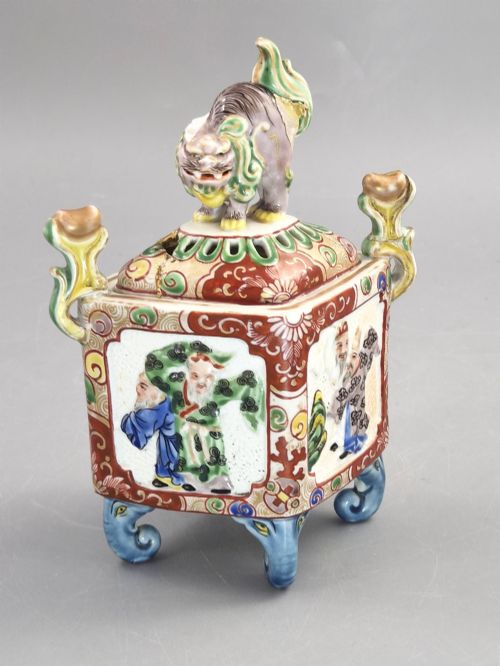
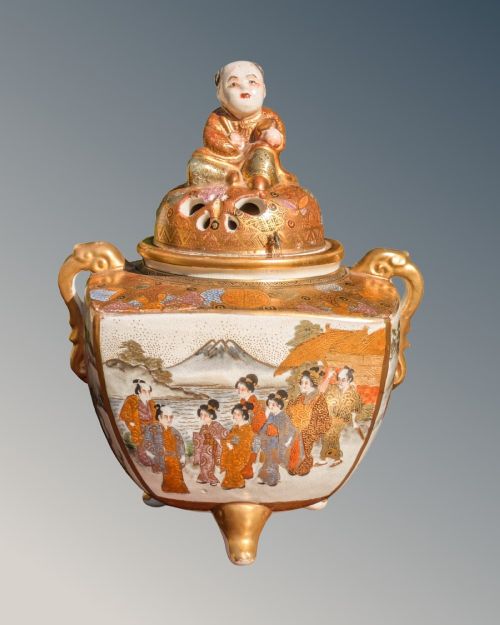
You will most commonly encounter Satsuma, Kutani, Imari, and Hirado examples on this page. They frequently arrive complete with covers, sometimes topped by sculpted figures such as the Karashishi or Shi-Shi lion.
The objects range from modest table pieces to large lidded vessels, often supported by distinct feet shaped like elephant heads or traditional scrolls. Each piece serves as both a functional burner and a decorative focus for a room.
Materials and methods
Makers shaped these vessels using porcelain or earthenware bodies, applying cobalt underglaze pigments before the initial firing. Artisans then layered enamel paints, gold leaf, and delicate gilding across the surfaces to create intricate patterns.
Sculptural elements such as dragons, lions, and elephant head feet were modelled by hand before attachment to the main body. Reticulated panels and pierced ceramic work required immense skill to carve while the clay remained damp.
Materials recorded on this page include cobalt underglaze, bronze, gold leaf, and earthenware alongside standard porcelain.
Judging quality and execution
The integration of the cover with the main body reveals the maker's discipline. Weaker pieces often show clumsy proportions or heavy, muddy glaze pooling, whereas finer koro maintain balance across the entire silhouette.
Kizan
The Japanese Porcelain Koro Glossary
- Koro
- An incense burner, typically fitted with a removable cover and resting on three or more feet. These vessels hold aromatic materials for ritual or domestic fragrance.
- Meiji Period
- The era in Japanese history spanning from 1868 to 1912, characterised by opening trade and exceptional decorative arts output. Many surviving porcelain pieces date from this time.
- Satsuma
- A type of Japanese earthenware featuring a pale, crackle-glaze finish painted with polychrome enamels and gilding. Pieces often include rich figural scenes or floral motifs.
- Imari
- A style of Japanese export porcelain decorated in underglaze blue, iron red, and gold. The palette is distinct and visually striking.
- Karashishi
- A mythical lion dog often depicted as a sculptural finial on vessel covers. These figures symbolise protection and guardian strength.
Japanese Porcelain Koro: Frequently Asked Questions
How do I date a koro?
Dating relies on stylistic markers, materials, and signatures recorded across the nineteenth and early twentieth centuries.
Pieces frequently align with the Edo or Meiji periods, identified through specific glaze types, enamel palettes, and recorded maker marks.
Were these vessels used for burning incense?
Yes, their primary historical function was the burning of aromatic woods and resins within domestic and temple spaces.
The pierced covers allowed fragrant smoke to filter through while containing the embers safely inside the body.
How should I display a koro at home?
These lidded vessels work best placed on a stable surface where their detailed enamel work and sculpted finials can be examined closely.
Keep them away from direct sunlight and heavy foot traffic to protect delicate gilding and gold leaf details.