


Gilded Ceramic Censer
These gilded ceramic censer examples bring rich, hand-painted Japanese and English craftsmanship into your home for burning incense.
Gilded Ceramic Censer
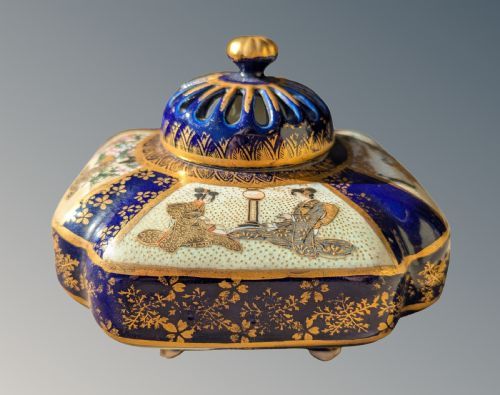
A gilded ceramic censer serves as a decorative vessel for burning fragrant incense across various historical periods. You are most likely to encounter nineteenth century Japanese examples, particularly Satsuma and Imari wares featuring intricate gold highlights.
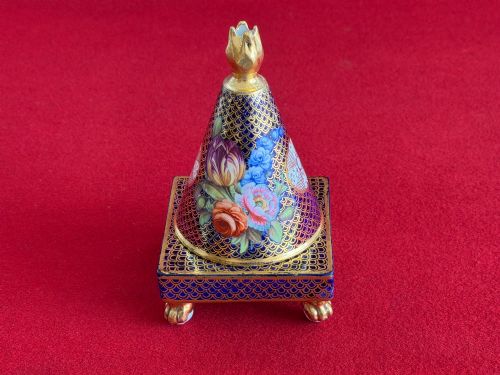
The selection ranges from lidded koro vessels and tripod bowls to pastille burners originating from English manufactories such as Chamberlain Worcester. These pieces combine sculptural ceramic forms with delicate metallic leaf applications.
Originating from both the Edo and Meiji periods in Japan alongside the English Regency era, these vessels reflect diverse cultural approaches to domestic incense burning. Each piece balances functional design with ornate decorative schemes suited to nineteenth century display cabinets.
Materials and construction methods
Potters shaped these vessels using earthenware and porcelain before applying detailed enamel pigments and gold leaf or gilt finishes. Kiln firing fixed the base glazes and underglaze colours prior to the secondary application of metallic leaf details.
Many Japanese items incorporate precise hand-painted motifs alongside raised enamel work and the family crests of prominent houses. English equivalents utilise fine porcelain bodies finished with gilded decorative accents typical of the early nineteenth century.
One extraordinary censer takes the shape of a legendary Japanese treasure ship, ready to sail fragrance across your drawing room.
Assessing craftsmanship and execution
Quality rests upon the precision of the hand-painted enamel work and the integrity of the applied gold leaf. Finer pieces demonstrate superior control over the ceramic form and a balanced composition of gilded details.
Signatures by recognised workshops or individual artists elevate a piece above standard decorative items, reflecting greater skill in the moulding and firing processes.
Kinkozan·Kizan·Shizan·Chamberlain Worcester
The Gilded Ceramic Censer Glossary
- Koro
- A traditional Japanese incense burner typically featuring a pierced cover to allow fragrance to escape. These vessels often stand on three small feet and display elaborate painted scenes.
- Imari
- A style of Japanese porcelain decorated in underglaze blue, iron red, and rich gilt. The aesthetic originated in Arita and became widely exported to European markets.
- Satsuma
- A type of earthenware from Satsuma province characterised by a crackle glaze and ornate polychrome enamel paintings enhanced with gold. It gained massive popularity during the Meiji period.
- Pastille burner
- A small ceramic vessel used in Regency homes to burn scented pastilles rather than loose incense. They frequently take architectural or urn-like shapes with fitted pierced lids.
- Bakumatsu
- The final days of the Edo period in Japan spanning the transition into the Meiji restoration. Wares from this era often show distinct artistic shifts.
Gilded Ceramic Censer: Frequently Asked Questions
How do I date a Japanese censer?
Dating relies on identifying stylistic markers from the Edo and Meiji periods, alongside specific regional characteristics and kiln marks. Meiji pieces frequently display dense, gilded enamel decoration.
Examining the base for artist signatures or factory stamps also helps narrow down the production era to the nineteenth century.
Where were English pastille burners made?
English pastille burners were produced by prominent porcelain factories during the Regency era, with Chamberlain Worcester being a notable maker. These pieces served domestic scenting purposes.
They often mimic miniature neoclassical urns or cottages, combining functional fragrance diffusion with mantelpiece display.
How do I care for gilded ceramics?
Gilded ceramic surfaces require gentle dusting with a soft, dry cloth to protect the delicate gold leaf and enamel details. Avoid using liquid cleaners or abrasive materials.
Keep these vessels out of direct sunlight to prevent the fading of hand-painted pigments over time.