


Inlaid Mahogany Cutlery Box
These inlaid mahogany cutlery box pieces are Georgian table storage solutions that bring refined timber craft and historic dining order to modern interiors.
Inlaid Mahogany Cutlery Box
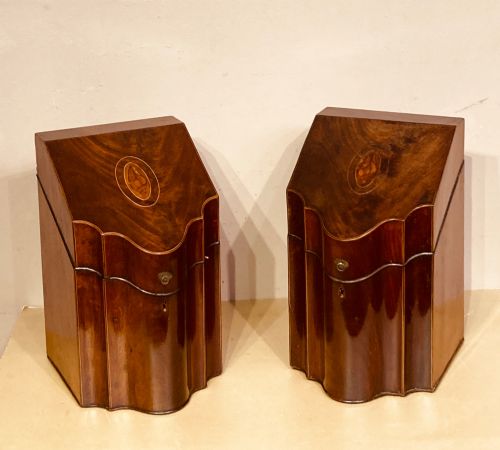
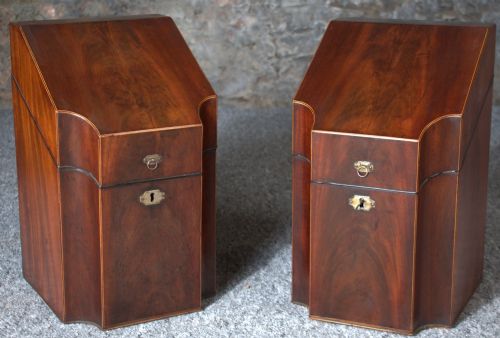
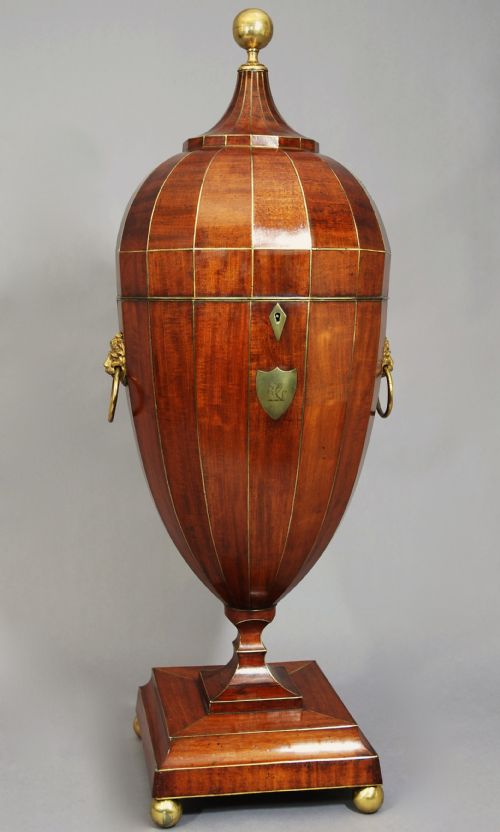
An inlaid mahogany cutlery box is primarily represented here by Georgian knife boxes, cutlery urns, and fitted storage chests dating from the eighteenth and nineteenth centuries. Buyers encounter upright sloping-lid containers alongside taller urn forms and occasional stationery conversions designed to hold domestic flatware securely.
Materials and construction
Makers utilised dense mahogany as the primary structural timber, often selected for rich grain patterns and deep warm tones. This was combined with contrasting light woods such as satinwood and boxwood to create delicate stringing and geometric inlays.
Metal fittings played a crucial functional role, incorporating brass handles, escutcheons, and hinges that contrasted sharply with the dark polished wood. Wood inlay techniques were applied with precision to borders, central medallions, and serpentine façades.
The listings span the eighteenth and nineteenth centuries, featuring mahogany, satinwood, boxwood inlay, and brass hardware across multiple Georgian and Victorian periods.
Distinctions in quality
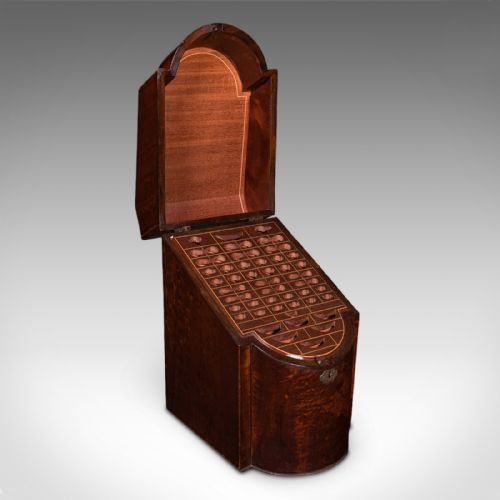
Quality rests upon the crispness of the exterior inlay work and the harmonious grain matching across the visible mahogany surfaces. Superior examples demonstrate meticulous hand-cut dovetailing and well-preserved interior fittings designed specifically for flatware organisation.
The architectural proportion of the slope or the graceful turn of an urn shape dictates the visual success of the piece. Lesser items display simpler timber selections and less refined brass hardware without the delicate contrasting stringing found on finer Georgian examples.
The Inlaid Mahogany Cutlery Box Glossary
- Serpentine front
- A gently undulating curved shape featuring a convex centre flanked by concave wings. This design requires advanced woodworking skill to execute cleanly on box lids and fronts.
- Stringing
- Thin inlaid lines of contrasting light wood set flush into the mahogany surface. It defines borders and panel edges on Georgian case furniture.
- Cutlery urn
- A tall, vase-shaped wooden vessel designed to hold table knives and forks during the eighteenth century. These pieces stood on sideboards alongside matching knife boxes.
- Dovetail
- An interlocking corner joint formed by triangular pins and tails. It provides exceptional structural strength for hardwood boxes without relying on metal fasteners.
Inlaid Mahogany Cutlery Box: Frequently Asked Questions
How were these boxes used?
These boxes sat upon sideboards or serving tables in grand dining rooms to store steel knives, forks, and spoons between meals. Servants would unlock them to set the table before guests arrived.
Over time, some of these containers were adapted to hold stationery, letters, or household collections as dining fashions shifted during the Victorian era.
How do I spot a Georgian period piece?
Examine the construction methods visible inside and underneath the box, looking for hand-cut dovetails and older secondary woods like oak or pine. The timber should exhibit a deep, natural patina developed through centuries of polishing.
Check for characteristic design traits such as brass bracket feet, escutcheons, and subtle boxwood or satinwood stringing typical of the late eighteenth century.
Why do they appear in pairs?
Dining room interiors of the eighteenth century placed a strong emphasis on strict symmetry and balanced decoration. A pair of matching knife boxes or urns anchored the ends of a sideboard with visual equilibrium.
Survival rates for matched pairs are lower than for single boxes, making matched sets particularly sought after by collectors furnishing period spaces.
Can I use them for modern storage?
Many of these containers retain their original fitted wooden partitions or velvet-lined interiors, making them suitable for storing modern table linen or desk accessories. Their robust mahogany construction handles everyday use well.
Care should be taken to keep them away from direct heat sources and strong sunlight to protect the fragile antique inlays and polished finishes.