


Mahogany Cutlery Urns
Mahogany cutlery urns are formal dining table containers for flatware, offering refined storage from the Georgian and Victorian eras.
Mahogany Cutlery Urns
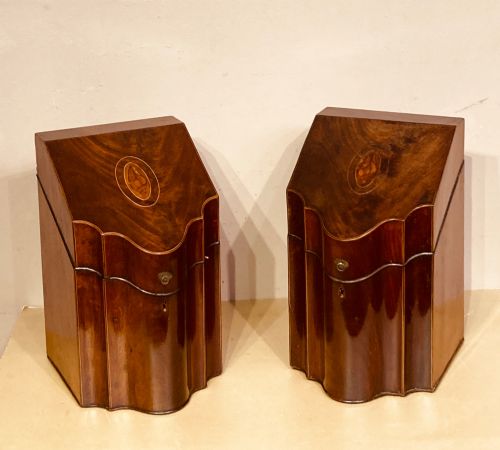
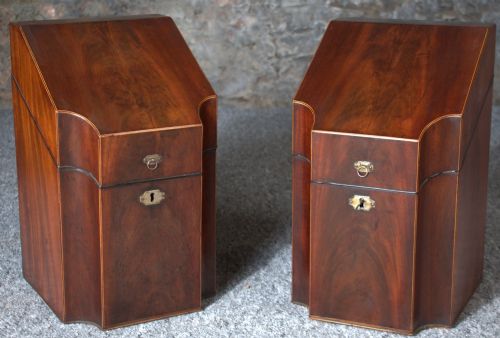
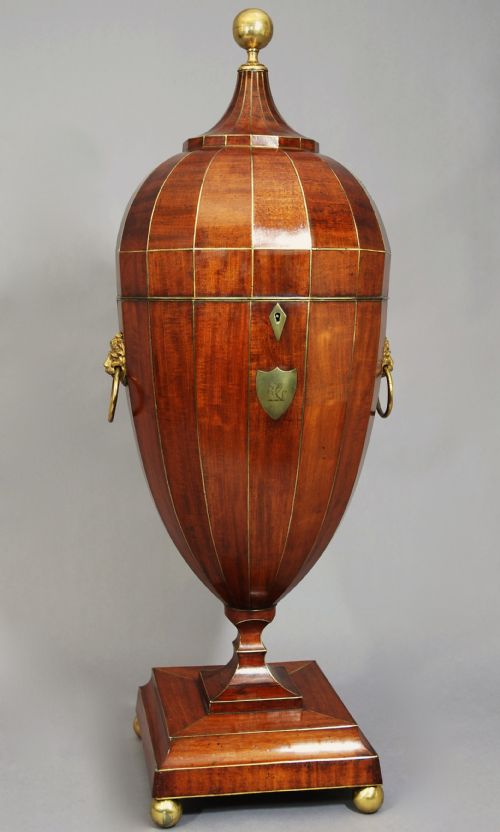
Mahogany cutlery urns are formal dining accessories designed to hold knives and flatware on sideboards or serving tables. When you search for mahogany cutlery urns, you encounter tall, neoclassical vessel forms alongside traditional sloped knife boxes from the eighteenth and nineteenth centuries.
The pieces appearing on this page span the Georgian period, the late eighteenth century, and the Victorian era, encompassing forms such as serpentine knife boxes, bow front storage boxes, and lidded urns. These objects served elite dining rooms by keeping silver and steel implements neatly housed between meals.
Most examples found here date from the George III era through to late nineteenth-century interpretations, showing variations in contour from straight geometric profiles to sinuous serpentine and bow fronts.
How they were made
Cabinetmakers constructed these pieces primarily from solid and figured mahogany, often enhancing the timber with delicate stringing and contrasting inlay work using satinwood and boxwood.
Metal components played a structural and decorative role, featuring brass fittings, locks, and handles, alongside occasional solid silver mounts on select late eighteenth-century specimens.
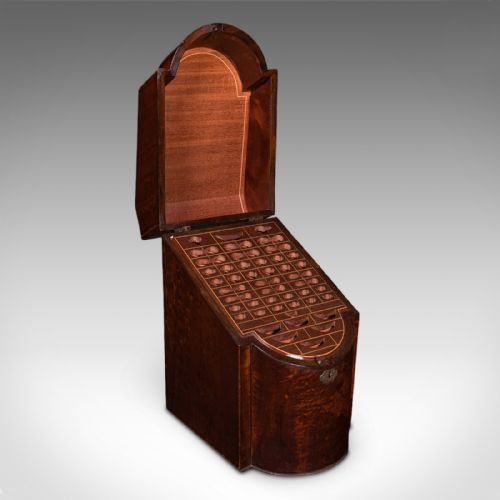
Some knife boxes contain fitted interior slots for precisely forty-six items of cutlery.
What varies in quality
Quality rests principally on the choice of timber figure, the crispness of the serpentine or bow front contours, and the precision of the boxwood and satinwood inlay.
Interior completeness and the original patination of the polished wood surfaces distinguish high-status examples from simpler domestic storage boxes.
The Mahogany Cutlery Urns Glossary
- Serpentine
- A curved shape featuring a convex centre flanked by concave wings. This contour appears on finer Georgian knife boxes to create visual movement.
- Bow front
- A convexly curved exterior surface that projects forward. This profile is seen on late eighteenth-century cutlery boxes.
- Inlay
- A decorative technique where contrasting woods like satinwood or boxwood are inserted into recesses in the mahogany base. It defines panel borders and geometric motifs.
- Patina
- The deep surface sheen and mellow colour developed by aged mahogany through handling and wax polishing over centuries. It indicates genuine age.
Mahogany Cutlery Urns: Frequently Asked Questions
What were mahogany cutlery urns used for?
These vessels stood on dining room sideboards to store silver-handled knives, forks, and spoons when tables were cleared between courses.
Servants retrieved the cutlery from inside the lidded containers as each new course required fresh implements.
How do I date a knife box?
Dating relies on observing the cabinet timber, hardware, and structural outline against known stylistic periods.
Georgian and George III examples display characteristic serpentine curves and fine string inlay, whereas Victorian pieces often show heavier proportions and distinct internal fittings.
Where should I place an urn in my home?
These tall vessel forms suit placement on sideboards, side tables, or serving consoles where their vertical silhouette can be appreciated.
They function well as standalone decorative objects or as containers for modern items in a traditional interior.
What is the difference between an urn and a box?
An urn is a freestanding, lidded vase-shaped vessel on a pedestal base designed specifically for high-status dining rooms.
A knife box is typically a sloped or serpentine lidded wooden desk-like container intended to sit flat on a sideboard.