



Georgian Mahogany Knife Box
A georgian mahogany knife box brings architectural slope and figured grain to a side table, built originally to hold dining silver out of the damp.
Georgian Mahogany Knife Box
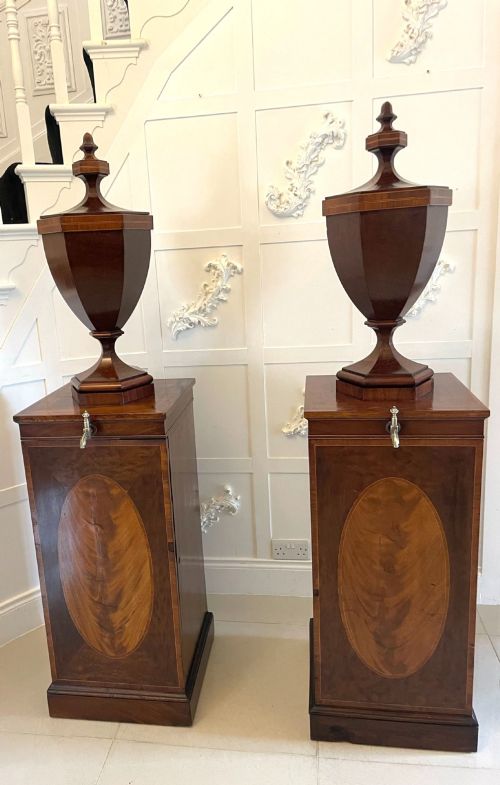
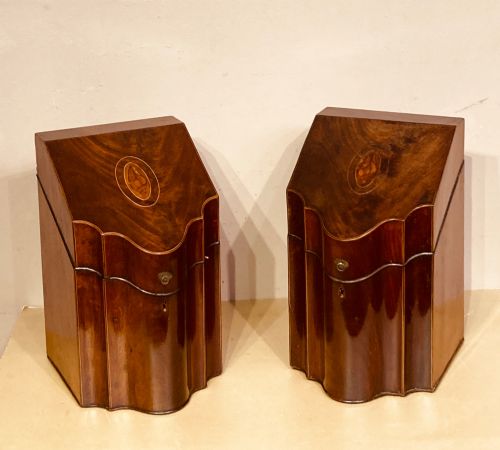
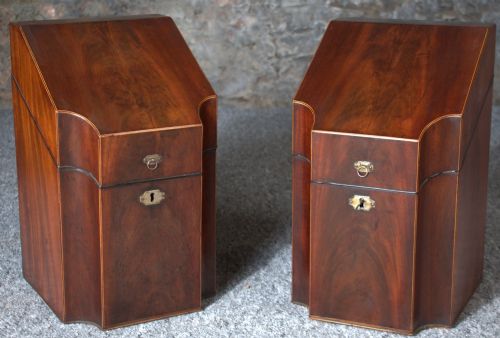
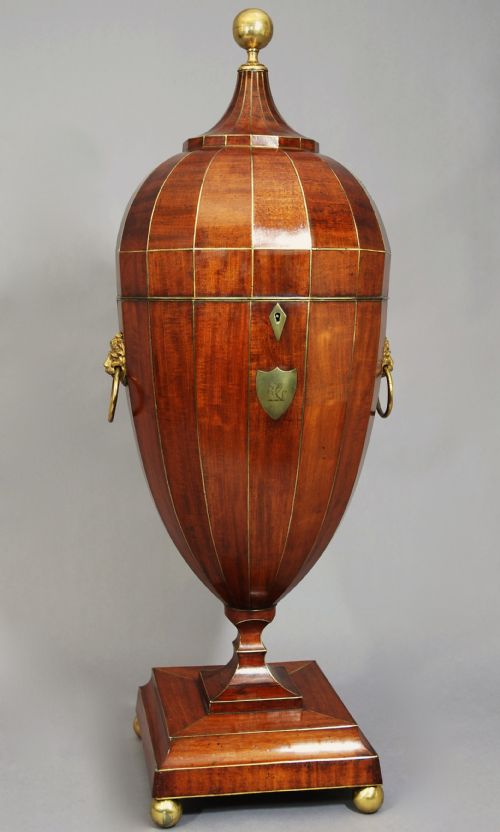
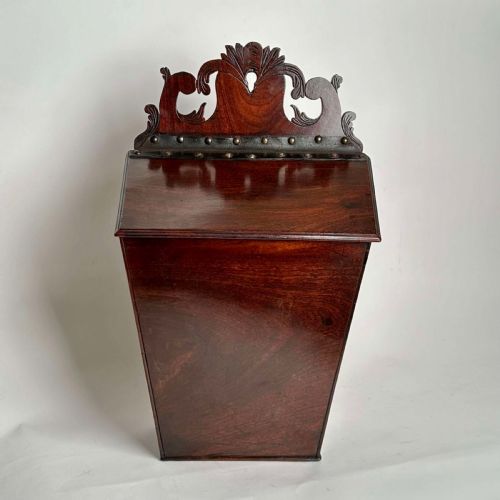
A georgian mahogany knife box typically appears as a sloped lidded container or an upright urn, designed for tabletop service in dining rooms of the eighteenth and nineteenth centuries. The pieces on this page span the 18th century, the Georgian period, and into the Victorian era, reflecting forms from simple sloping lids to serpentine fronts and tall cutlery urns on pedestals.
Buyers most frequently encounter slope-front boxes alongside curved serpentine variations and occasional stationery adaptations. These utilitarian items have transitioned from dining room storage to decorative objects that highlight period cabinet-making.
Origins cluster around the Georgian and George III eras, occasionally reaching into Victorian revivals, constructed in mahogany with decorative wood inlays.
Materials and construction
Makers built these pieces primarily from solid and veneered mahogany, often selecting timber with pronounced grain figures to create visual depth on the sloping lids and curved fronts. Crafting a serpentine or bow-front shape required precise cutting and bending of the wood.
Brass fittings such as escutcheons, side carrying handles, and internal hinges provided structural reinforcement and functional operation. Details like boxwood inlay and boxwood stringing added linear contrast to the dark mahogany surfaces.
Listings feature mahogany, brass, boxwood inlay, and silver across George III and Victorian periods.
Measures of quality
The standard of a piece rests heavily on the crispness of its serpentine contours and the choice of mahogany timber, where richly figured grain elevates the visual impact. Superior examples maintain balanced proportions and sharp joinery along complex curved fronts.
The integrity of original brass mounts and internal fittings distinguishes better survivals from heavily restored pieces. Patina developed through age adds depth to the wood, provided the surface retains its original character.
The Georgian Mahogany Knife Box Glossary
- Serpentine front
- A cabinet front featuring a convex centre flanked by concave curves, creating a fluid wave shape. This contour requires advanced woodworking skill to execute properly.
- Boxwood inlay
- Narrow strips or geometric shapes of pale boxwood set flush into the darker mahogany surface. It provides crisp linear contrast.
- Cutlery urn
- A tall, vase-shaped wooden vessel used on sideboards or pedestals for storing table silver during the Georgian era. These often matched the surrounding dining furniture.
- Escutcheon
- A protective metal plate surrounding a keyhole, usually fashioned from brass on these pieces. It prevents the wood from splitting around the lock.
- Patina
- The deep surface sheen and mellow colour acquired by mahogany through decades of handling, polishing, and exposure to light. It serves as an indicator of genuine age.
Georgian Mahogany Knife Box: Frequently Asked Questions
What were these boxes used for?
These containers were made to store dining cutlery and knives upright on sideboards or serving tables when not in use.
Servants brought them out during grand meals to keep silver organised and protected from tarnishing in damp dining rooms.
How do I tell a slope front from a serpentine front?
A slope front angles straight down from the back to the front, presenting a flat slanted lid for the eye to follow.
A serpentine front curves outward in the middle and inward at the sides, forming an undulating shape that demands far more intricate carpentry.
Can I use them to hold letters?
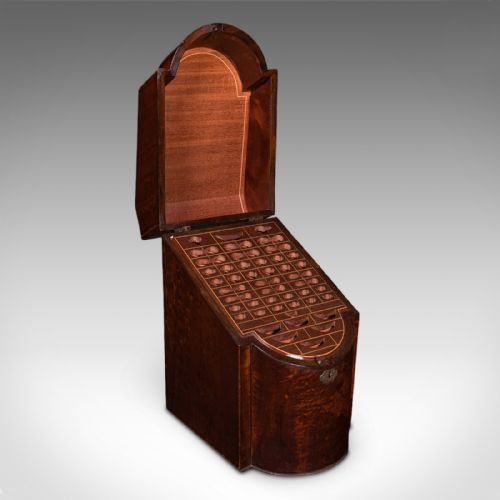
Many surviving examples function quite well as desktop stationery holders or letter boxes due to their internal dividers and proportions.
Their compartmented interiors adapt easily to modern paper storage without altering the historical structure.
Are pairs common for these boxes?
Matched pairs appear frequently because Georgian dining rooms balanced sideboards with symmetrical arrangements of cutlery storage on either end.
Finding two matching urns or slope-front boxes together remains a desirable configuration for collectors.