


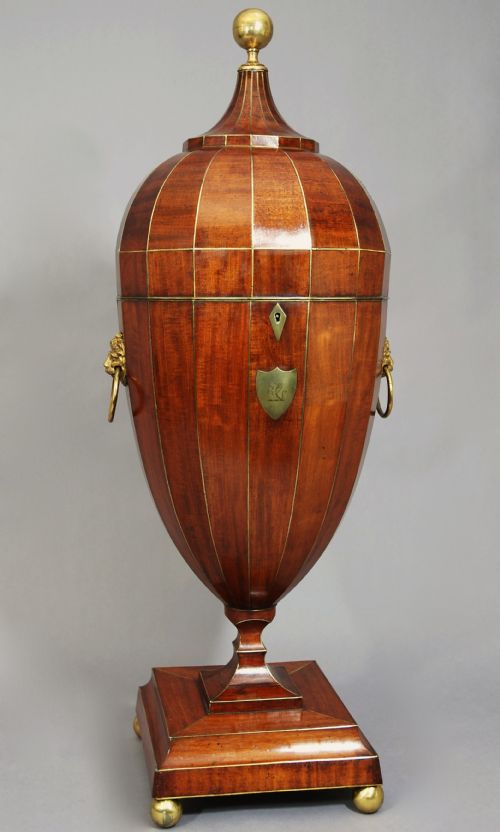


Sheraton Knife Box
Sheraton knife boxes are elegant dining room accessories designed to hold cutlery securely, offering refined Neoclassical lines that elevate any sideboard.
Sheraton Knife Box
When you search for a sheraton knife box, you are looking at sophisticated dining accessories from the Georgian and 18th Century periods. These pieces include upright knife boxes, pairs of cutlery boxes, and soaring cutlery urns designed to stand upon a sideboard. Many examples from this era feature sloping lids and serpentine fronts.
How they were made
Maker workshops constructed these boxes primarily using solid mahogany and satinwood, often enhanced with delicate boxwood and satinwood inlay. Cabinetmakers employed precise woodworking techniques to achieve the distinctive sloping contours and serpentine facades characteristic of the Sheraton style.
Metal components such as brass hinges, escutcheons, and occasional silver mounts provide functional structure and decorative contrast to the timber. Selected pieces also incorporate painted decoration upon the wooden surfaces to accentuate the Neoclassical motifs.
Sheraton Knife Box Retail Price Guide 2026
Typical asking prices for sheraton knife box among the pieces listed under this phrase on Sellingantiques today, from the lower quarter to the upper quarter. They describe what is for sale here now, not the wider market.
Several dining room knife boxes quietly changed jobs over the centuries to spend their retirement holding stationery.
What varies in quality
The standard of a sheraton knife box depends heavily on the crispness of the inlay work and the richness of the timber grain. Finer examples display intricate satinwood and boxwood banding that follows the exact curves of the mahogany carcase.
Proportion and scale dictate the visual success of the piece, particularly in taller cutlery urns and larger stationery conversions. Original brass and silver hardware further separates standard production from superior workshop output.
The Sheraton Knife Box Glossary
- Cutlery urn
- A tall, vase-shaped wooden vessel designed in the Georgian period to store table knives on a sideboard. These urns typically feature a removable top section and a tiered pedestal base.
- Satinwood inlay
- A decorative technique utilising contrasting light-toned satinwood veneers inlaid into a darker wood background, creating geometric or pictorial borders.
- Serpentine front
- A furniture contour that curves outward in the centre and inward at the sides, demanding high skill from the cabinetmaker.
- Stationery box
- A functional adaptation where the interior dividers of a former knife box are modified to hold paper and letters rather than handled cutlery.
- George III period
- The era spanning the reign of King George III from 1760 to 1820, encompassing the height of Sheraton neoclassical design.
Sheraton Knife Box: Frequently Asked Questions
What were sheraton knife boxes used for?
These boxes sat upon dining room sideboards to store steel-bladed table knives and forks when not in use.
Keeping cutlery enclosed protected the polished steel blades from the damp air of the dining room.
How do I tell an 18th century box from a later one?
Eighteenth-century examples display hand-cut dovetails, older secondary woods, and genuine period brass hardware.
Later Victorian pieces often exhibit mechanical consistency in construction and different interior configurations.
Can I use a knife box for letters?
Many surviving boxes were converted in period or later to hold stationery and letters.
The sloping interior dimensions suit envelopes and writing paper rather than modern handled cutlery.
Are these boxes sold as pairs?
Some listings offer matched pairs of cutlery boxes or urns intended to flank a sideboard mirror.
Single boxes also appear frequently for collectors seeking a standalone decorative accent.