

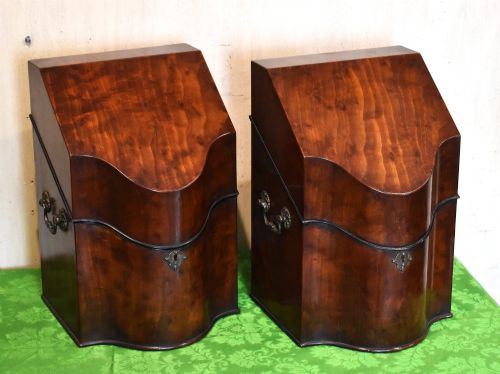
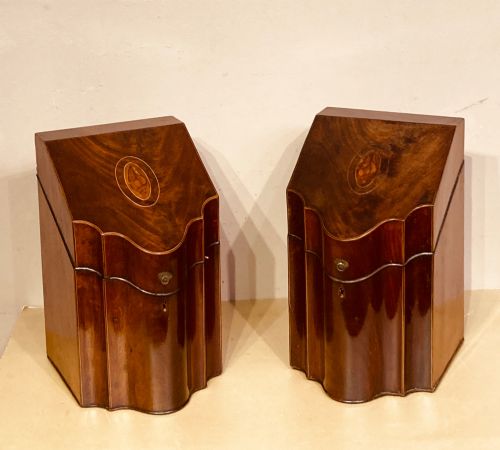


Serpentine Knife Box
These serpentine knife boxes are eighteenth-century Georgian dining room pieces in mahogany, often inlaid with boxwood and satinwood, prized for their sinuous fronts and fitted interiors.
Serpentine Knife Box
A serpentine knife box is a dining room chest designed to hold cutlery during the Georgian period, characterised by a distinctive undulating front. The pieces seen here span the eighteenth century and the George III era, taking the form of specialised knife boxes and boxes and chests.
While primarily built for cutlery, some examples serve broader desk or storage functions as stationery boxes. The form combines practical table service with sophisticated cabinetwork from the eighteen-hundreds and earlier.
How they were made
Cabinetmakers constructed these boxes primarily using solid mahogany, shaping the distinctive curved profile of the serpentine front by hand. Delicate boxwood inlay and satinwood banding were frequently incorporated into the exterior surfaces to create visual contrast.
Metal and brass hardware, including hinges, escutcheons, and carrying handles, were fitted to secure the lid and facilitate movement. Internal compartments were lined and fitted specifically to organise upright cutlery safely.
Serpentine Knife Box Retail Price Guide 2026
Typical asking prices for serpentine knife box among the pieces listed under this phrase on Sellingantiques today, from the lower quarter to the upper quarter. They describe what is for sale here now, not the wider market.
Listings feature eighteenth-century and Georgian periods exclusively, constructed from mahogany, boxwood, metal, brass, silver, and satinwood.
What varies in quality
The sophistication of the timber figure and the precision of the wood inlay distinguish finer examples from standard production. Sharply defined serpentine curves in the mahogany demonstrate superior cabinetmaking skill.
The integrity of original brass hardware and the completeness of internal fittings elevate a piece's standing. Surviving pairs command greater interest than isolated single boxes.
The Serpentine Knife Box Glossary
- Serpentine
- A shaped furniture front featuring a central convex curve flanked by two concave curves, creating a subtle wave effect. This contour demands advanced woodworking skill to execute properly.
- George III
- The period of British history spanning from seventeen-sixty to eighteen-twenty, noted for refined cabinetmaking styles. Furniture from this era often utilises dense mahogany and delicate inlay.
- Satinwood
- A durable, yellowish timber native to Ceylon and the West Indies, used extensively for contrasting inlay work. Its lustrous grain catches the light effectively.
- Boxwood inlay
- Light-coloured wood sections inserted into contrasting darker timber to form geometric or linear borders. This technique highlights the structural edges of the box.
Serpentine Knife Box: Frequently Asked Questions
What did they store inside?
These boxes held sets of dining cutlery, specifically knives and forks, during formal meals. The internal wooden dividers kept individual handles and blades separated and secure.
Over time, owners also utilised them for storing stationery and letters once dining fashions shifted.
Are they found in pairs?
Yes, many eighteenth-century examples survive as matching pairs. Dining rooms of the period often featured two boxes placed at opposite ends of a sideboard or serving table.
Single boxes also appear frequently in collections, reflecting original dispersion over the centuries.
What wood was used?
Mahogany serves as the primary structural material across nearly all examples. Cabinetmakers enhanced the exterior appearance using lighter woods such as boxwood and satinwood for decorative inlay.
Brass hardware provides the functional metal accents on lids and escutcheons.
How do I date a box?
Dating relies on stylistic markers associated with the Georgian era and the reign of George III. The presence of specific inlay patterns and serpentine proportions helps assign pieces to the eighteenth century.
Construction methods visible inside the box further confirm the manufacturing period.