
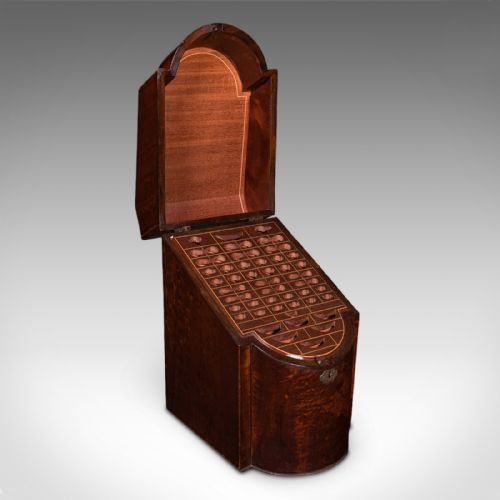


18th Century Stationery Box
An 18th century stationery box brings the refined desk organisation of the Georgian era directly into a modern room.
18th Century Stationery Box
When you search for an 18th century stationery box, you encounter pieces designed during the Georgian period and around eighteen hundred to house correspondence and writing equipment. The selection frequently includes converted knife boxes, slope-front chests, and specialised writing boxes adapted for paper storage over the centuries.
Makers of the period applied their craft to forms such as serpentine storage boxes, oak letter chests, and satinwood cheverets. Mahogany and oak dominate the construction, often enhanced by elaborate wood inlay and brass fittings.
Buyers are most likely to meet Georgian mahogany knife boxes or writing slopes that serve well as stationery cabinets today. These versatile containers reflect the domestic requirements of elite households during the reign of George III and the Sheraton period.
Materials and construction
Cabinetmakers utilised dense timbers like mahogany, oak, and satinwood to build these rigid storage containers. Wood inlay added decorative patterns to the exterior surfaces of finer examples.
Metal components such as brass fittings and silver mounts secured the lids, corners, and drop-fronts. Bone details occasionally appeared on interior compartments and escutcheons.
A few knife boxes made sharp shifts in career paths, trading dinner knives for love letters.
Distinguishing quality in period boxes
The sophistication of the timber figure and the precision of the wood inlay separate standard utility pieces from exceptional examples. Figured mahogany with strong grain patterns indicates a more deliberate selection of materials by the cabinetmaker.
The integration of brass fittings, silver mounts, and bone details dictates the overall refinement of the piece. Superior items display harmonious proportions across serpentine shapes and well-executed interior conversions.
The 18th Century Stationery Box Glossary
- Cheveret
- A small portable writing cabinet or table fitted with drawers and a carrying handle. This form typically dates to the Sheraton period around seventeen ninety.
- Serpentine
- A curved line of furniture shaping that undulates outward then inward. This contour appears on the fronts of finer Georgian storage boxes.
- Writing Slope
- A desk accessory featuring an angled hinged lid designed for handwriting. Many examples were subsequently converted to hold stationery.
- Inlay
- A decorative technique where pieces of contrasting wood are inserted into recesses within a solid surface. This method creates geometric patterns on mahogany boxes.
18th Century Stationery Box: Frequently Asked Questions
What is an 18th century stationery box?
These pieces are historical containers originally built to hold writing paper, letters, or cutlery during the Georgian era. Many surviving examples were adapted from knife boxes or writing slopes to serve as desktop organisers.
Cabinetmakers constructed them from dense woods like mahogany and oak, often incorporating brass fittings and wood inlay. They reflect the paperwork storage needs of wealthy households around seventeen ninety and eighteen hundred.
How were knife boxes used for stationery?
Georgian knife boxes featured sloping lids and vertical internal dividers originally intended to organise flatware upright. As dining fashions changed, owners repurposed these lidded containers to store letters and writing paper.
This historical conversion is why many stationery boxes retain the steep profile and brass carrying handles of traditional cutlery storage. The interior dividers conveniently kept different sizes of correspondence separated.
How do I identify a George III box?
George III pieces typically display characteristic Georgian proportions, use figured mahogany or satinwood, and incorporate brass hardware. Stylistic markers from the Sheraton period often include delicate wood inlay and serpentine curves.
Examining the construction methods and the natural ageing of the wood helps confirm the eighteenth-century origin. Metal fittings and hinges should align with the manufacturing techniques of the era around eighteen hundred.
Where should I place a stationery box?
These compact wooden containers sit comfortably on a modern desk, side table, or bookcase top to store contemporary correspondence. Their historical character adds warmth and texture to a study or living space.
Placing them away from direct heat sources and strong sunlight protects the antique wood and delicate inlay. Regular dusting keeps the mahogany and brass hardware in stable condition.