
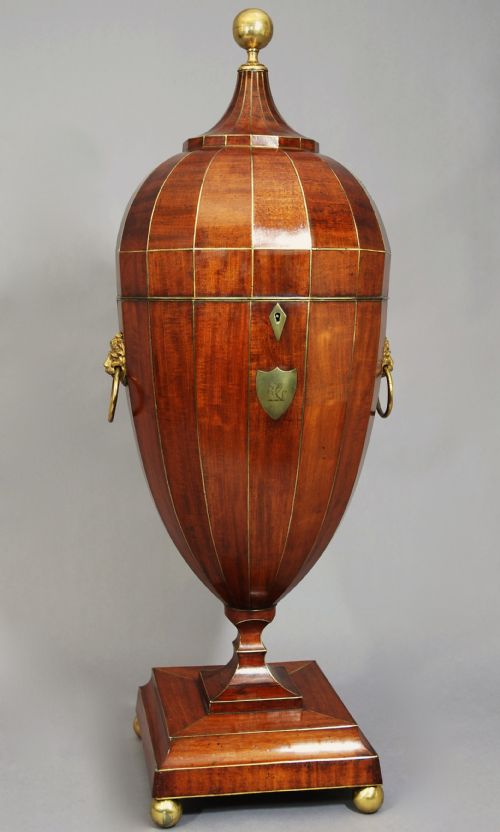


Georgian Knife Urns
Georgian knife urns are commanding mahogany vessels designed for formal dining rooms, offering a disciplined way to store table cutlery.
Georgian Knife Urns
When buyers search for georgian knife urns, they encounter towering neoclassical forms alongside traditional knife boxes and serpentine storage pieces. These items originate predominantly from the eighteenth century, with George III and Sheraton periods dominating the available selection.
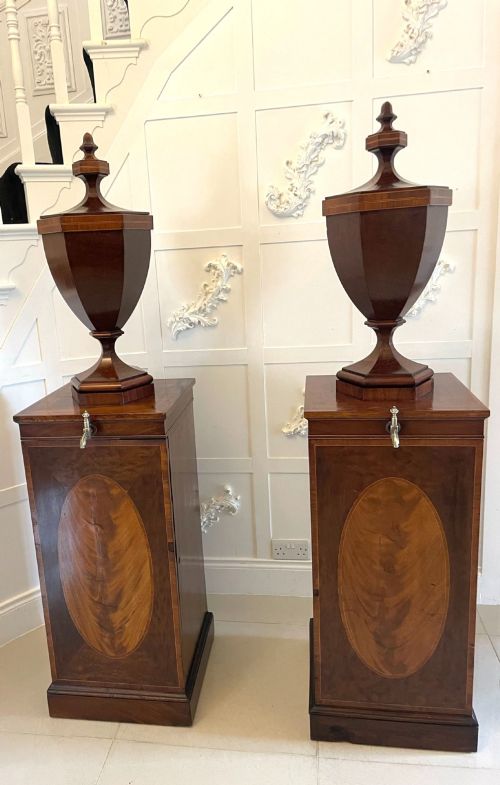
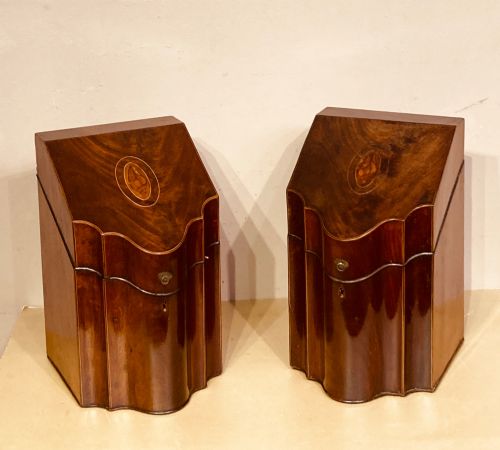
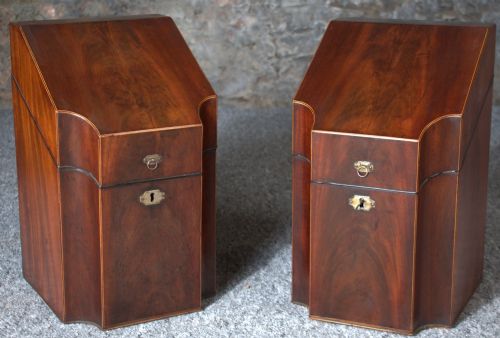
The objects take the form of urns placed upon pedestal cupboards or distinct sloping-front boxes designed to house cutlery on the sideboard. Mahogany is the primary medium, frequently ornamented with satinwood and boxwood inlay to create contrasting geometric patterns.
While many survive as pairs, single items and later Victorian interpretations also appear within the inventory. The forms reflect the rising sophistication of dining rituals during the late georgian era.
How they were made
Cabinetmakers utilised dense solid mahogany and figured veneers, shaping the timber over curved frames to achieve serpentine and bow fronts. Wood inlay techniques, incorporating boxwood and satinwood, created delicate banding and decorative motifs across the surfaces.
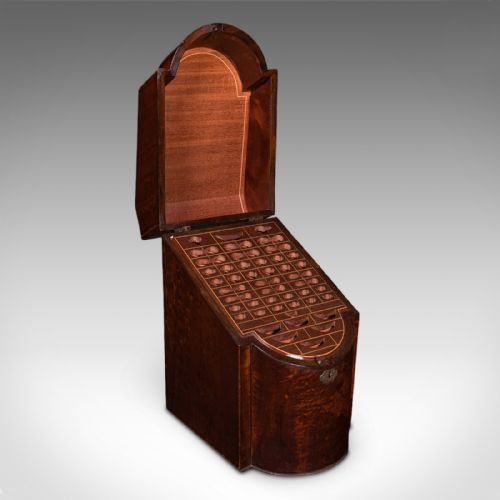
Metal mounts in brass and solid silver provided functional hinges, escutcheons and carrying handles. Interiors were fitted with compartmentalised block inserts to hold individual knife blades securely.
Some dining urns were later converted to hold stationery when formal knife storage went out of fashion.
What varies in quality
The distinction between average and exceptional pieces lies in the choice of timber and the precision of the inlay. Figured mahogany with deep natural grain and crisp boxwood stringing commands greater attention than plain stock.
Proportion and architectural balance dictate the visual success of an urn or box, particularly in the curve of the lid and the execution of the brass mounts.
The Georgian Knife Urns Glossary
- Serpentine front
- A furniture front characterised by a concave central section flanked by two convex curves, or the reverse. This undulating profile requires skilled carpentry and appears on finer eighteenth-century boxes.
- Inlay
- A decorative technique where pieces of contrasting wood, such as boxwood and satinwood, are inserted into recessed cavities in the primary mahogany surface. It defines the neoclassical aesthetic of the period.
- Pedestal
- A structural base or cupboard upon which an urn is mounted to elevate the cutlery storage. These matched sets formed grand architectural facades in formal dining rooms.
- Silver mount
- Cast or wrought silver hardware applied to wooden boxes as handles, escutcheons or feet. Such metalwork indicates high patronage and adds considerable weight to the piece.
- Boxwood
- A pale, hard timber utilised for contrasting stringing and geometric details in marquetry. Its fine grain permits sharp, precise lines.
Georgian Knife Urns: Frequently Asked Questions
What were georgian knife urns used for?
These vessels stood upon sideboards or pedestals in the dining room to hold silver cutlery before and after meals. Servants retrieved the knives as each course was served.
The interiors were fitted with tiered wooden blocks pierced with slots to keep steel blades separated and prevent tarnishing.
How do I identify a George III piece?
George III pieces date from the late eighteenth century and typically display neoclassical design motifs, balanced proportions and mahogany construction. Look for fine boxwood inlay and traditional brass hardware.
Construction methods inside the box, such as hand-cut dovetails and secondary softwoods, also point towards eighteenth-century workshop practices.
Can I store modern cutlery inside them?
Most original interiors were carved to fit slender eighteenth-century knife blades and three-pronged forks. Modern cutlery handles are frequently too bulky for the historic slots.
Buyers often repurpose converted boxes for stationery or keep the interior fittings intact for display purposes only.
What is the difference between an urn and a box?
Urns are neoclassical, vase-shaped vessels raised on a stem, often sold paired with matching pedestal cupboards. Knife boxes feature a sloping lid and a flat base designed to sit directly on a sideboard.
Both forms served the same functional purpose of containing dining cutlery within the formal entertaining spaces of the house.