
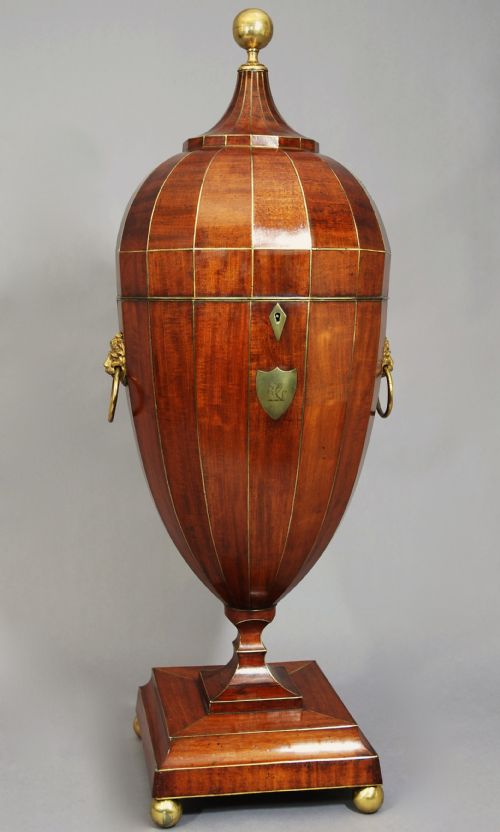


Inlaid Mahogany Knife Urns
Inlaid mahogany knife urns are formal dining accessories from the Georgian and Victorian eras, prized for their striking architectural silhouettes and delicate stringing.
Inlaid Mahogany Knife Urns
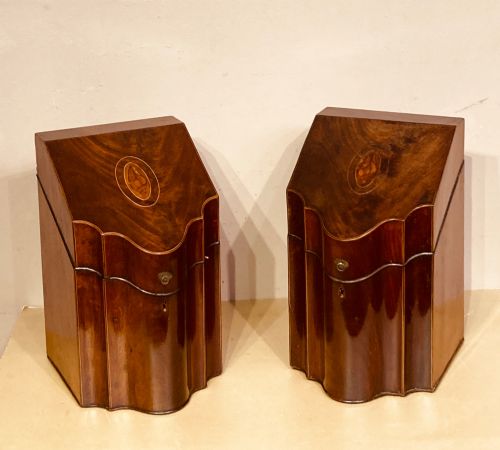
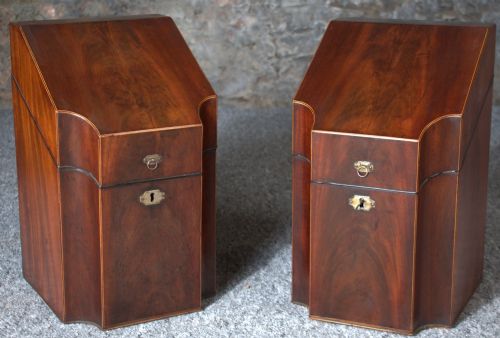
When you search for inlaid mahogany knife urns, you encounter tall, neoclassical vessels designed to house dining cutlery on sideboards during the eighteenth and nineteenth centuries. These pieces encompass both sculptural urn forms and sloping serpentine knife boxes originating from Georgian and Victorian workshops.
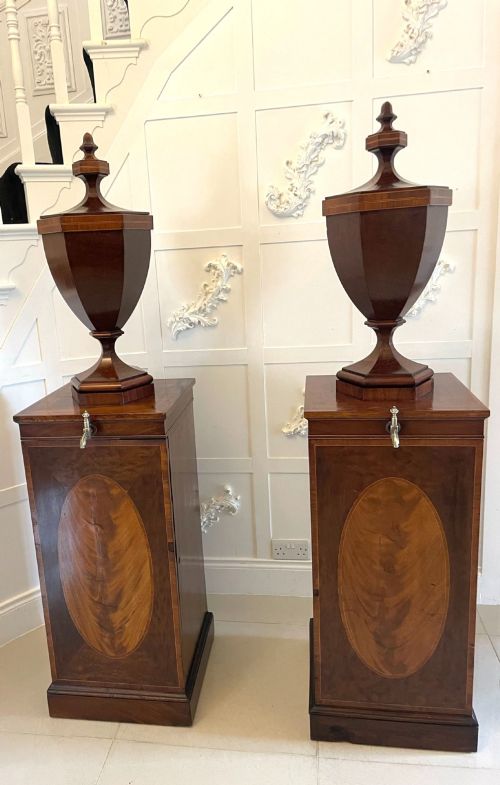
The versions most commonly met on this page include pairs of George III mahogany knife boxes alongside lidded cutlery urns from eighteen-ninety or earlier nineteenth century periods. These items range from standalone kitchen organisers and cutlery storage to matched pairs resting on original pedestal cupboards.
How they were made
Cabinet makers utilised dense, richly figured mahogany as the primary timber, shaping the curved bodies of the urns and the slanted lids of the boxes. They accentuated the deep brown grain with contrasting light stringing using boxwood and satinwood inlay.
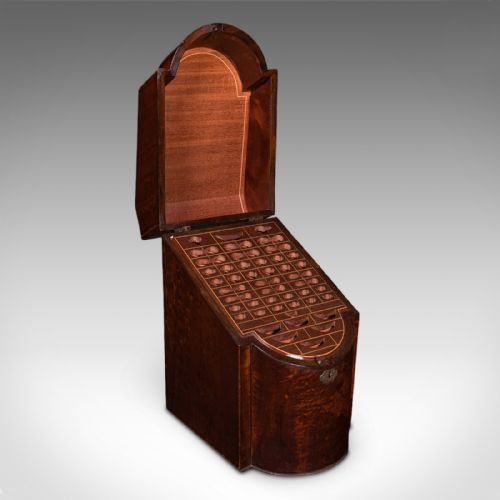
Artisans fitted the interiors with vertical slots to organise individual cutlery items, and mounted brass handles, escutcheons, or lock plates to the exterior. Some examples incorporate bone details to complete the functional fittings of the storage compartments.
Many a Victorian dinner guest unknowingly reached for dessert past forty concealed knives nestled inside a hollow mahogany vase.
What varies in quality
The distinction between standard examples and the finest pieces lies in the precision of the wood inlay and the symmetry of the turned urn body. Crisp geometric boxwood lines and balanced proportions indicate superior craftsmanship from the George III period.
Completeness also dictates the standing of a piece, with surviving internal fittings and matching pairs commanding greater attention than single modified boxes. Original brass hardware and intact pedestals elevate the historical integrity of the item.
The Inlaid Mahogany Knife Urns Glossary
- Mahogany
- A durable, deep reddish-brown tropical hardwood favoured by eighteenth century cabinet makers for its stability and rich grain. It takes a high polish and forms the primary structure of these dining accessories.
- Stringing
- Narrow lines of contrasting light wood, typically boxwood or satinwood, inlaid into shallow channels on the surface. This technique creates delicate geometric borders around panels and lids.
- Serpentine
- A gently undulating curved line featuring a convex centre flanked by concave wings. This contour appears frequently on the fronts of Georgian knife boxes.
- Escutcheon
- A protective metal plate surrounding a keyhole, usually fashioned from brass on these pieces. It prevents the wood from splintering around the lock.
- Neoclassical
- A decorative style inspired by classical antiquity prevalent during the reign of George III. It introduces strict symmetry, urn motifs, and restrained floral inlay to furniture design.
Inlaid Mahogany Knife Urns: Frequently Asked Questions
What were knife urns used for?
These vessels stood upon dining room sideboards to hold silver cutlery and knives when not in use for meals. Servants retrieved the pieces from the internal compartments as required during formal dining.
They served both a practical storage function and a decorative purpose, displaying the wealth and taste of the household through fine cabinet work.
How do I date an inlaid knife box?
Examine the timber, the style of the inlay, and the shape of the enclosure to determine the period. George III examples often feature neoclassical boxwood stringing and serpentine fronts dating from the eighteenth century.
Later Victorian pieces from eighteen-ninety adopt similar urn forms but often display different secondary timbers and heavier construction methods.
Are these pieces sold as pairs?
Many listings feature matched pairs of boxes or urns designed to sit symmetrically on either side of a dining room sideboard. Single items also appear frequently in the selection.
Pairs often command higher interest among collectors seeking balanced arrangements for period interiors.
How do I care for mahogany urns?
Keep the wood away from direct heat sources and strong sunlight to prevent the mahogany from drying out and the inlay from lifting. Dust gently with a dry, soft cloth.
Apply a microcrystalline wax sparingly if the surface requires nourishment, avoiding silicone-based polishes that damage antique finishes.