



Pair Mahogany Knife Boxes
These pair mahogany knife boxes are formal dining table containers from the Georgian and Victorian eras, designed to hold and display cutlery.
Pair Mahogany Knife Boxes
When you search for pair mahogany knife boxes, you encounter formal dining table containers that date mainly from the 18th century, the Georgian period, and the 19th century. These matching containers sat on sideboards or serving tables in grand dining rooms to hold cutlery before and after meals.
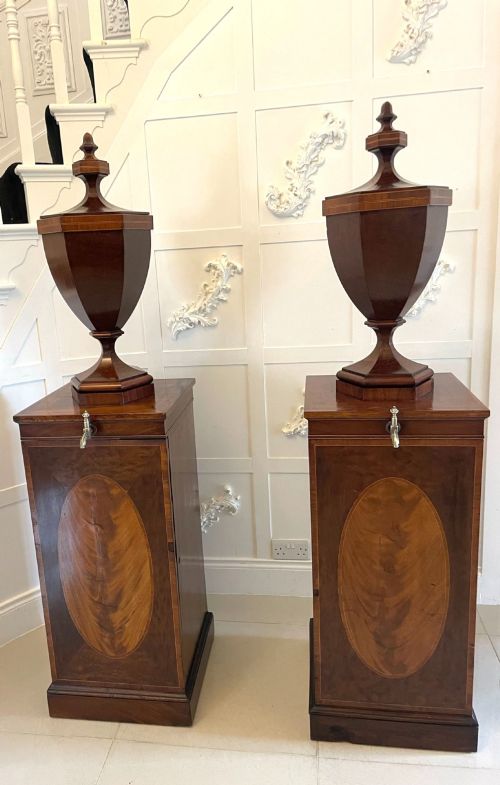
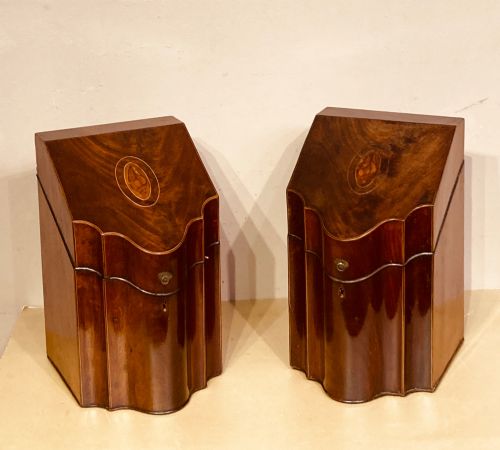
The most common forms on this page are slant-lidded boxes with serpentine or bow fronts, alongside taller lidded cutlery urns mounted on pedestals. Most examples originate from the Georgian and George III eras, constructed to house steel blades and bone or silver handles within fitted interiors.
How they were made
Cabinet makers built these pieces using solid mahogany and mahogany veneers, frequently incorporating boxwood and satinwood inlay to create contrasting borders and decorative fan motifs. Selected timbers were chosen for their deep grain and rich colour before being polished to a smooth finish.
Metalwork played a structural and decorative role, with brass handles, escutcheons, and hinges fitted to the wood. More elaborate examples incorporated solid silver mounts to enhance the formal appearance of the containers.
Pair Mahogany Knife Boxes Retail Price Guide 2026
Typical asking prices for pair mahogany knife boxes among the pieces listed under this phrase on Sellingantiques today, from the lower quarter to the upper quarter. They describe what is for sale here now, not the wider market.
Some knife boxes spent centuries holding cutlery before finding new retirement careers guarding TV remotes.
What varies in quality
Quality in these boxes rests upon the crispness of the cabinet work, the retention of original brass or silver hardware, and the depth of the mahogany patina. Pieces featuring finely executed boxwood stringing and well-preserved internal dividers represent the higher end of the range.
Proportion and form dictate desirability, with narrow bow fronts and matched grain patterns commanding attention. Simpler construction and replaced fittings mark out pieces of lesser distinction.
The Pair Mahogany Knife Boxes Glossary
- Mahogany
- A durable tropical hardwood known for its reddish-brown colour and stability, used extensively in fine cabinet making.
- Boxwood inlay
- Contrasting pale wood inserted into recesses in the mahogany surface to form geometric lines and decorative patterns.
- Cutlery urn
- A tall, vase-shaped wooden container designed to sit on a pedestal and store table knives.
- Bow front
- A convex, outwardly curved front profile popular in late 18th-century case furniture.
- Escutcheon
- A protective plate surrounding a keyhole, usually fashioned from brass.
Pair Mahogany Knife Boxes: Frequently Asked Questions
What were pair mahogany knife boxes used for?
These boxes sat on sideboards in grand dining rooms to hold silver-handled knives and forks until the meal began. Servants brought them out to keep cutlery organised and secure.
After dining, the blades were returned to the fitted interior slots for cleaning and storage.
How do I date a pair of knife boxes?
Dating relies on the overall shape, the style of the woodwork, and the decorative inlay techniques used by the cabinet maker. Slant-lidded varieties with serpentine outlines typically point to the 18th century and the George III period.
Later Victorian interpretations often take the form of classical urns rather than traditional sloped boxes.
Are the interiors usually original?
Many surviving examples retain their original shaped and pierced wooden divider blocks designed to hold individual knife blades upright. These internal fittings often show marks and wear from decades of historical cutlery use.
Replacements or alterations to the interior happen over time due to the practical demands placed on the wood.
How should I care for mahogany knife boxes?
Keep the wood away from direct sunlight and sudden temperature changes to prevent the mahogany and veneers from drying out or splitting. Gentle dusting with a dry cloth maintains the surface.
Occasional application of appropriate wax helps preserve the sheen of the timber without building up heavy residues.