



Brown Mahogany Knife Urns
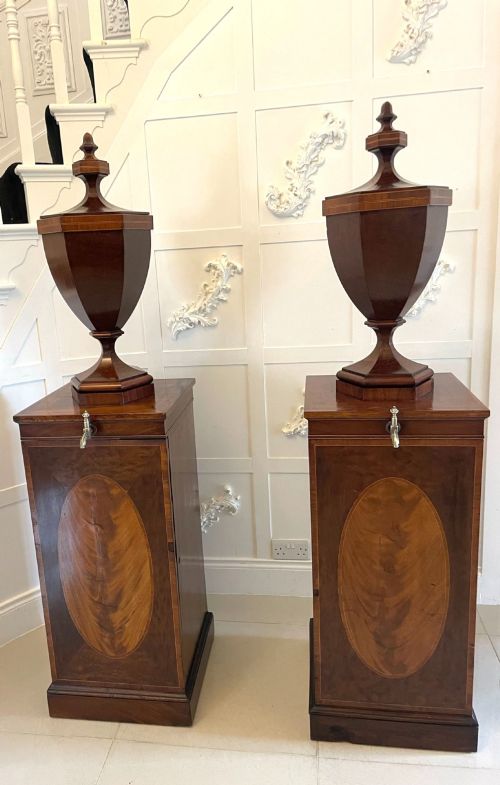
Brown mahogany knife urns are commanding dining room accessories designed to store cutlery with architectural symmetry, combining functional utility with striking timber grain.
Brown Mahogany Knife Urns
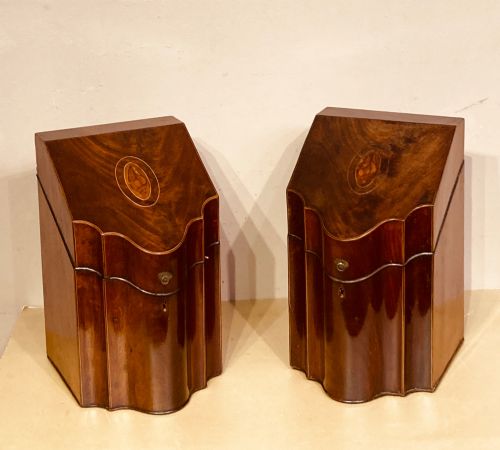
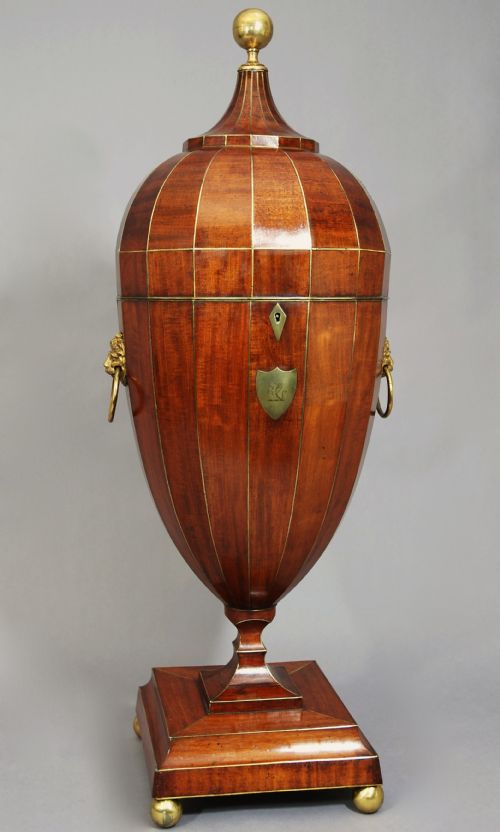
Brown mahogany knife urns represent a specialised form of dining room furniture designed for storing cutlery, appearing primarily as Georgian George III pieces or later Victorian interpretations. These items span periods from the eighteenth century through to eighteen ninety, often taking the form of classical urns on pedestals or serpentine fronted boxes.
Buyers examining this selection will encounter various configurations including lidded cutlery urns, storage boxes, and matched pairs outfitted with brass fittings. The forms range from classical George III neoclassical designs to later nineteenth century iterations in mahogany.
The objects serve as impressive focal points on sideboards, maintaining the symmetry favoured in formal dining spaces. Their construction reflects the rigorous storage requirements of period households.
How they were made
Cabinet makers utilised dense timber, constructing the main bodies from mahogany and enhancing surfaces with boxwood and satinwood inlay. These woods were chosen for their stability and ability to take a fine polish.
Metal components such as brass fittings provided functional utility for locks, handles, and hinges, while bone details occasionally appeared on interior elements. The combination of figured timber veneers and precise inlay work defined the method of construction.
Brown Mahogany Knife Urns Retail Price Guide 2026
Typical asking prices for brown mahogany knife urns among the pieces listed under this phrase on Sellingantiques today, from the lower quarter to the upper quarter. They describe what is for sale here now, not the wider market.
What varies in quality
The standard of execution depends heavily on the selection of figured mahogany and the precision of the boxwood inlay work. Superior examples display balanced grain patterns that follow the serpentine contours harmoniously.
Quality also rests in the handling of brass hardware and the crispness of the classical urn turning. Finer pieces maintain structural integrity in their internal dividers and retain original locking mechanisms.
The Brown Mahogany Knife Urns Glossary
- Serpentine
- A furniture front or edge that curves outward in the centre and inward at the sides, creating an undulating wave effect. This shape requires advanced cabinet making skill to execute successfully in mahogany.
- Inlay
- A technique where pieces of contrasting wood like boxwood or satinwood are inserted into recesses in the mahogany base to form decorative patterns. It adds visual depth to the surface.
- George III
- The period of British design spanning from seventeen sixty to eighteen twenty, noted for classical proportions and neoclassical influence. Pieces from this era often feature refined mahogany craftsmanship.
- Cutlery Urn
- A vase shaped vessel designed specifically for holding table knives and forks before the widespread adoption of fitted canteen boxes. They frequently sat upon matching pedestals in grand dining rooms.
Brown Mahogany Knife Urns: Frequently Asked Questions
What were brown mahogany knife urns used for?
These vessels were kept in the dining room to store and present silver handled knives and forks before modern fitted drawer storage became standard.
Servants would retrieve the cutlery from the urns during meal times and return them immediately afterward for safekeeping under lock and key.
How do I date a George III knife box?
Dating relies on observing the timber choice, hardware styles, and the presence of serpentine shaping characteristic of the late eighteenth century.
Makers of this era frequently employed boxwood inlay and figured mahogany veneers that differ in depth compared to later nineteenth century revivals.
Are these pieces usually found as pairs?
Dining room symmetry in the eighteenth century meant that many cutlery urns and knife boxes were produced and displayed as matching sets.
Surviving examples often appear as pairs designed to flank a sideboard or sit atop matching pedestal cupboards.
How do I care for mahogany knife urns?
Maintenance requires keeping the timber away from direct heat sources and sudden humidity changes to protect the delicate boxwood inlay.
Applying traditional wax polish periodically helps preserve the lustre of the mahogany grain without building up heavy residues.