
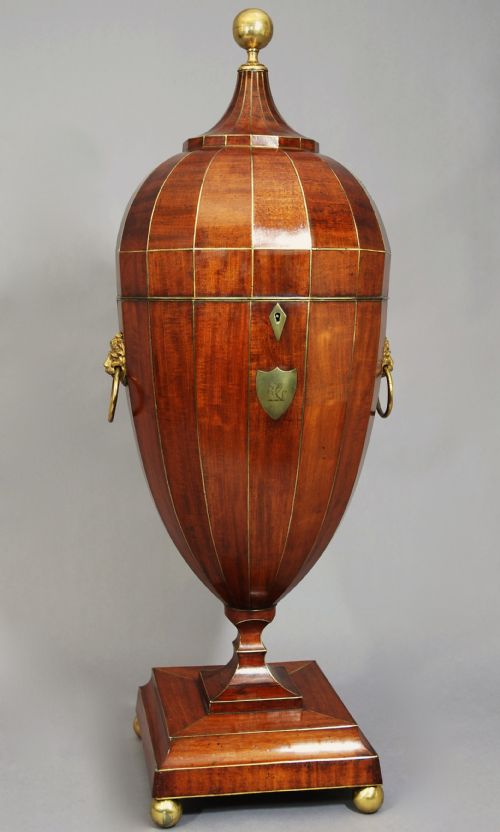


Sheraton Knife Boxes
Sheraton knife boxes are graceful table pieces designed to hold cutlery, combining fine timber work with classical Georgian proportion.
Sheraton Knife Boxes
Most pieces date from the eighteenth century or the George III period, appearing as serpentine or sloping wooden boxes as well as classical urn forms. Makers frequently integrated satinwood inlay, boxwood stringing, and brass hardware into these functional dining accessories.
Beyond standard cutlery storage, several pieces show later adaptation into stationery boxes or letter holders. You also find larger variants and matched pairs that reflect the formal dining practices of their original period.
Materials and construction
Cabinetmakers built these containers using dense timbers such as mahogany and satinwood, often embellishing the surfaces with boxwood inlay. Metal components like brass hinges, escutcheons, and silver mounts provided both structural reinforcement and decorative contrast.
The construction relies on precise joinery to shape the sloping lids, serpentine fronts, and soaring classical urn profiles. Inlaid veneers required careful hand-cutting to create the delicate geometric borders characteristic of the style.
Several dining boxes made a successful career change into stationery holders.
Judging the workmanship
Quality rests in the crispness of the cabinetwork and the subtlety of the timber selection. Finer examples display highly figured mahogany grain, perfectly matched satinwood veneers, and intricate boxwood stringing that remains sharp and intact.
Proportion defines the superior pieces, whether dealing with a slender knife box or a tall cutlery urn. The integration of original brass and silver mounts elevates a piece, as does the survival of the internal fittings before any conversion to stationery use.
The Sheraton Knife Boxes Glossary
- Serpentine
- A gentle undulating curve forming an S-shape across the front of a cabinet or box. This contour demands skilled woodworking to maintain symmetry and balance.
- Stringing
- A narrow, contrasting line of inlay used to outline panels and edges on furniture. It frames the primary timber with precise linear geometry.
- Cutlery urn
- A classical vase-shaped vessel designed to house table silver during the Georgian period. These tall forms often stand in matched pairs.
- Escutcheon
- A protective plate surrounding a keyhole, usually cast in brass. It shields the surrounding wood from wear caused by the key.
- Satinwood
- A pale, lustrous hardwood native to the tropics, prized for its golden sheen. Cabinetmakers employed it extensively for contrasting veneers and geometric inlay.
Sheraton Knife Boxes: Frequently Asked Questions
What were sheraton knife boxes used for?
These boxes stored steel-bladed table knives and forks upright on the sideboard or dining table before and during the meal. Servants locked the lids to protect expensive cutlery when not in use.
Over the centuries, owners frequently adapted them for other desk and table uses, such as holding stationery, letters, or papers.
How do I date a sheraton knife box?
Dating relies on examining the timber species, construction methods, and secondary woods used inside the carcass. Eighteenth-century and George III pieces typically exhibit dense mahogany, hand-cut dovetails, and period brass hardware.
Later Victorian interpretations often show different internal arrangements or heavier construction compared to their Georgian predecessors.
Are pairs harder to find than single boxes?
Matched pairs are considerably scarcer because many boxes became separated or damaged over centuries of domestic use. Dining rooms of the period traditionally utilised balanced arrangements on either side of the sideboard.
When a pair survives together, it commands greater interest from collectors seeking symmetry for display.
Can I still use them for modern cutlery?
Modern stainless steel cutlery rarely matches the smaller scale and specific slots of eighteenth-century knife interiors. Most contemporary owners display them as decorative objects or utilise converted examples for letters and desk accessories.
Unconverted boxes retain their internal partitions, making them suitable for careful storage of slim items.