
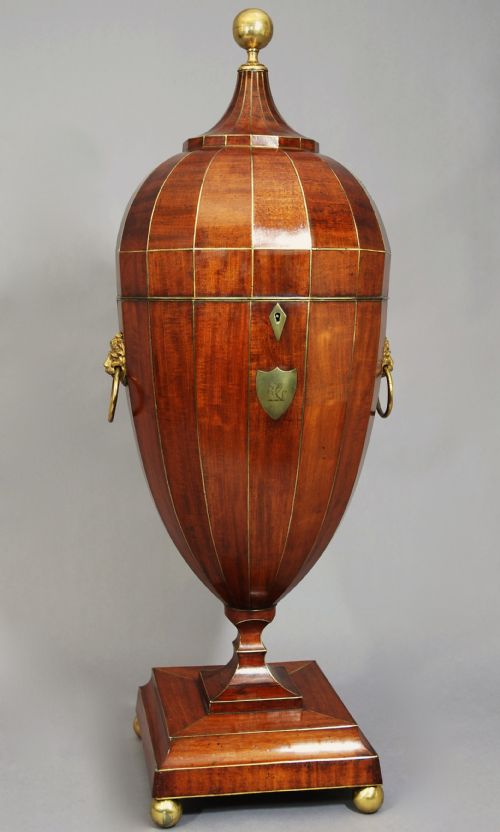


Sheraton Cutlery Box
These sheraton cutlery box examples are refined mahogany and satinwood table pieces from the Georgian era designed to house fine dining silver.
Sheraton Cutlery Box
When you search for a sheraton cutlery box, you encounter elegant storage containers created during the eighteenth and nineteenth centuries. The selection centres on upright knife boxes and classical cutlery urns designed to stand on sideboards.
You are most likely to meet mahogany examples from the Georgian period, often featuring distinctive sloping lids and upright fronts. Some pieces arrive as matched or formal pairs intended to flank a dining room.
The category extends to related forms such as stationery boxes and letter holders, reflecting later conversions or alternative uses for these refined wooden receptacles. Originating in the eighteenth century and stretching into the Victorian era, these items demonstrate classical proportions.
How they were made
Cabinet makers utilised dense timbers such as mahogany and satinwood, often enhanced with boxwood and delicate inlaid details. These materials provided a stable foundation for crisp geometric lines and curved surfaces.
Metal fittings played a crucial role in construction, with brass handles, escutcheons and silver mounts adding functional security and visual contrast. Fine joinery techniques ensured the angled lids and vertical compartments remained durable over centuries.
Periods represented in the inventory include the eighteenth century, the Georgian era, the year eighteen hundred, the Victorian period and eighteen ninety.
What varies in quality
Quality rests in the precision of the cabinet work and the choice of timber figures, where rich grain patterns elevate an ordinary container. Superior examples display meticulous satinwood inlay and well-chosen secondary woods that show no hesitation in execution.
The sophistication of the brass or silver mounts also dictates the standing of a piece, with cast and chased hardware marking out the finer workshops. Proportion and symmetry separate standard utility boxes from exceptional decorative urns.
The Sheraton Cutlery Box Glossary
- Mahogany
- A durable tropical hardwood prized for its deep reddish-brown tone and stable grain. It formed the primary structure for the vast majority of eighteenth-century dining furniture.
- Satinwood
- A luminous timber with a yellowish sheen used for contrasting stringing and decorative panels. Cabinet makers deployed it to create striking visual borders on premium boxes.
- Escutcheon
- A protective metal plate surrounding a keyhole. On these boxes, it frequently incorporates brass to prevent wear around the lock.
- Cutlery Urn
- A classical vase-shaped vessel designed to hold silverware on a sideboard. These tall pieces often appear in matched pairs from the Georgian period.
- Inlay
- The technique of embedding contrasting woods into a primary surface to form patterns. Boxwood and satinwood strips commonly create these geometric borders.
Sheraton Cutlery Box: Frequently Asked Questions
How were these boxes used?
Households placed them on sideboards during formal meals to keep silver cutlery organised and secure.
Servants retrieved the knives and forks from the fitted interior slots as required for each course.
Are they always paired?
Many survive as pairs to create a balanced display on either side of a dining room sideboard.
Single examples also appear frequently, reflecting the dispersal of original sets over the centuries.
Can I use them for letters?
Many examples find modern utility as stationery cabinets or letter holders on a desk.
Some pieces underwent conversion for paper storage during the nineteenth century due to changing domestic habits.
How do I date an antique box?
Dating relies on examining the timber species, construction methods and hardware styles.
Georgian pieces display hand-cut dovetails and classical brass mounts typical of the eighteenth century.