

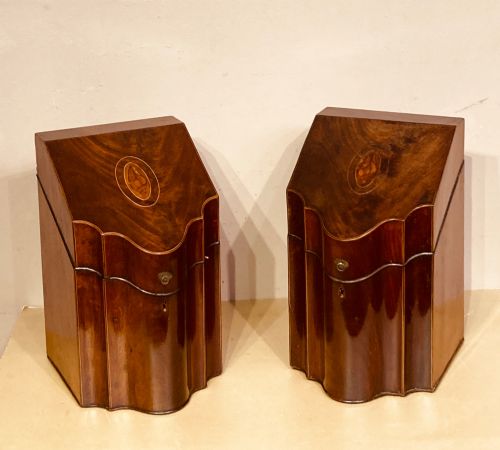


Georgian Cutlery Box Pair
These georgian cutlery box pair pieces are fine wooden table furniture designed to house dining implements with elegance.
Georgian Cutlery Box Pair
When you search for georgian cutlery box pair, you are looking at dual sets of storage containers made for dining implements during the eighteenth and nineteenth centuries. These items take the form of knife boxes, cutlery boxes, and lidded cutlery urns designed to sit on sideboards or serving tables.
The version you are most likely to meet on this page is constructed from mahogany, often conforming to George III styles and eighteenth-century periods. These examples frequently feature sloping lids, upright fronts, and matched construction suitable for symmetrical placement in a dining room.
Other variations appearing in the evidence include Victorian lidded inlaid cutlery urns, narrow bow front shapes with silver mounts, and boxed sets containing silver knives and forks with mother of pearl handles. Each variant serves the fundamental purpose of storing and displaying dining cutlery.
How they were made
Makers utilised solid and veneered mahogany as the primary timber, shaping the wood to form upright desk-style knife boxes or curved urn profiles. Boxwood and wood inlay work provided contrasting decorative lines and geometric banding across the surfaces of these containers.
Metal components played a structural and decorative role, with brass hinges, escutcheons, and handles fitted to secure the lids and assist movement. Certain high-status examples incorporated solid silver mounts to frame the timber construction and elevate the visual finish.
Georgian Cutlery Box Pair Retail Price Guide 2026
Typical asking prices for georgian cutlery box pair among the pieces listed under this phrase on Sellingantiques today, from the lower quarter to the upper quarter. They describe what is for sale here now, not the wider market.
Some boxes feature such narrow proportions that one wonders how guests managed to extract their knives without spilling the port.
What varies in quality
The distinction between standard examples and superior pieces rests on the choice of timber and the crispness of the inlay work. Finer items display carefully selected mahogany grain patterns combined with precise boxwood stringing and well-executed curved fronts.
Mounts and hardware contribute significantly to the overall merit of a pair. Finely cast brass or solid silver mounts demonstrate a higher standard of workshop production than plain or replacement metalwork.
The Georgian Cutlery Box Pair Glossary
- Knife box
- A sloping lidded container designed to hold table knives upright in fitted interior slots. These pieces formed standard dining room furnishings during the Georgian period.
- Cutlery urn
- A classical vase-shaped vessel with a removable lid used for storing dining implements. Victorian interpretations often incorporate decorative wood inlay.
- Inlay
- A technique where pieces of contrasting timber such as boxwood are fitted into recessed portions of the mahogany carcase to create patterns.
- Bow front
- A convex curved cabinet face that swells outward in the centre. This curved profile appears on select eighteenth-century examples.
- Escutcheon
- A protective plate surrounding a keyhole, usually fashioned from brass or silver to prevent wear to the surrounding wood.
Georgian Cutlery Box Pair: Frequently Asked Questions
What is a georgian cutlery box pair?
A georgian cutlery box pair consists of two matching wooden containers designed to hold dining knives and forks during meals.
These items date predominantly from the eighteenth and nineteenth centuries, reflecting the formal dining habits of the period.
How were these boxes used?
They sat upon sideboards or serving tables in the dining room to keep cutlery organised and protected when not in use.
Servants retrieved the dining implements from the containers as each course required during formal dinner service.
What timber is most common?
Mahogany serves as the principal wood for these items, often accented with boxwood stringing and decorative inlay work.
Craftsmenship from the Georgian era relied heavily on mahogany for its durability and rich natural colour.
Are all items from the Georgian era?
While the majority reflect George III and eighteenth-century styles, the selection also includes Victorian pieces and items dated towards 1890.
Matched pairs span multiple decades, incorporating later interpretations of traditional cutlery urn and box forms.