

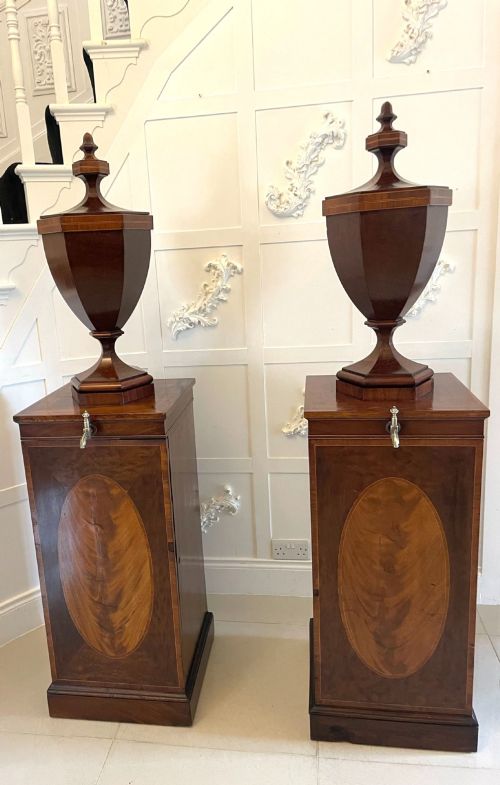
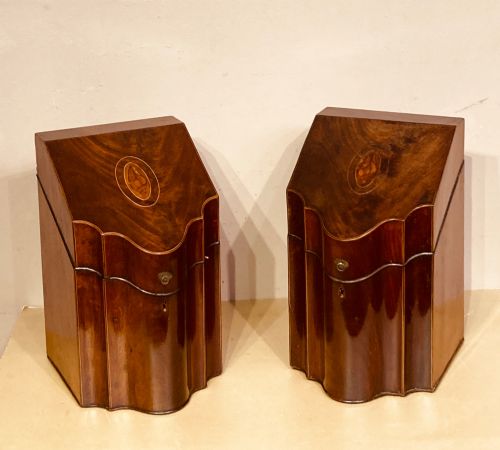


Pair Georgian Knife Boxes
Pair georgian knife boxes are formal tabletop receptacles designed to hold dining cutlery, offering striking symmetry and period presence for the interior.
Pair Georgian Knife Boxes
When you search for pair georgian knife boxes, you encounter dual storage containers originating primarily from the eighteenth century, George III period, and Victorian era. These pieces frequently take the classic sloping-lidded form designed to stand on sideboards and serve the dining table.
The inventory includes variations ranging from traditional slanted wooden boxes to taller lidded cutlery urns mounted on pedestals. Materials span richly grained timbers embellished with contrasting stringing, alongside occasional silver mounts and fitted interiors intended for individual knives and forks.
How they were made
Cabinetmakers utilised dense tropical hardwoods such as mahogany to construct the carcase, often selecting timber with deep natural grain patterns. Surfaces were frequently enhanced through the application of boxwood inlay and delicate stringing to define the sloping lids and curved fronts.
Metalwork played a functional and decorative role, with brass hinges, escutcheons, and carrying handles secured to the wood. Solid silver mounts appear on select examples, while internal partitions were carefully arranged to accommodate specialised cutlery sets.
Pair Georgian Knife Boxes Retail Price Guide 2026
Typical asking prices for pair georgian knife boxes among the pieces listed under this phrase on Sellingantiques today, from the lower quarter to the upper quarter. They describe what is for sale here now, not the wider market.
Listings for pair georgian knife boxes encompass both traditional sloping desk-form boxes and neoclassical urn shapes paired with wooden pedestals.
What varies in quality
The distinction between standard examples and superior pieces rests upon the crispness of the cabinetmaking and the quality of the timber selection. Finer boxes display harmonious grain matching across the pair and precise execution of inlaid borders.
Proportions also dictate merit, with narrower bow front profiles and well-preserved interior fittings holding greater appeal. The depth of the surface patina and the originality of the brass or silver mounts further separate exceptional items from ordinary production.
The Pair Georgian Knife Boxes Glossary
- Bow front
- A convex curved front facade that softens the rigid angles of the cabinet. This shaping requires advanced woodworking skill to achieve balance across a pair.
- Stringing
- Thin lines of contrasting timber inlaid into the primary wood surface. It forms geometric borders that accentuate the architectural lines of the box.
- Escutcheon
- A protective metal plate surrounding the keyhole. It shields the wood from wear while adding a bright metallic accent to the front panel.
- Patina
- The deep sheen and surface character acquired by wood over centuries of handling and age. A good surface reflects gentle oxidation rather than modern intervention.
- Pedestal
- A supporting columnar base or cupboard beneath an urn. These architectural elements elevate the main storage vessel to create a commanding display.
Pair Georgian Knife Boxes: Frequently Asked Questions
What were pair georgian knife boxes used for?
These containers were originally kept on sideboards in grand dining rooms to store and present heavy steel-bladed eating knives and forks when not in use at the table.
Servants would retrieve the cutlery from the boxes as courses progressed, keeping the dining surface orderly and protecting the polished steel from damp air.
How do you date a pair of knife boxes?
Dating relies on examining the timber construction methods, the style of the brass hardware, and the complexity of any inlay work present on the sloping lid.
Eighteenth-century examples typically show hand-cut dovetailing and simpler brasses, whereas later nineteenth-century interpretations often incorporate decorative urn forms or Victorian revival details.
Where should you place them at home?
They suit placement upon sideboards, console tables, or dedicated pedestals where their symmetrical forms and dark timber tones can create a strong visual anchor.
Because they were designed to be viewed from multiple angles on serving furniture, positioning them slightly apart allows the matching grain and proportions to stand out.
Are the interiors usually intact?
Many surviving pieces retain their original wooden divider slats or stepped interior blocks, though some have lost these internal fittings over generations of use.
Collectors generally accept minor interior alterations provided the exterior mahogany carcase and original lid configuration remain unaltered and structurally sound.