

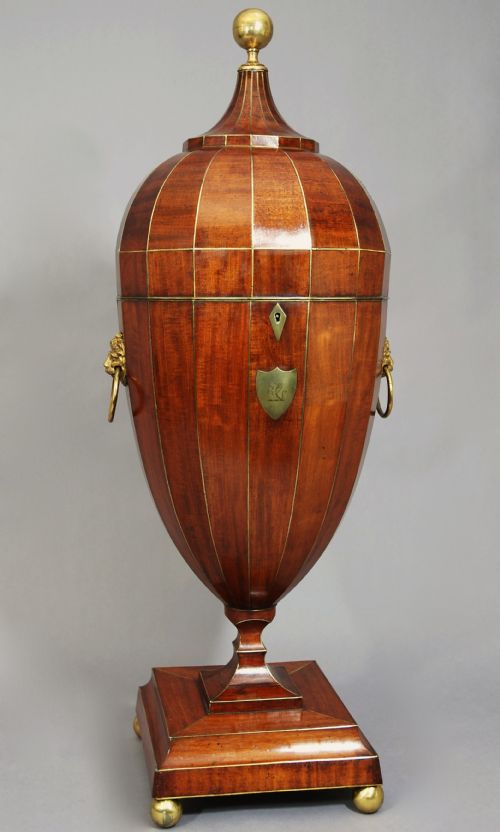


Sheraton Mahogany Knife Box
These Sheraton mahogany knife box pieces are refined Georgian table accessories designed to hold cutlery with elegance.

Sheraton Mahogany Knife Box
Buyers examining a Sheraton mahogany knife box encounter sloping lidded desk forms and tall urn shapes originating from the eighteenth century and the Georgian period. The selection includes single examples alongside matched pairs.
Forms span traditional knife boxes, cutlery urns, and stationery boxes or letter holders. Examples emerge from the eighteenth century, the Georgian era, and nineteenth century Victorian revivals.
The dominant material is mahogany, frequently enriched with satinwood and boxwood inlay in the Neoclassical taste. Pieces function variously as cutlery holders or adapted stationery cabinets.
Materials and construction
Construction relies on solid mahogany cabinets and shaped lids, often accented with contrasting satinwood inlay and boxwood inlay. Cabinetmakers utilised fine timber veneers to achieve decorative surfaces.
Brass hardware such as hinges, escutcheons, and carrying handles provide functional and decorative contrast to the dark wood. Metal components secure the sloping lids and internal compartments.
Sheraton Mahogany Knife Box Retail Price Guide 2026
Typical asking prices for sheraton mahogany knife box among the pieces listed under this phrase on Sellingantiques today, from the lower quarter to the upper quarter. They describe what is for sale here now, not the wider market.
Listings feature mahogany, satinwood inlay, boxwood inlay, and brass hardware across Georgian and Victorian periods.
Judging quality
Quality rests in the precision of the satinwood and boxwood inlay work and the depth of the mahogany grain. Refined proportions distinguish superior examples from standard utility boxes.
The crispness of carved details and the integration of original brass fitments separate notable pieces from later alterations.
The Sheraton Mahogany Knife Box Glossary
- Knife box
- A sloping lidded container designed in the eighteenth century to store table cutlery upright on the sideboard. These boxes often feature serpentine fronts and inlaid decoration.
- Cutlery urn
- A tall neoclassical vase shaped vessel used during the Georgian period for storing tableware. They frequently appear in matched pairs.
- Satinwood inlay
- A contrasting light tropical hardwood inserted into mahogany surfaces to create decorative geometric or floral patterns. This technique defines much of the Sheraton aesthetic.
- George III
- The British monarchical period spanning the late eighteenth and early nineteenth centuries. Most traditional knife boxes originate from this stylistic era.
Sheraton Mahogany Knife Box: Frequently Asked Questions
How were cutlery urns used?
Cutlery urns served as ornamental storage vessels for dining cutlery during the Georgian period. They sat upon sideboards alongside traditional knife boxes.
Pairs of urns provided symmetrical balance to formal eighteenth century dining room interiors.
How do I identify Georgian pieces?
Georgian pieces are identified by their eighteenth century materials, particularly solid mahogany and contrasting boxwood inlay. Construction methods utilise period joinery and brass hardware.
Stylistic cues include neoclassical proportions and serpentine or sloping profiles characteristic of the era.
Can these boxes store stationery?
Several knife boxes and related forms function as stationery cabinets or letter holders. Interior partitions originally built for cutlery adapt readily to paper storage.
Converted pieces maintain their exterior eighteenth century appearance while serving new organizational roles.