


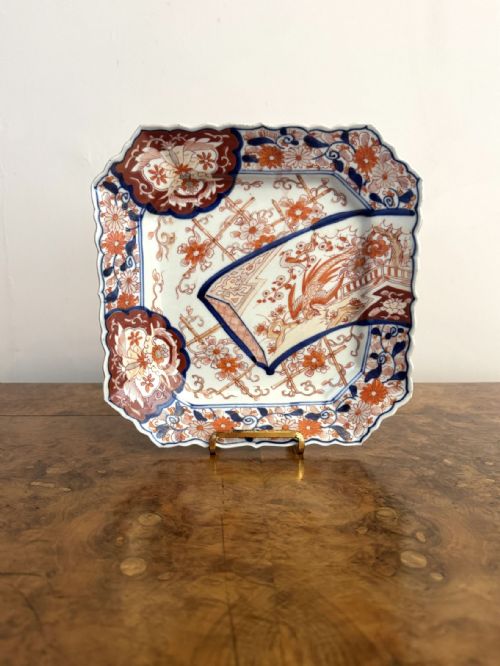


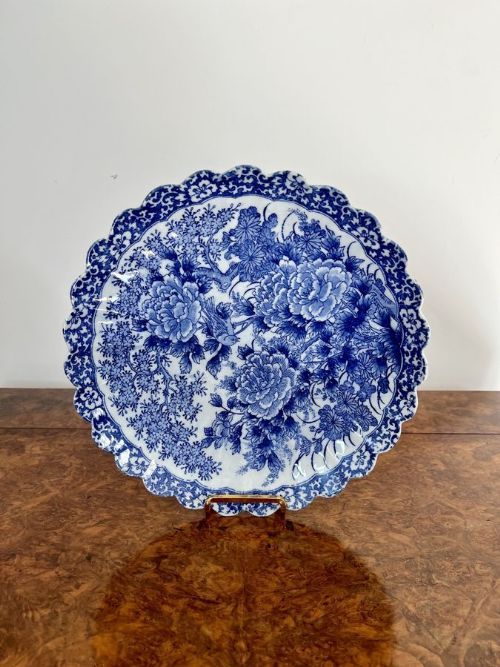


Imari Ware Decorative Dish
An imari ware decorative dish brings vibrant hand-painted colour and rich cobalt blue into a room.

Imari Ware Decorative Dish
An imari ware decorative dish is a porcelain vessel created for display and service, combining deep cobalt blue underglaze with iron red and other enamel colours. These pieces emerge from traditional kilns in Japan, specifically associated with the Arita region and the Edo and Meiji periods.
The objects seen here span centuries of production, ranging from large chargers and deep bowls to scalloped plates and square dishes. Most examples encountered on this page date from the nineteenth and early twentieth centuries, reflecting the high point of export trade and domestic appreciation.
Forms vary from simple round plates to complex hexagonal shapes, clam shell dishes, and scalloped edge bowls designed to catch the light. Collectors select these items for their strong visual impact and the intricate hand-painted floral and bird motifs that cover their surfaces.
Materials and Techniques
The foundation of every piece is fine porcelain clay shaped on a potter's wheel or pressed into moulds to form plates, bowls, and chargers. Artisans then apply cobalt blue underglaze directly to the body before the initial firing.
After the first high-temperature firing, craftsmen paint secondary details using iron red enamel and touches of gold leaf or gilding. A final glaze seals the pigments, creating a durable surface that protects the layered colours.
Porcelain is the primary material across all entries, enhanced by cobalt glaze, enamel work, and occasional applications of gold leaf.
Quality Variations
The distinction between ordinary and superior imari ware lies in the precision of the hand-painted brushwork and the clarity of the cobalt glaze. Finer pieces display crisp lines in the floral and bird designs, with careful alignment between the underglaze blue and the overglaze enamels.
Weight, potting thickness, and the complexity of the form also determine the standing of a dish. Square shapes, hexagonal bowls, and scalloped edges demand greater skill from the potter than standard round plates, elevating the character of the finished object.
The Imari Ware Decorative Dish Glossary
- Imari
- A style of Japanese export porcelain originating from the port of Imari, traditionally characterised by a palette of cobalt blue, iron red, and gold.
- Arita
- The Japanese town and surrounding region where porcelain production first began, providing the clay and kilns for these wares.
- Charger
- A large decorative plate intended primarily for display on a wall or sideboard rather than for dining use.
- Edo Period
- The historical era in Japan lasting from 1603 to 1868, noted for peace and the flourishing of ceramic arts.
- Meiji Period
- The period of Japanese history spanning from 1868 to 1912, marked by industrialisation and widespread export of decorative arts.
Imari Ware Decorative Dish: Frequently Asked Questions
What is an imari ware decorative dish?
An imari ware decorative dish is a porcelain plate, bowl, or charger produced in Japan featuring hand-painted designs in cobalt blue, iron red, and enamel.
These items were made for both domestic use and international export, prized for their bright colours and detailed patterns.
How were these dishes used originally?
Many larger pieces served as display chargers in formal rooms, while smaller plates and bowls held food or sweetmeats during gatherings.
Over time, collectors favoured them purely for decorative display on walls, cabinets, and tables.
How do I date an imari dish?
Dating relies on stylistic clues, potting techniques, and historical periods such as the Edo or Meiji eras recorded in the listings.
Earlier pieces often show softer cobalt tones and heavier potting, while later export items display sharper enamel colours.
Can I display these plates on walls?
Displaying chargers and plates on walls is common practice, provided appropriate and secure hanging hardware is utilised.
Care should be taken to distribute the weight evenly across the rim or foot ring of the porcelain.
What colours define imari porcelain?
The defining palette combines underglaze cobalt blue with overglaze iron red, supplemented by green, yellow, and gold leaf.
This distinct combination creates the high-contrast decorative effect recognisable across different periods.