
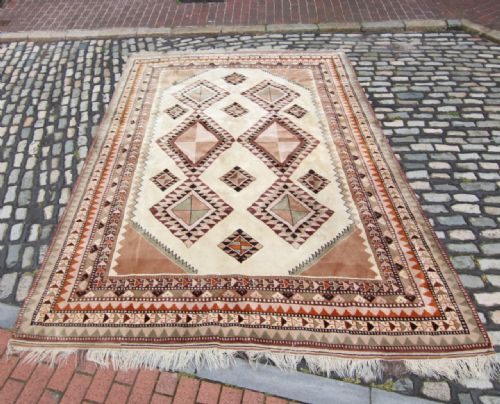


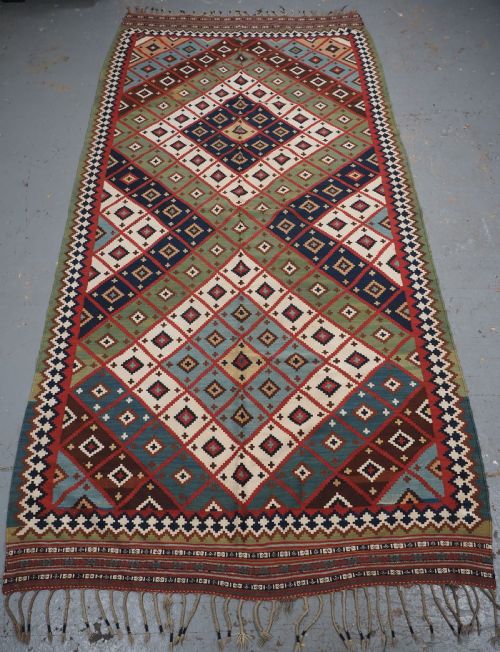


Diamond Pattern Rug
A diamond pattern rug brings geometric weight to a floor through tribal motifs and rich regional wool.
Diamond Pattern Rug
A diamond pattern rug encompasses tribal and traditional floor coverings woven across Persia, Central Asia, and the Balkans. When searching for a diamond pattern rug, buyers encounter heavy hand-woven carpets, flat-woven kilims, and small saddle bag faces dating from the nineteenth century up to the middle of the twentieth century.
The selection on this page demonstrates strong regional traditions such as Qashqai, Turkmen, Senneh, and Balkan weaving. Buyers are most likely to meet pieces employing traditional tribal motifs, repeat diamond layouts, and classic Central Asian or Persian compositions.
These textiles serve both functional and decorative roles in modern interiors, offering heavy wool construction and resilient flat-weave structures. Each piece reflects the specific cultural vocabulary of the weavers who created it across diverse geographical origins.
How They Were Made
These rugs and kilims rely primarily on natural wool and cotton materials shaped by traditional hand-weaving techniques. Artisans utilise durable construction methods such as flat-woven soumak, kilim structures, and dense pile knots.
The palette depends on natural dyes applied to hand-spun wool, yielding deep, enduring tones across Persian and tribal carpets. Weavers construct these textiles with sturdy foundations designed to withstand generations of daily use.
Listings incorporate wool, cotton, and natural dyes across Persian, Central Asian, and Balkan traditions spanning the nineteenth and twentieth centuries.
What Varies in Quality
Quality rests upon the fineness of the weave, the precision of the geometric layout, and the integrity of the materials. Pieces exhibiting tighter knotting or sharper flat-weave execution represent a higher standard of production.
The richness and depth of the natural dyes further distinguish finer examples from standard productions. Preservation of the original edges and structural soundness also determine the standing of each textile.
The Diamond Pattern Rug Glossary
- Kilim
- A flat-woven carpet or rug produced without a pile. These pieces rely on tightly packed horizontal weft threads pulled across vertical warps to form sharp geometric designs.
- Soumak
- A brocade-like flat-weave technique where coloured weft threads wrap around the warp threads in a continuous sequence. This method creates a textured surface with raised pattern details.
- Saddle bag face
- The front panel of a utilitarian animal transport bag preserved as an independent rug. These smaller formats display concentrated tribal motifs and distinct regional layouts.
- Natural dye
- Colouring derived from plants, insects, and minerals rather than synthetic compounds. These dyes age gracefully and develop subtle tonal variations over decades of light exposure.
- Warp
- The stationary vertical threads stretched across a loom that form the structural foundation of the textile. Weft threads are woven through these structural elements.
Diamond Pattern Rug: Frequently Asked Questions
How do I clean an old wool rug?
Maintenance requires gentle surface vacuuming without a rotating brush head to protect the wool fibres and woven edges. Professional textile cleaning is necessary for deep washing to prevent dye migration.
Harsh chemical detergents and excessive moisture damage natural dyes and weaken hand-spun wool. Regular rotation helps distribute foot traffic evenly across the surface of the carpet.
Where were these tribal rugs made?
Production centres span western Persia, Central Asian regions, Afghanistan, and the Balkans. Tribal groups such as the Qashqai, Yomut Turkmen, and Khamseh created these textiles using local wool.
Each weaving region developed distinct geometric vocabulary and colour palettes passed down through generations. Geography directly dictates the structural style and motif combinations found in the wool.
Can I place a kilim on a wooden floor?
Flat-woven kilims function effectively on wooden floors when paired with a breathable underlay. The underlay prevents slipping and reduces friction between the flat weave and the boards.
Heavy carpets and rugs provide substantial insulation and acoustic softening for hard flooring surfaces. Proper placement ensures the foundation fibres remain protected from abrasive pressure.
How do I date a traditional carpet?
Dating relies on analysing the wool quality, dye composition, structural materials, and stylistic motifs. Nineteenth-century examples often display specific regional colour variations and hand-spun textures.
Structural analysis of the foundation warps and wefts reveals manufacturing shifts over time. Comparing design symmetry with documented tribal pieces helps establish an approximate period of origin.