
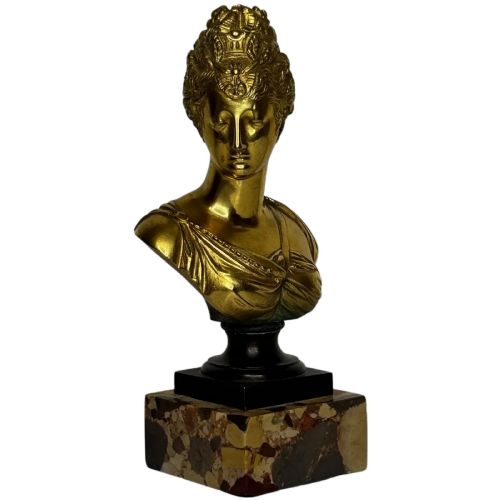


Classical Female Bronze Bust
A classical female bronze bust brings timeless sculptural grace to an interior, offering a direct line to historical artistry and refined portraiture.
Classical Female Bronze Bust
When you search for a classical female bronze bust, you encounter sculptural works that portray historical, mythological, or allegorical women from various periods. These pieces serve as striking decorative focal points in domestic settings.
The most common examples on this page date from the nineteenth century, encompassing Victorian and Edwardian interpretations alongside French Art Nouveau and Neoclassical revivals. Makers frequently drew inspiration from antiquity, rendering subjects like Diana de Poitiers, Sappho, and Cleopatra.
Forms range from intimate cabinet sculptures to monumental pieces mounted on marble plinths. Alongside solid bronze, you will find variants incorporating patinated surfaces, terracotta, ormolu, and wood.
How They Were Made
Foundries typically utilised the lost-wax casting method for these bronze busts, capturing intricate details in the hair, drapery, and facial expressions. Molten metal filled the mould, which was then chased and finished by hand.
Makers often applied patination to the bronze surface, creating deep brown, green, or dark tones that highlight the contours of the subject. Many examples integrate contrasting materials, mounting the cast metal onto carved marble plinths or incorporating ormolu details.
Several subjects bear the names of ancient poets and literary heroines, proving that nineteenth-century desk ornaments read better than most modern bookshelves.
What Varies in Quality
The choice of secondary materials, such as heavy veined marble bases or fine ormolu mounts, elevates the presence of a bust. The depth and subtlety of the patination further indicate the care taken during the finishing stages of production.
Emmanuel Villanis·Georges-Charles Coudray·Hans Müller·G.V. Vaerenbergh·E. Laurent·Eutrope Bouret·Henri Plé·J C De Blezer·HL Blasche for Reps & Trinte·Goldscheider
The Classical Female Bronze Bust Glossary
- Patinated bronze
- Bronze that has been treated with chemical solutions to produce a specific surface colour and finish. This process protects the metal and enhances visual depth.
- Ormolu
- Gilt bronze mounted or applied as an ornamental feature on sculpture bases. The technique involves applying a finely ground gold-mercury amalgam to bronze.
- Terracotta
- Fired clay used as a medium for sculptural busts, sometimes bronzed to mimic metal. It allows for highly expressive, direct modelling by the artist.
- Allegory
- The representation of abstract ideas through human form, such as seasons or historical concepts. Artists frequently used allegorical titles for nineteenth-century portrait busts.
- Neoclassical
- A style drawing inspiration from the classical art and culture of ancient Greece and Rome. This aesthetic prioritises restraint, symmetry, and classical drapery.
Classical Female Bronze Bust: Frequently Asked Questions
Where should I display a bronze bust?
These sculptures suit prominent locations such as a mantelpiece, a dedicated console table, or a sturdy bookcase where the profile can be appreciated from multiple angles.
Ensure the placement offers adequate lighting to highlight the patination and surface details of the metal or terracotta.
How do I clean a bronze bust?
Dust the surface gently with a soft, dry microfibre cloth to remove particulate matter without disturbing the patina. Avoid using chemical cleaners, water, or abrasive polishes, which can strip the protective finish.
For intricate areas around hair and drapery, a clean artist's paintbrush helps lift settled dust safely.
How can I tell Art Nouveau from Neoclassical pieces?
Art Nouveau examples feature flowing, organic lines inspired by natural forms, often displaying stylized hair and asymmetric drapery typical of the turn of the twentieth century. These pieces frequently bear signatures of known French sculptors.
Neoclassical works rely on strict symmetry, restrained proportions, and direct references to ancient Greek and Roman portraiture.
Why are some busts mounted on marble?
Marble plinths provide structural stability and visual weight, elevating the sculpture to create a more formal appearance. The contrast between cool stone and dark patinated metal enhances the overall aesthetic.
Many nineteenth-century French foundries integrated marble bases as a standard component of high-quality portrait sculpture.