


Black Porcelain Urns
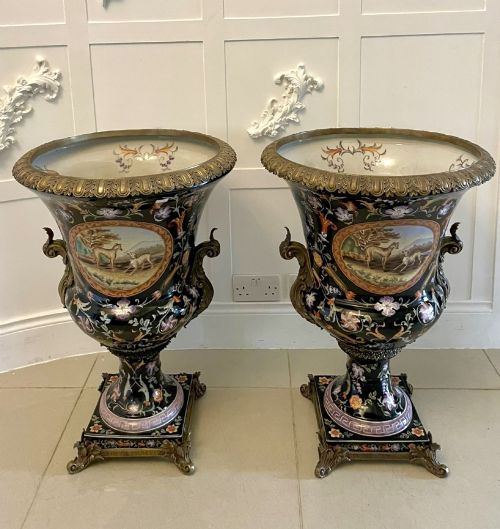
These black porcelain urns and related vases bring striking dark ceramics and ornate metal mounts into a room.
Black Porcelain Urns
When you search for black porcelain urns, you encounter a selection of nineteenth-century decorative pieces including jardiniere urns, floor jars, and bulbous vases. The listings span the Victorian era, the Meiji period, and the turn of the twentieth century.
You are most likely to meet French porcelain mounted in brass alongside Japanese porcelain finished with lacquer over black paint. These objects take the form of flared vases, goblet shapes, and large floor pieces.
The aesthetic bridges European neoclassical and French styles with Japanese Meiji craftsmanship and Chinese Qing style influences. Pieces frequently incorporate hand-painted details, gold leaf, and geometric inset panels.
Materials and construction
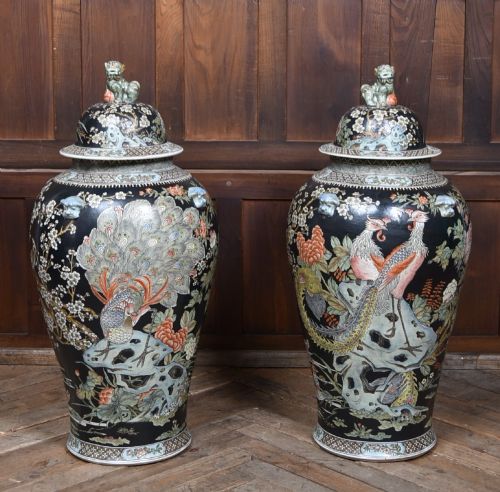
The construction combines ceramic bodies of porcelain and earthenware with applied decorative layers. Japanese examples often utilise lacquer applied over black paint to create deep, dark surfaces.
Mounts and embellishments involve brass, gilt, and gold leaf applied to frame the ceramic forms. Hand-painted decoration and enamel work complete the surface finish on pieces from Dutch and Japanese makers.
Several Japanese vases feature unexpected geometric inset panels alongside hand-painted koi swimming through dark lacquer.
Assessing quality and execution
Quality separates through the precision of hand-painted details and the crispness of applied lacquer over black paint. Superior pieces display finely rendered motifs such as koi or birds without blurring.
The integration of brass mounts and gilt details indicates the standard of manufacture. Well-cast metalwork fitted securely to the porcelain distinguishes finer production from simpler wares.
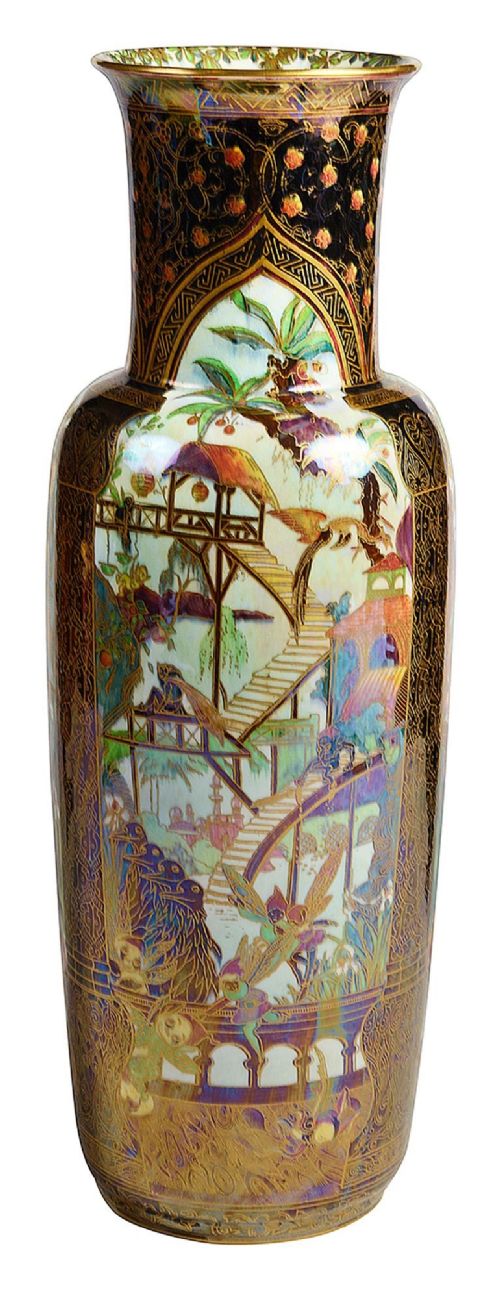
Daisy Makeig Jones·Rozenburg
The Black Porcelain Urns Glossary
- Meiji Period
- A period of Japanese history lasting from 1868 to 1912 noted for its decorative arts exported to the West. Works from this time often feature intricate gilt and lacquer decoration.
- Jardiniere
- An ornamental pot or receptacle designed for holding plants or flowers. In larger sizes, these take the form of floor-standing urns.
- Gilt
- A thin layer of gold or gold-like material applied to a surface. This technique highlights raised portions of ceramic and brass mounts.
- Lacquer
- A clear or coloured varnish applied in multiple coats to wood or ceramic. It produces a hard, durable finish with a high gloss.
- Neoclassical
- A Western stylistic movement drawing inspiration from the classical art and culture of ancient Greece and Rome. It informs the symmetry and metal mounts seen on French pieces.
Black Porcelain Urns: Frequently Asked Questions
What are black porcelain urns?
Black porcelain urns and vases are nineteenth-century decorative vessels created in Europe and Asia. They combine dark ceramic bodies with hand-painted scenes, lacquer work, and metal mounts.
These pieces served primarily as decorative ornaments for grand interiors, ranging from mantelpiece vases to large floor jars.
How do I care for these urns?
Dust these ceramic and lacquered surfaces gently with a soft, dry cloth. Avoid chemical cleaners that might damage the delicate gilt or lacquer.
Keep the pieces away from direct sunlight and areas of high humidity to protect the paint and metal mounts over time.
How do I date these pieces?
Dating relies on stylistic markers such as French neoclassical brass mounts or Japanese Meiji period motifs. Reference points include Victorian production standards and turn-of-the-century Art Nouveau influences.
Examining the construction of the base and the application of lacquer provides further clues to the manufacturing era.
Where were these pieces made?
The listings show origins spanning France, Japan, China, Holland, and England. Each region contributed distinct aesthetic traditions to the medium.
European workshops often favoured brass mounts and classical shapes, while Japanese makers utilised lacquer over black paint and intricate gold decoration.