
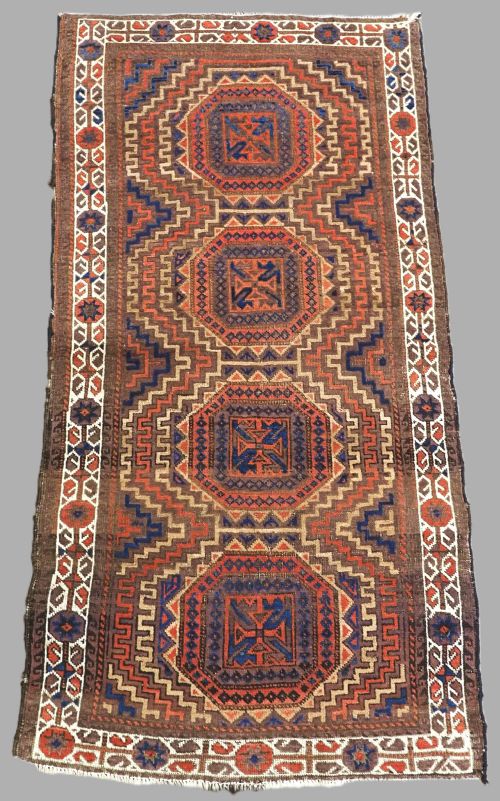


Antique Khorasan Baluch Carpet
These antique khorasan baluch carpet and rug pieces offer rich tribal character, woven by nomadic groups in northeast Persia.
Antique Khorasan Baluch Carpet
When you examine an antique khorasan baluch carpet, you are looking at tribal weaving originating from the Khorasan region of northeast Persia. These pieces reflect nomadic traditions, often categorised under Persian tribal or Baluch tribal styles.
The selections available here showcase classic formats such as area rugs and smaller carpets. Designs frequently incorporate traditional motifs like the Mina Khani variant, calyx lattice patterns, and large guls.
Most examples date from the late nineteenth century up to the early twentieth century, spanning periods around eighteen-eighty to nineteen-ten. Pieces associated with specific sub-groups like the Quchan Kurds or Salar Khani and Mahdad Khani weavers appear regularly.
How they were made
The construction relies fundamentally on wool, with certain rustic examples incorporating camel wool to provide distinctive texture and natural tonal variation. Foundation elements often utilise cotton alongside traditional wool structures.
Weavers employed hand-knotting techniques to execute intricate geometric lattices and repeat patterns. The combination of local materials and traditional dyeing methods produced durable floor coverings designed for nomadic daily life.
What varies in quality
The fineness of the weave and the precision of the lattice design distinguish finer rugs from more rustic examples. Denser knotting allows complex motifs like the Mina Khani variant to display greater clarity.
Material choice also influences the character of the piece, particularly where weavers introduced camel wool for specific tactile effects. Overall preservation and structural integrity determine how well the textile retains its original form.
The Antique Khorasan Baluch Carpet Glossary
- Khorasan
- A large province in northeast Persia known for producing distinctive tribal and village rugs. Weavings from this area often bridge nomadic designs with finer regional techniques.
- Gul
- A medallion or repeating floral motif commonly found in Central Asian and tribal Persian carpets. These octagonal or geometric shapes form the primary focal points of the field design.
- Salar Khani
- A specific sub-group of Baluch weavers associated with distinct regional patterns. Their work forms a recognised subset within broader tribal weaving.
Antique Khorasan Baluch Carpet: Frequently Asked Questions
How do I identify a Khorasan Baluch rug?
Look for characteristic tribal motifs combined with wool materials typical of northeast Persia. Many pieces feature geometric lattices or repeating guls.
Working knowledge of nineteenth and early twentieth-century dating helps separate these regional rugs from later reproductions.
Where were these rugs originally made?
Nomadic and tribal groups produced these textiles within the Khorasan province of Persia. Various sub-groups, including specific Kurdish communities, contributed to the regional output.
Production took place largely within pastoral and village settings rather than large urban workshops.
What materials are used in these carpets?
Traditional construction relies primarily on wool for both the pile and foundation. Some rustic nomadic pieces incorporate camel wool for added texture and natural colour variation.
Cotton foundations also appear in specific examples from the late nineteenth and early twentieth centuries.
How should I care for an antique tribal rug?
Gentle vacuuming without a rotating brush helps maintain the wool pile safely. Professional cleaning suited for antique textiles preserves the natural dyes and fibres.
Using a quality underlay prevents slipping and reduces wear from daily foot traffic.