
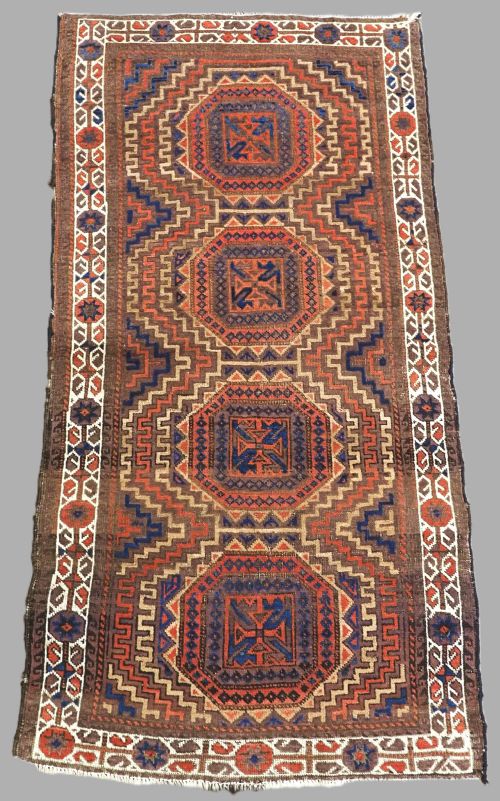


19th Century Baluch Rug
These 19th century baluch rug examples bring tribal artistry into modern spaces through deep indigo grounds and geometric motifs.
19th Century Baluch Rug
A 19th century baluch rug is a tribal floor covering originating from the borderlands of Persia and Afghanistan, woven by nomadic groups. Buyers search for these pieces to acquire authentic examples of village weaving from the eighteen-seventies through the eighteen-nineties.
The most common forms on this page are area rugs and prayer rugs, often featuring intricate repeating patterns like the kalam donneh or dokhtar-e-qazi designs. These formats reflect the daily lives and portable traditions of their makers.
Regional origins span Western Afghanistan and Khorasan, uniting distinct tribal aesthetics under the broader baluch designation. Each piece carries motifs passed down through generations of weavers.
How They Were Made
Weavers constructed these textiles using wool foundations, incorporating cotton and goat hair details for structural contrast. Natural dyes provided the rich palette of blues, reds, and camel grounds visible across the pieces.
Techniques relied on traditional upright looms set up in nomadic camps or village settlements. Long kilim ends frequently finished the ends of prayer rugs to protect the knotted pile from fraying.
19th Century Baluch Rug Retail Price Guide 2026
Typical asking prices for 19th century baluch rug among the pieces listed under this phrase on Sellingantiques today, from the lower quarter to the upper quarter. They describe what is for sale here now, not the wider market.
Dated examples across the inventory span the decades from eighteen-seventy to eighteen-ninety.
What Varies in Quality
Quality differences stem from the depth and saturation of the natural dyes, where vibrant blues and camel grounds elevate certain pieces. The complexity and precision of the lattice or shrub designs also separate standard village output from superior works.
The fineness of the wool weave and the preservation of the original kilim ends influence the overall integrity of the textile. Pieces displaying unusual border choices, such as Yomut Turkmen motifs, demonstrate greater artisanal ambition.
The 19th Century Baluch Rug Glossary
- Prayer rug
- A small format rug featuring a mihrab or arch design used for daily Islamic prayer. These often incorporate tree of life motifs.
- Kalam donneh
- A traditional boteh-inspired pattern resembling a seed or almond, frequently repeated across the field. It is a hallmark of Western Afghan weaving.
- Dokhtar-e-qazi
- A specific design attribution associated with Timuri and baluch groups, often found on prayer rugs. The term translates historically in dealer lexicons to daughter of the judge.
- Natural dyes
- Colourants derived from plants, insects, and minerals before the widespread adoption of synthetic aniline dyes in the late nineteenth century. They produce a rich, mellow patina over time.
- Kilim ends
- Flat-woven sections of warp and weft extending beyond the knotted pile at the top and bottom of a rug. They provide structural strength and prevent unravelling.
19th Century Baluch Rug: Frequently Asked Questions
How do I identify a baluch rug?
Look for deep indigo or camel grounds paired with geometric shrub, lattice, or star motifs. These pieces typically originate from nineteenth-century Khorasan or Western Afghanistan.
Nomadic weavers utilised wool and goat hair to create compact formats that functioned easily in portable tent settings.
What is a prayer rug?
A prayer rug is a smaller format textile featuring an arched mihrab design at one end. Weavers utilised these for personal devotion during daily prayers.
They frequently display central trees of life or tile patterns directing the eye toward the niche.
Where were these rugs woven?
These textiles were produced by nomadic and semi-nomadic tribes inhabiting the border regions of Persia and Afghanistan. Khorasan and Western Afghanistan represent the primary geographic centres for this weaving tradition.
Different tribal groups, including Timuri and Bahluli sub-tribes, contributed distinct design variations to the tradition.
How should I care for an antique rug?
Protect the textile by placing it in low-traffic areas away from direct sunlight to preserve the natural wool pile and dyes. Vacuum gently without a rotating beater brush to remove embedded dust.
Professional antique textile cleaning is recommended when washing becomes necessary.