


Antique European Wool Tapestry
These antique european wool tapestry pieces bring centuries of textile artistry into a room, offering rich textures and historic narratives that define a serious interior.
Antique European Wool Tapestry
When you search for antique european wool tapestry, you encounter a diverse range of textiles spanning from the sixteenth century up through the early twentieth century. These pieces encompass large wall hangings, framed textile panels, decorative cushions, and flatweave rugs originating from various European regions including France, Flanders, Germany, Romania, and Audenaarde.
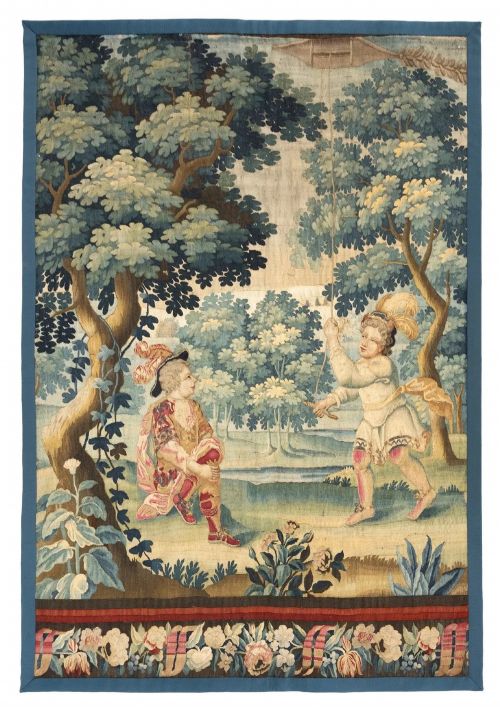
The assortment on this page leans heavily into distinct regional traditions, balancing grand Flemish verdure scenes and French baroque compositions with vibrant Eastern European folk art and Bessarabian kilims. Buyers frequently choose between narrative wall tapestries woven with metallic thread and floor coverings bearing banded designs or floral motifs.
Materials and construction
The primary construction relies on wool, often combined with silk, cotton, linen, and metallic thread to achieve textural depth and visual variation. Workshops employed intricate weaving and needlework techniques, sometimes incorporating wooden frames and glass backing to preserve fragile panels.
Earlier pieces from the sixteenth and seventeenth centuries depend on dense wool and silk yarns to build complex pictorial depths, whereas later nineteenth and twentieth-century folk pieces utilise flatweave methods for durable kilims and rugs.
Listings span from the 16th century to the 1930s, featuring wool, silk, cotton, linen, and metallic thread across Flemish, French, German, and Eastern European folk traditions.
Assessing quality
Quality rests upon the complexity of the design, the richness of the palette, and the survival of the original materials. Pieces incorporating metallic thread alongside wool and silk demand greater technical skill and typically indicate higher workshop standards.
The integrity of the weave and the clarity of the pictorial or banded design separate standard decorative items from superior historical examples. Early Flemish and French works demonstrate intricate pictorial mastery, while Bessarabian kilims showcase precise control over folk floral motifs.
The Antique European Wool Tapestry Glossary
- Verdure
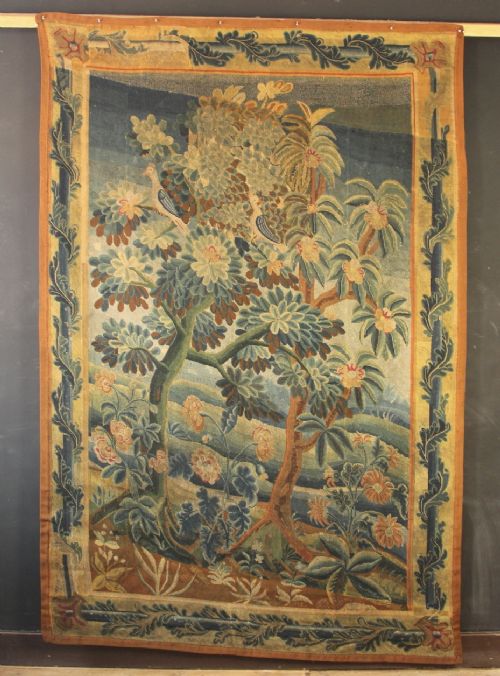
- A type of tapestry featuring a lush landscape background filled with foliage, trees, and often animals. These scenes dominated seventeenth-century Flemish production.
- Kilim
- A flatweave carpet or rug produced in regions such as Bessarabia and Sharkoy. They lack a pile, relying instead on tightly interlocked warp and weft threads.
- Flemish
- Pertaining to Flanders, a historical region renowned for producing elaborate narrative and landscape tapestries during the Renaissance and baroque periods.
- Needlework
- Textile art created by stitching yarn onto a foundation canvas or fabric by hand, rather than utilising a loom during the initial weaving process.
- Metallic Thread
- Fine wire or metal-wrapped fibres woven into textile panels to reflect light and add opulent detail to the composition.
Antique European Wool Tapestry: Frequently Asked Questions
How do I hang a heavy tapestry?
Large wall hangings require a weight-distributing support system, such as a lined sleeve sewn to the reverse that accepts a sturdy wooden baton or metal rod.
Avoid hanging textiles directly from isolated nails or hooks, which concentrates tension and damages the historic wool fibres over time.
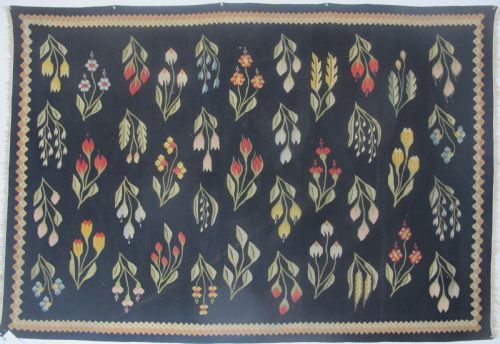
Where were Bessarabian kilims made?
Bessarabian kilims originate from the historical region of Bessarabia, situated between the Prut and Dniester rivers in Eastern Europe.
These flatweave rugs are distinct for their dark grounds and naturalistic floral patterns influenced by both Ottoman and European design traditions.
Can tapestry cushions be used daily?
Seventeenth-century tapestry cushions function best as decorative accents rather than heavy-use items due to the delicate nature of historic wool and needlework.
Gentle handling preserves the structural integrity of the fabric and prevents excessive friction on the aged threads.
What is a verdure tapestry?
A verdure tapestry depicts a dense forest, garden, or woodland landscape, frequently populated by birds or animals hiding among the foliage.
Master weavers in Flanders and northern Europe popularised this style during the sixteenth and seventeenth centuries to bring the outdoors inside.
How do I clean an antique wool tapestry?
Professional textile conservators should handle any major cleaning to prevent shrinkage, dye bleeding, or structural damage to aged wool and silk fibres.
Routine maintenance is limited to very gentle surface dust removal using a soft brush with low suction.