


19th Century Glass Print
A 19th century glass print brings historical subjects and vibrant colour beneath a protective transparent surface.
19th Century Glass Print
When you search for a 19th century glass print, you encounter framed wall art that employs reverse painting, engraving, or chrystoleum techniques to capture portraiture, military scenes, and allegorical subjects. These pieces span Georgian, Regency, and Victorian periods, often presenting historical figures or sentimental genre scenes.
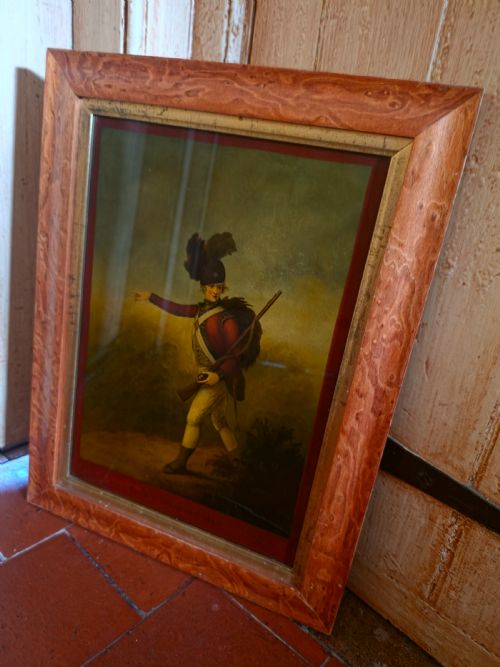
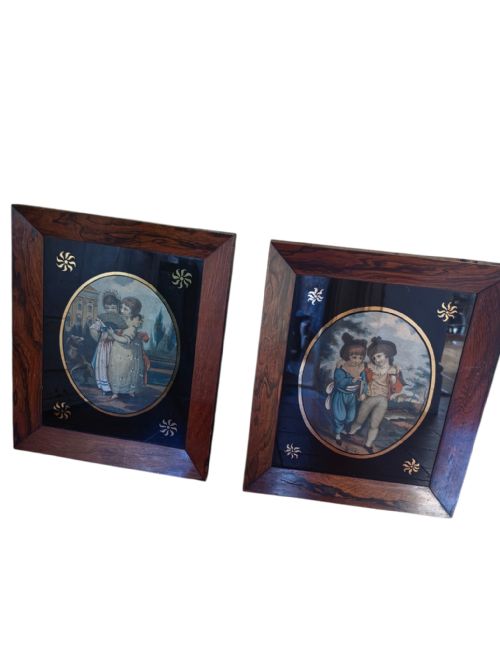
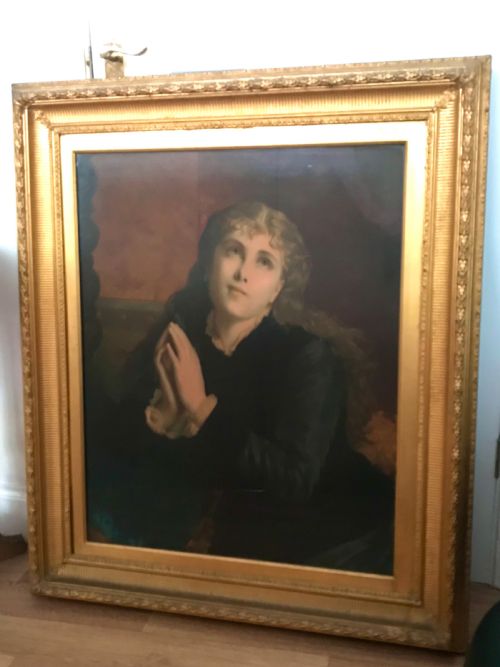
The version you are most likely to meet on this page is a framed reverse glass print or a chrystoleum, frequently housed in rosewood or giltwood frames. Examples range from military depictions like light infantrymen and the Battle of Waterloo to delicate portraits and continental views.
Many items combine paper prints and paint directly beneath glass, while others utilise oil paintings or lithographs protected behind convex glass. The physical construction places the delicate visual layer safely behind a transparent barrier.
What varies in quality
The finesse of the hand-applied pigment separates standard decorative items from finer works, particularly in chrystoleums where precise brushwork defines facial expressions and drapery. Superior pieces retain crisp lines and vibrant colour beneath the glass without fading or flaking.
The integrity and originality of the surrounding frame heavily influence the overall standard, with period giltwood and rosewood mouldings commanding greater appreciation than later replacements.
The clarity of the glass itself and the preservation of the underlying paper or paint layers dictate whether the visual narrative remains sharp and unobstructed.
Even light infantrymen and solemn Mary Magdalenes need a sturdy wooden frame to keep their nineteenth-century dignity intact.
Schweninger·Macklin
The 19th Century Glass Print Glossary
- Chrystoleum
- A specialised Victorian method where a paper print was stuck face down to glass, the paper backing rubbed away, and the remaining transparent image hand-painted before being framed.
- Reverse glass painting
- An artistic technique where the composition is painted on the back of a glass sheet, meaning details and foreground elements must be applied before background layers.
- Giltwood
- Wood that has been covered with a thin layer of gold leaf or gilt powder, commonly found on the ornate frames enclosing these prints.
- Convex glass
- Curved glass panes used in framing to add depth and dimension to portraits and scenes.
- Oleograph
- A type of chromolithographic reproduction textured to imitate an oil painting, sometimes found mounted under glass.
19th Century Glass Print: Frequently Asked Questions
What is a reverse glass print?
A reverse glass print is an artwork where the image is applied directly to the back of a glass panel. This technique protects the pictorial surface from dust and environmental wear while giving the colours a distinct glossy sheen.
Viewers look through the smooth front of the glass to see the composition, which often depicts military figures, historical portraits, or classical scenes from the Georgian and Regency eras.
How do I care for framed glass art?
Care involves keeping the pieces away from direct sunlight to prevent the underlying paper and pigments from fading. Dust the wooden and gilt frames gently with a dry cloth.
Avoid spraying cleaning fluids directly onto the glass, as moisture can seep beneath the edges and damage the delicate paint or paper layers resting behind.
What is a chrystoleum?
A chrystoleum is a Victorian picture created by adhering a photograph or print to glass, thinning the paper, and painstakingly painting colours onto the reverse side. This process produced a rich, multi-layered coloured image.
These pieces were usually set into deep period gilt or wood frames to showcase the dimensional quality of the hand-painted details.
How do I identify a Regency print?
Regency pieces often feature specific historical subjects, military uniforms from the early nineteenth century, or classical allegories popular during that specific reign. The framing styles and printing methods characteristic of the period offer further clues.
Checking for early inscriptions, publisher details, or characteristic engraving techniques helps distinguish Regency items from later Victorian chrystoleums.