45,040  PAGES BROWSED TODAY PAGES TODAY • 189 ANTIQUES UPLOADED TODAYNEW ARRIVALS
GIFTS
189 ITEMS ADDED TODAY
Sort Order
Items Per Page
Browse Categories
Sort order
Relevant Links
Items per page
ID #SA1148332
SOLD
Email Phone
Save
Important Cocus Wood Oyster Veneer English Scriptor C. 1675
Sold by Webberley Antiques
sold SA1148332
Sorry, but this item has been sold.
Webberley Antiques

Webberley Antiques

Sellingantiques Verified Since Nov 2008
Browse dealers 84 items
  • About Us
    Specialists in 18th century and earlier furniture for more than 45 years
Id #SA1148332
PDF SHARE
SAVE

Important Cocus Wood Oyster Veneer English Scriptor C. 1675

17th century
Sold 24 June 2025 · Webberley Antiques
This “Important Cocus Wood Oyster Veneer English Scriptor C. 1675” found a buyer.

It was listed by Webberley Antiques. Sold pieces stay on Sellingantiques as a record of what has passed through, and the next one is rarely far away.

Description

This extraordinary piece has come from a private vendor and it is remarkably original in all aspects. It dates from c. 1675

.

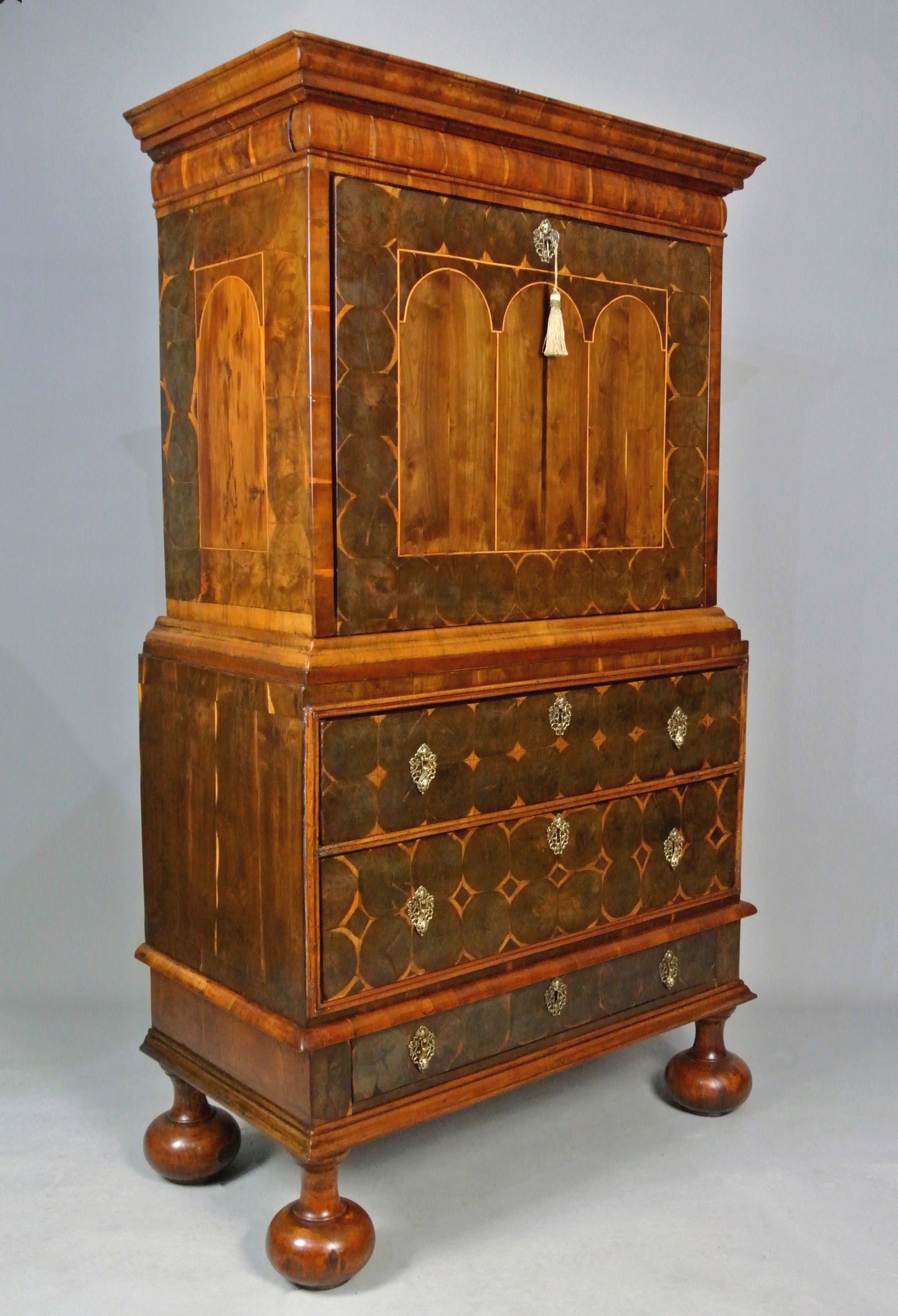
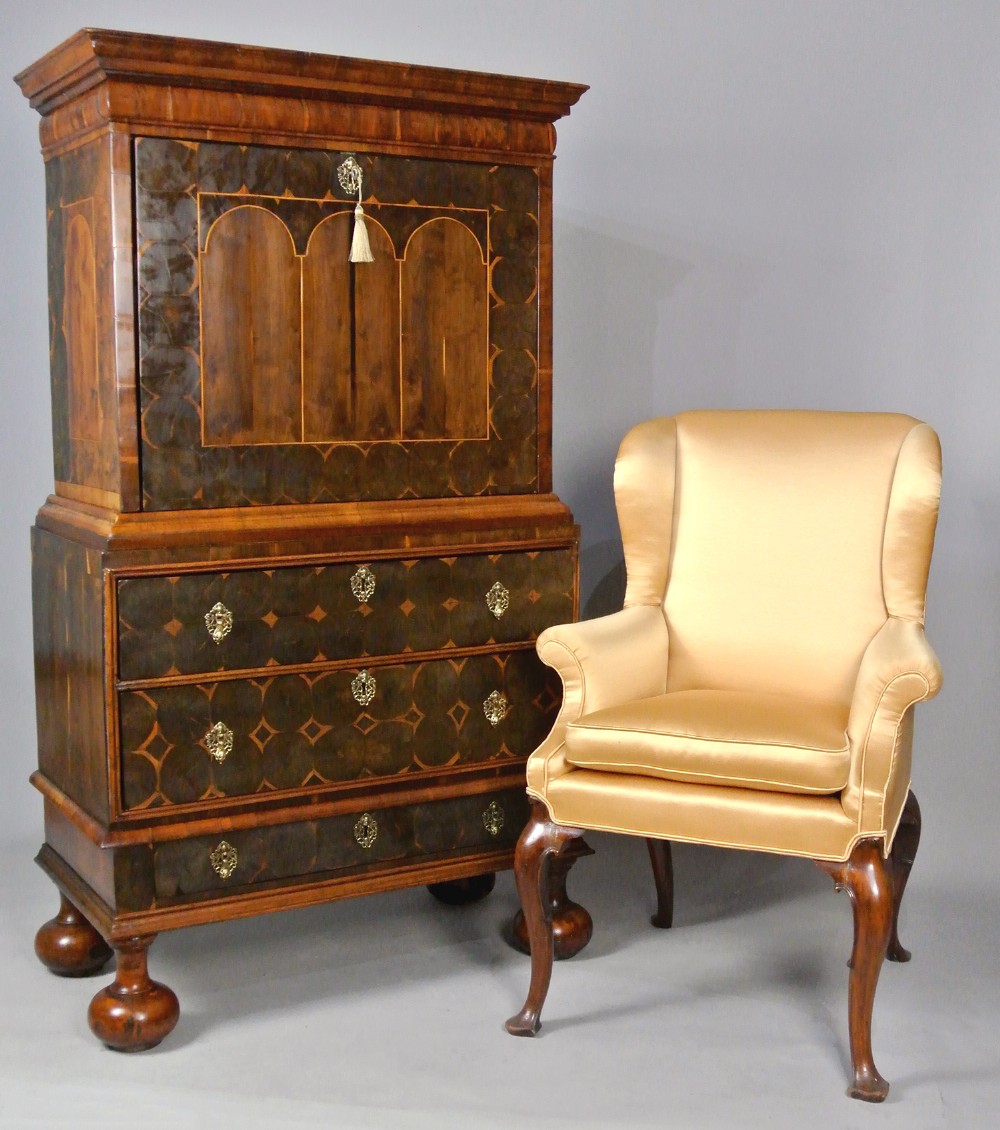
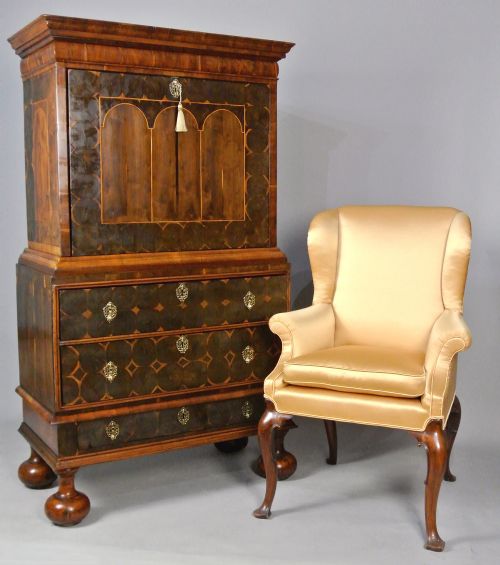
Small and beautifully proportioned it is extremely rare to find a piece of English furniture of this date that is so complete and original. The whole is dressed in oyster cut veneers of Cocus Wood – an expensive and exotic timber prized for its contrasting dark heartwood and prominent pale sapwood.
.

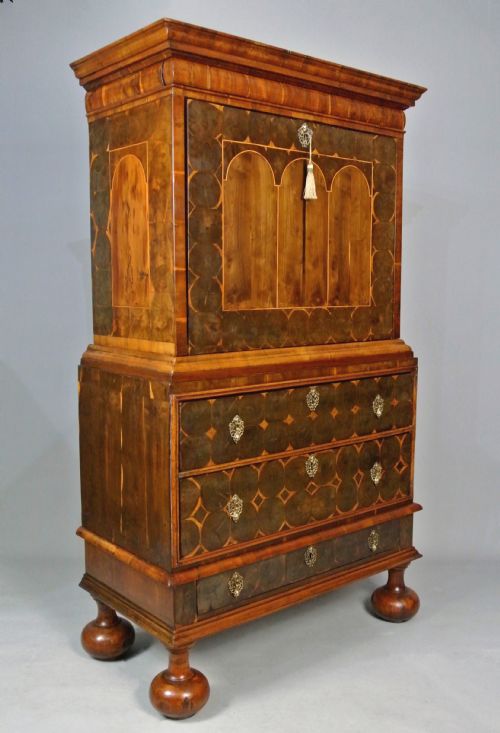
The outer face of the fall is beautifully inlaid with an architectural three bay window of matched figured walnut outlined with holly and this is centred with a band of ebony. The architectural window motif is repeated to both side panels.
.

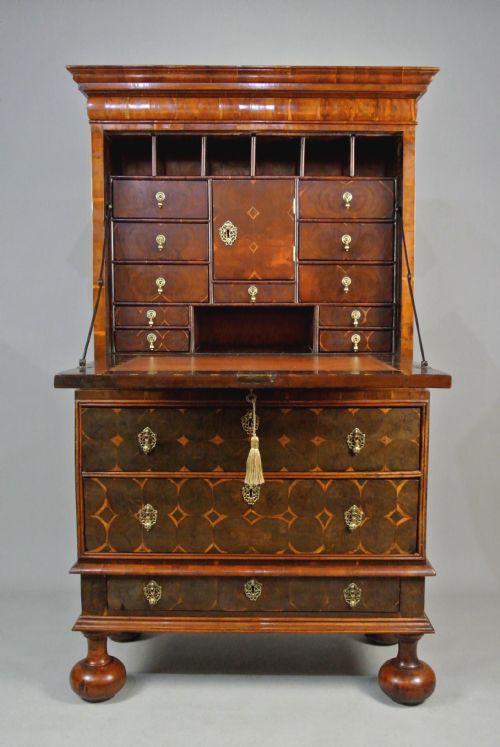
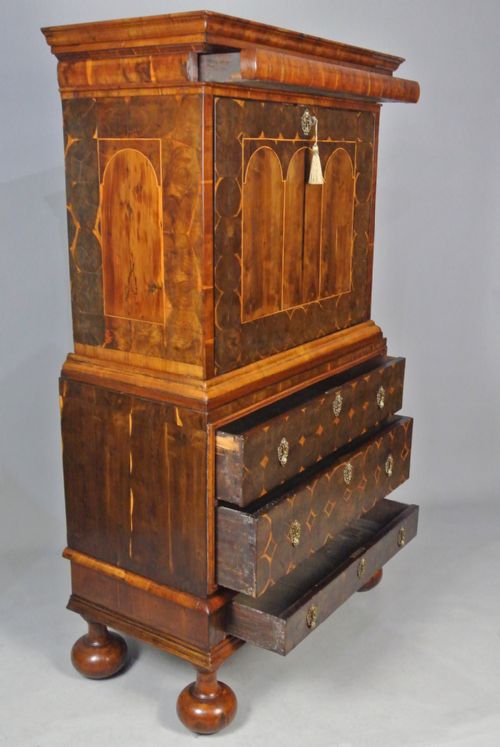
The slender upper curved secret drawer, double ogee cornice and double ogee waste mouldings are dressed with thickly cut and shaped cocus wood veneers, the wood cut with the grain to produce a stunning ribbon effect. The lower more simply shaped borders are original also and separate the principal drawers from lowest drawer giving symmetry and consistent width.
.

The original tall bun feet are constructed in shaped sections as is correct for the period and have old worm, chips, marks and significant wear to the bases as is expected over hundreds of years of use.
.

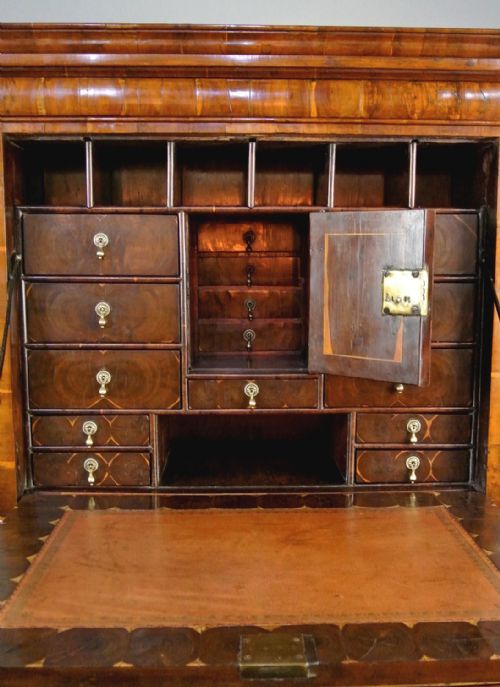
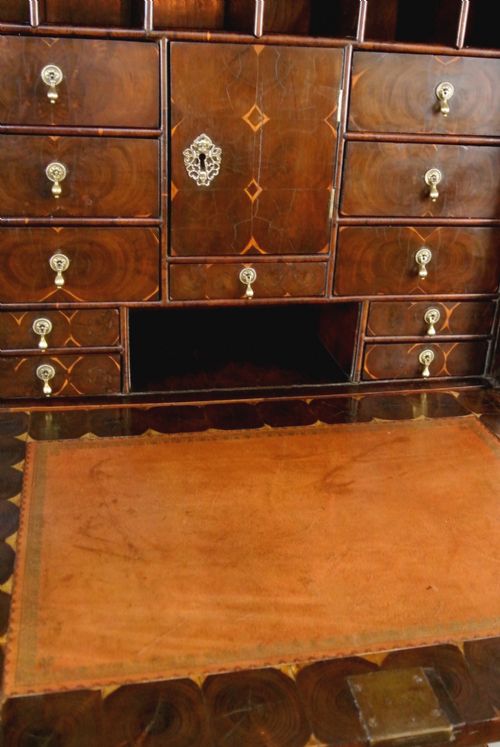
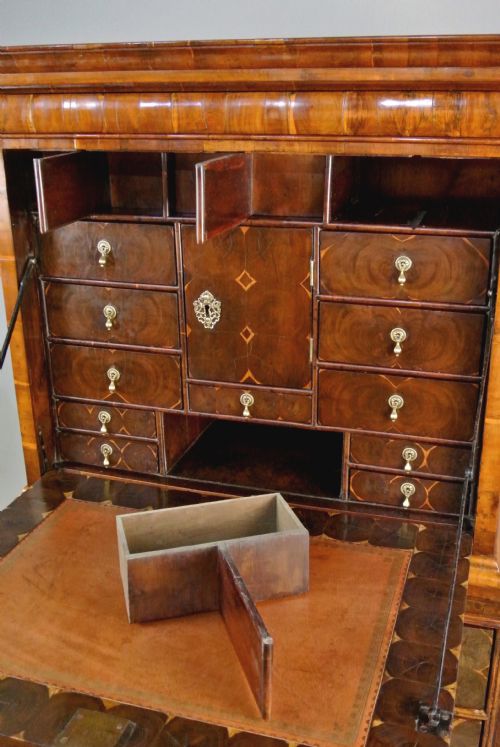
The interior finely crafted and with multiple secret drawers – each of the pigeon holes along the top pulls forward to reveal a secret double drawer. Again all drawers with wainscot oak linings. A small brass pen rest in a divided drawer on the lower left appears original also. The inner fall inset with a thickly cut leather skiver with gold tooling – attractively aged with some old marks and wear.
.

Minor marks, some old worm and small restorations. I believe a couple of the timbers at the back and in the very base of the rear carcase may be later replacements for once original wormed sections but these replacements are very old indeed, minimal and professionally done.
.

In the post restoration period from the 1660s the skill of English cabinet makers was unsurpassed and World renowned. And this must have been a very important piece of furntiure in its day, or certainly made for an important person. Cocus wood was imported from Jamaica in large quantities from the 1660s and was frequently used by English cabinet-makers of the period both in the solid and as veneers. The colour, cut and quality of the oysters on this scriptor are superb, each beautifully cut and matched so that there is a sense of flow and movement – it has great charm and character. After 1680 oyster veneers were more usually cut from Olive wood – a much cheaper wood for the cabinet makers to buy and which in the late 17th century was being imported in great quantities from the Mediterranean.
.

The principal graduated drawers retain their original full oak linings and open and close smoothly. All handles and escutcheons appear original also. Very fine hand cast and fettled pierced brass with small faces amongst the filigree.

.

Beautifully proportioned and demonstrating wonderful skills in the making, it is hard to believe that such a piece can be found outside of a museum. Fantastic colour, patination and of spectacular quality - and a truly superb early English scriptor.

.

The scriptor separates into two sections for transport.

.

.

Dimensions are:

.

65.75 inches high

38.5 inches wide

20 inches deep

.

The upper secret drawer has a height of 2 inches

The upper main drawer is 6 inches

The second 7.25 inches

The lowest inset drawer is 3.5 inches.

The feet are 8 inches tall

.

For metric please multiply by 2.5

Date of Manufacture

Webberley Antiques has dated this Cocus Wood Oyster Veneer Scriptor to the Before 1700 period.

Reference Numbers
Sellingantiques Reference
SA1148332
Dealers Notes

I describe and photograph my pieces accurately and with the aim that on arrival each will exceed your expectations.

I operate a full refund guarantee and am always happy to give free, honest and friendly advice.

Description
This extraordinary piece has come from a private vendor and it is remarkably original in all aspects. It dates from c. 1675
“
Small and beautifully proportioned it is extremely rare to find a piece of English furniture of this date that is so complete and original.
Webberley Antiques

The whole is dressed in oyster cut veneers of Cocus Wood – an expensive and exotic timber prized for its contrasting dark heartwood and prominent pale sapwood.

fig 1. A seventeenth-century English cocus wood oyster veneered scriptor featuring a fall-front writing compartment over three graduated drawers on bun feet.
fig 1. Important Cocus Wood Oyster Veneer English Scriptor C. 1675

The outer face of the fall is beautifully inlaid with an architectural three bay window of matched figured walnut outlined with holly and this is centred with a band of ebony. The architectural window motif is repeated to both side panels.

fig 2. A seventeenth-century English cocus wood oyster veneered scriptor featuring a fall-front writing compartment over three graduated drawers on bun feet.
fig 2. Important Cocus Wood Oyster Veneer English Scriptor C. 1675

The slender upper curved secret drawer, double ogee cornice and double ogee waste mouldings are dressed with thickly cut and shaped cocus wood veneers, the wood cut with the grain to produce a stunning ribbon effect. The lower more simply shaped borders are original also and separate the principal drawers from lowest drawer giving symmetry and consistent width.

fig 3. A seventeenth-century English cocus wood oyster veneered scriptor featuring a fall-front writing compartment over three graduated drawers on bun feet.
fig 3. Important Cocus Wood Oyster Veneer English Scriptor C. 1675

The original tall bun feet are constructed in shaped sections as is correct for the period and have old worm, chips, marks and significant wear to the bases as is expected over hundreds of years of use.

fig 4. A seventeenth-century English cocus wood oyster veneered scriptor featuring a fall-front writing compartment over three graduated drawers on bun feet.
fig 4. Important Cocus Wood Oyster Veneer English Scriptor C. 1675

The interior finely crafted and with multiple secret drawers – each of the pigeon holes along the top pulls forward to reveal a secret double drawer. Again all drawers with wainscot oak linings. A small brass pen rest in a divided drawer on the lower left appears original also. The inner fall inset with a thickly cut leather skiver with gold tooling – attractively aged with some old marks and wear.

fig 5. A seventeenth-century English cocus wood oyster veneered scriptor featuring a fall-front writing compartment over three graduated drawers on bun feet.
fig 5. Important Cocus Wood Oyster Veneer English Scriptor C. 1675

Minor marks, some old worm and small restorations. I believe a couple of the timbers at the back and in the very base of the rear carcase may be later replacements for once original wormed sections but these replacements are very old indeed, minimal and professionally done.

fig 6. A seventeenth-century English cocus wood oyster veneered scriptor featuring a fall-front writing compartment over three graduated drawers on bun feet.
fig 6. Important Cocus Wood Oyster Veneer English Scriptor C. 1675

In the post restoration period from the 1660s the skill of English cabinet makers was unsurpassed and World renowned. And this must have been a very important piece of furntiure in its day, or certainly made for an important person. Cocus wood was imported from Jamaica in large quantities from the 1660s and was frequently used by English cabinet-makers of the period both in the solid and as veneers. The colour, cut and quality of the oysters on this scriptor are superb, each beautifully cut and matched so that there is a sense of flow and movement – it has great charm and character. After 1680 oyster veneers were more usually cut from Olive wood – a much cheaper wood for the cabinet makers to buy and which in the late 17th century was being imported in great quantities from the Mediterranean.

fig 7. A seventeenth-century English cocus wood oyster veneered scriptor featuring a fall-front writing compartment over three graduated drawers on bun feet.
fig 7. Important Cocus Wood Oyster Veneer English Scriptor C. 1675

The principal graduated drawers retain their original full oak linings and open and close smoothly. All handles and escutcheons appear original also. Very fine hand cast and fettled pierced brass with small faces amongst the filigree.

fig 8. A seventeenth-century English cocus wood oyster veneered scriptor featuring a fall-front writing compartment over three graduated drawers on bun feet.
fig 8. Important Cocus Wood Oyster Veneer English Scriptor C. 1675

Beautifully proportioned and demonstrating wonderful skills in the making, it is hard to believe that such a piece can be found outside of a museum. Fantastic colour, patination and of spectacular quality - and a truly superb early English scriptor.

The scriptor separates into two sections for transport.

Dimensions are:

65.75 inches high

38.5 inches wide

20 inches deep

The upper secret drawer has a height of 2 inches

The upper main drawer is 6 inches

The second 7.25 inches

The lowest inset drawer is 3.5 inches.

The feet are 8 inches tall

For metric please multiply by 2.5

Date of Manufacture

Webberley Antiques has dated this Cocus Wood Oyster Veneer Scriptor to the Before 1700 period.

Reference Numbers
Sellingantiques Ref
SA1148332
Webberley Antiques
Webberley Antiques
Sellingantiques verified Since Nov 2008

Specialists in 18th century and earlier furniture for more than 45 years

Dealer Profile

You can view the stock and full dealer information on the Webberley Antiques Profile Page

PDF SHARE
SAVE
A seventeenth-century English cocus wood oyster veneered scriptor featuring a fall-front writing compartment over three graduated drawers on bun feet. SOLD6+ MONTHS AGO
1 / 9
Archive I A seventeenth-century English cocus wood oyster veneered scriptor featuring a fall-front writing compartment over three graduated drawers on bun feet. SOLD6+ MONTHS AGO

Important Cocus Wood Oyster Veneer English Scriptor C. 1675

Archive II A seventeenth-century English cocus wood oyster veneered scriptor featuring a fall-front writing compartment over three graduated drawers on bun feet. View II
Archive III A seventeenth-century English cocus wood oyster veneered scriptor featuring a fall-front writing compartment over three graduated drawers on bun feet. View III
Archive IV A seventeenth-century English cocus wood oyster veneered scriptor featuring a fall-front writing compartment over three graduated drawers on bun feet. View IV
Archive V A seventeenth-century English cocus wood oyster veneered scriptor featuring a fall-front writing compartment over three graduated drawers on bun feet. View V
Archive VI A seventeenth-century English cocus wood oyster veneered scriptor featuring a fall-front writing compartment over three graduated drawers on bun feet. View VI
Archive VII A seventeenth-century English cocus wood oyster veneered scriptor featuring a fall-front writing compartment over three graduated drawers on bun feet. View VII
Archive VIII A seventeenth-century English cocus wood oyster veneered scriptor featuring a fall-front writing compartment over three graduated drawers on bun feet. View VIII
Archive IX A seventeenth-century English cocus wood oyster veneered scriptor featuring a fall-front writing compartment over three graduated drawers on bun feet. View IX
Enlarged Archival View
Location
East Sussex
United Kingdom

By appointment only.
Verified Since Nov 2008
Items For Sale 84
Items Sold 431
Webberley Antiques
Webberley Antiques
Verified Since Nov 2008
View Dealer Info
Location: East Sussex, United Kingdom, , By appointment only.
Verified
Nov 2008
For Sale
84
Sold
431
A seventeenth-century English cocus wood oyster veneered scriptor featuring a fall-front writing compartment over three graduated drawers on bun feet.
Important Cocus Wood Oyster Veneer English Scriptor c. 1675
Ref: SA1148332
A seventeenth-century English cocus wood oyster veneered scriptor featuring a fall-front writing compartment over three graduated drawers on bun feet.
Detail View 1
Detail View 2
Detail View 3
Detail View 4
Detail View 5
Detail View 6
Detail View 7
Detail View 8
Archival Detail
Every single antique dealer on our platform is individually approved by our internal team. We verify their professional trade history, ethical standards, and photographic quality to ensure a secure, high-standard buying environment. Upon joining, every dealer agrees to a strict 9-point code of conduct. While issues can occasionally arise, our dealers typically resolve them swiftly and directly with the buyer. In fact, since our founding in 2002, Sellingantiques has only had to step in to help resolve an issue on roughly five occasions—a true testament to the quality of our dealers and their dedication to your happiness.
Our dealers are highly experienced in packing and shipping fragile, high-value antiques. Because you are in direct contact with the dealer, you will be able to easily go through all available shipping and insurance options together to ensure your item arrives safely.
Antiques are the ultimate green purchase. By choosing historical pieces over newly manufactured goods, you completely eliminate the carbon footprint of modern mass production while preserving exceptional, timeless craftsmanship.
Written by Sellingantiques from the dealer’s photographs and listing
  • ObjectDesks & Bureaus
  • Period17th century
  • StyleCarolean / Restoration
  • MaterialCocus Wood, Walnut, Oak
  • ColourDark Brown
  • MotifsOyster veneer geometric patterning, Fall-front writing flap, Graduated drawers, Turned bun feet

A scriptor is an early form of writing cabinet or bureau featuring a fall-front or sloping lid that opens to reveal a fitted interior with compartments and small drawers, popular during the late seventeenth century.

These pieces typically utilized native and exotic timbers such as oak, pine, walnut, and cocus wood, often featuring intricate oyster veneer cut from small branches to create circular geometric patterns.

Authentic pieces exhibit hand-cut cross-grain veneer slices showing natural growth rings, traditional hand-cut dovetailing in the internal drawers, and period-correct wrought iron or brass hardware.

Position the piece as a focal point in a study or living room against a neutral wall to highlight the complex wood grain, pairing it with minimalist lighting to balance the historical weight.

Maintain stable indoor humidity levels away from direct sunlight and heat sources, applying occasional microcrystalline wax to nourish the timber without damaging the delicate historic polish.
items
Add keywords to the filter
Price
£100
£250000
Era
Period
Style
Material
Origin
Stock Location
Recently Added
Online Payments
Categories