


A 2026 Guide by Sellingantiques
The cabriole leg arrived in Britain from continental Europe right at the start of the eighteenth century.
A staple of Georgian seating. Antique cabriole stools usually formed part of a larger suite of matching salon furniture.
Look for the shift from early Queen Anne forms to more elaborate mid-century Chippendale styles.
Upholstered seating was a luxury before the Victorian era, keeping these pieces strictly in the domain of wealthy households.
Thomas Chippendale produced numerous variations of these stools during the mid-eighteenth century, often detailing the leg carvings in his published designs.
Giles Grendey ran a large London workshop exporting furniture. He supplied well-documented matching suites containing cabriole stools to Spanish clients.
Regional joiners made countless unsigned versions. The vast majority of antique cabriole stools carry no maker stamp.
The 2026 retail price guide for Antique Cabriole Stools is drawn from a proprietary archive of over 1.1 million retail prices indexed by Sellingantiques since 2003. This guide relies exclusively on their own internal data; no external sources or auction records are used.
Analysing nearly 25 years of UK antique market history alongside current retail values, the data indicates that typical UK retail prices for Antique Cabriole Stools range between £400 and £1,500. Entry-level prices generally fall under £400 and premium examples upwards of £1,500.
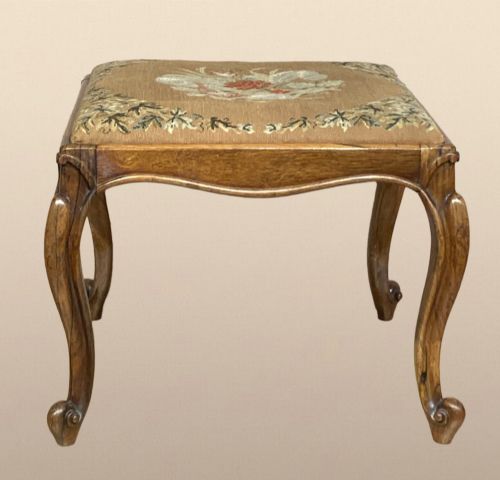
An S-shaped curve defines the leg. It sweeps outwards at the knee and tapers inwards towards the ankle.
Feet take several forms. Pad and club styles belong to the earlier period, while claw and ball designs emerge later.
Expect a drop-in seat or a fixed stuffed-over top. Both styles sit flush upon the seat rails.
Craftsmen shaped these sweeping legs from solid timber blocks. They relied on templates and hand saws rather than steam bending.
Mortise and tenon joints secure the legs to the rails. A tight fit here relies heavily on the maker precision.
Notice the carved details on the knees. Acanthus leaves and scallop shells required specialist carvers working after the main frame was assembled.
"The curving leg shape actually mimics the anatomy of an animal hind leg. It brings a sense of organic movement to stationary furniture."
"Turn a drop-in seat over. You sometimes find early webbing or horsehair stuffing preserved beneath the modern top cover."
"These were versatile pieces in a Georgian home. They doubled as fireside seats or occasional tables for displaying silver trays."
Based on almost 25 years of Sellingantiques UK antique market data, Antique Cabriole Stools appeared 738 times (out of 1,100,000 antiques) which gives it a rarity score of 86/100.
This score measures scarcity within the Sellingantiques archive only and is not a survey of the entire antiques market, so these statistics may not be indicative of the general availability of Antique Cabriole Stools elsewhere.
They bear the weight of an average adult without issue. The mortise and tenon joints combined with the angled leg stance create a solid load-bearing structure.
Listen for creaks when you sit. If the frame moves or twists under load, the glue blocks have likely failed and the joints need tightening by a restorer.
Antique cabriole stools usually started life as part of a larger suite. Eighteenth-century drawing rooms featured matching sets of armchairs, sofas and stools arranged formally against the walls.
Families divided these suites over the centuries through inheritance or sale. Finding a complete matching set today is uncommon, so single stools circulate widely as standalone pieces.
Traditional wool damask or silk brocade suits the period. These textiles sit well against dark mahogany frames.
Keep the profile crisp. Thick modern chenille looks bulky and ruins the line.
Both variations exist as original features. Heavy mahogany stools occasionally retain early leather-roller castors, allowing servants to push them across carpets with ease.
Many flat-footed antique cabriole stools lost a fraction of their height to wear. Look at the pad or claw foot to see if the bottom carving abruptly stops.
Some owners added brass castors later in the nineteenth century to raise the seating height.
Please note: This Antique Cabriole Stools guide and its associated pricing data are provided for general informational purposes only. It does not constitute formal financial, investment, or appraisal advice and should not be relied upon as the sole basis for any commercial activity, purchasing, or sales decisions. Sellingantiques.co.uk accepts no liability for any actions taken in reliance on this information. Always consult with a qualified professional or independent appraiser.
