
Antique Oak Desks
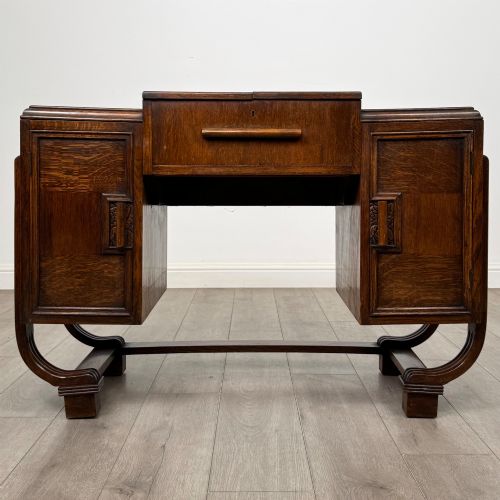
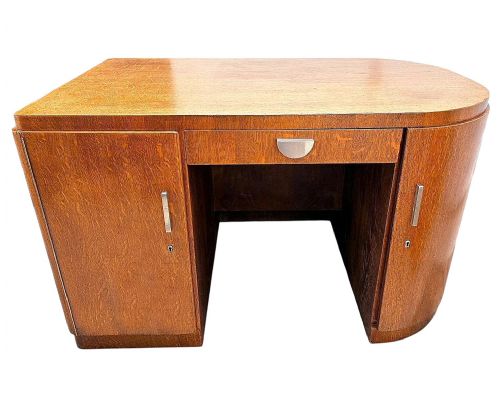
An oak desk with a flat writing top over drawers, made for the Victorian and Edwardian office, study and schoolroom.
What Are Oak Desks?
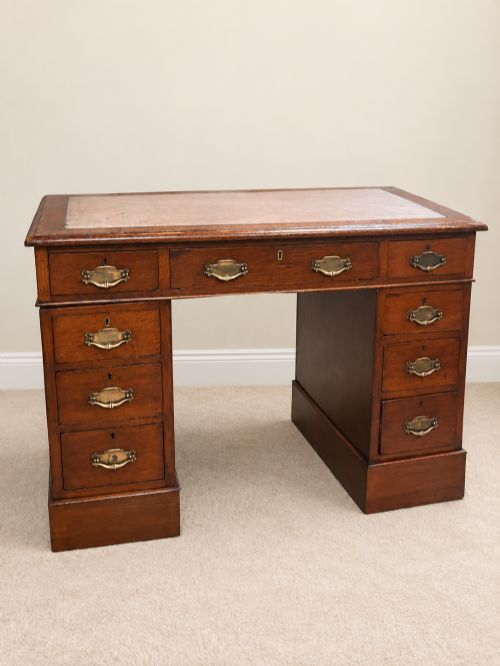
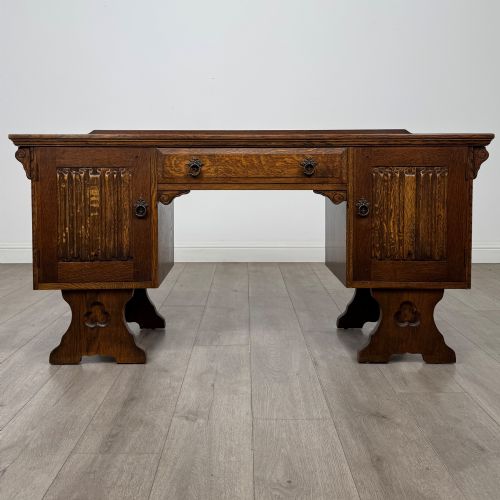
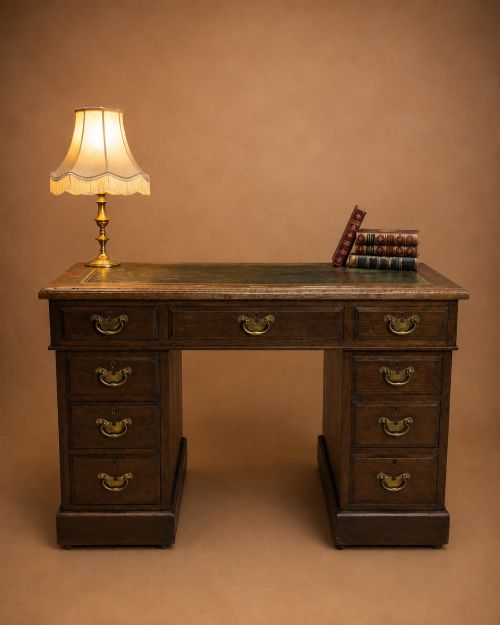
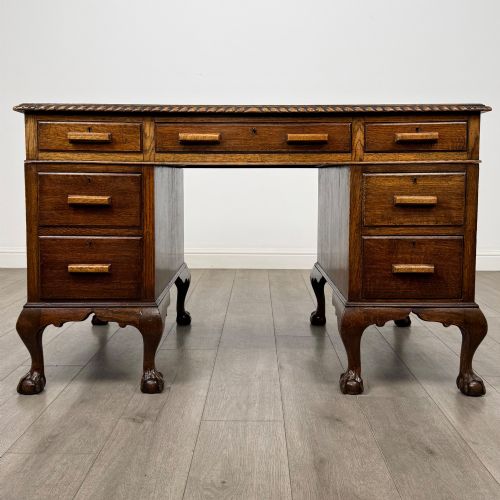
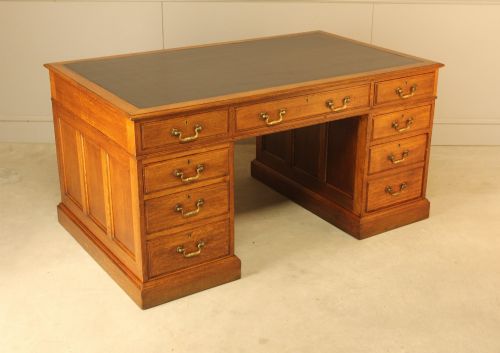
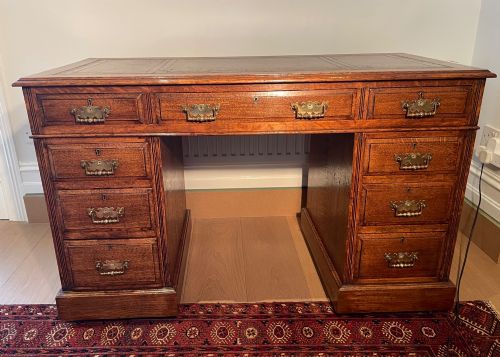
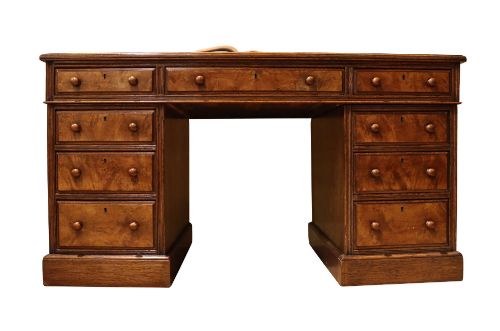
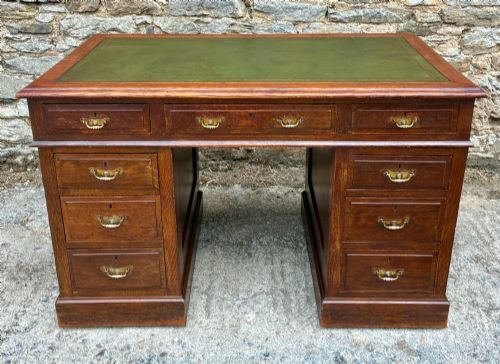
The pedestal desk dominates. A flat rectangular top carried on one or two banks of drawers, with a knee recess between them, and often three drawers to a side making nine in all. "Pedestal" appears in 529 of 1,339 titles on Sellingantiques, and kneehole in another 127. Oak was the working timber for office and institutional furniture, hard-wearing and cheaper than mahogany.
Roll-tops are the second shape, 191 titles, with a curved tambour shutter that slides down over the writing surface so papers could be locked away without clearing the desk. Cylinder tops, with a rigid quarter-round lid, turn up in smaller numbers. Partners desks, double-sided so two people can work facing each other, account for 126 titles.
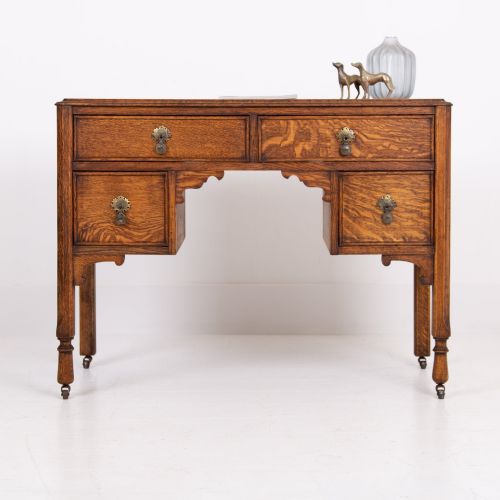
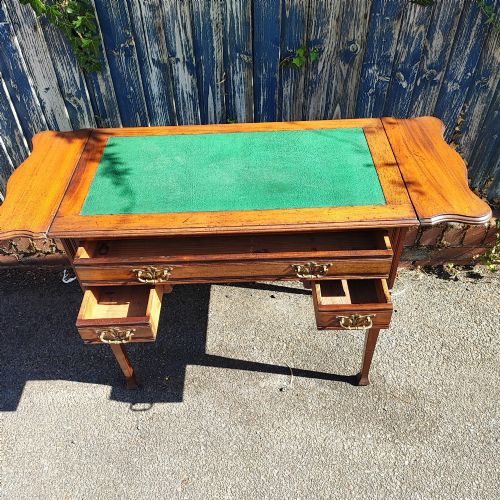
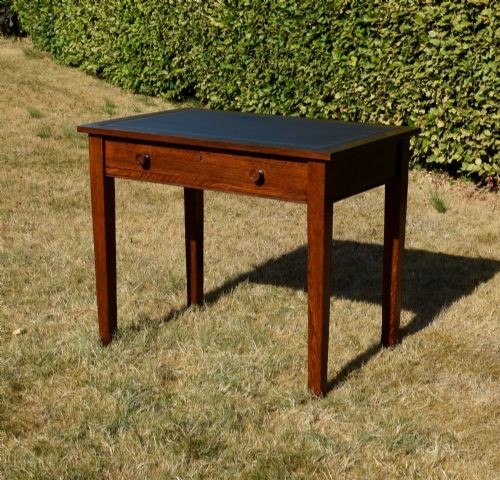
Beyond those, a steady minority of writing tables, davenports and library tables, and at the cheaper end iron-framed school desks, clerks' desks and children's desks. Most listings carry only a period and a form in the title, so the heading tells you shape, wood and roughly the decade.
The centre of gravity is c.1870-1930: Victorian is the largest bucket at 287 listings, then Edwardian at 164 and the 1920s at 143. Only 674 of the 1,339 listings give a clean year, and a bare "19th Century" covers 139 of them, committing to a hundred-year span. Georgian and earlier pieces appear in single figures.
Top And Bottom
Timber does more than form. Pollard oak (21 titles) and burr oak (26) together account for fewer than fifty listings, and they sit almost entirely at the top of the range: pollard oak partners and davenport desks, burr oak veneered pedestals, a burr oak Regency partners desk. Plainly described oak runs through the lower half regardless of shape.
After that, construction and scale. Partners desks are heavily represented above the midpoint, with sampled titles advertising eighteen and twenty-two drawers. "Large" appears in 121 titles and recurs through the upper entries, while "small" (62 titles) clusters low alongside the school and children's desks that fill the bottom.
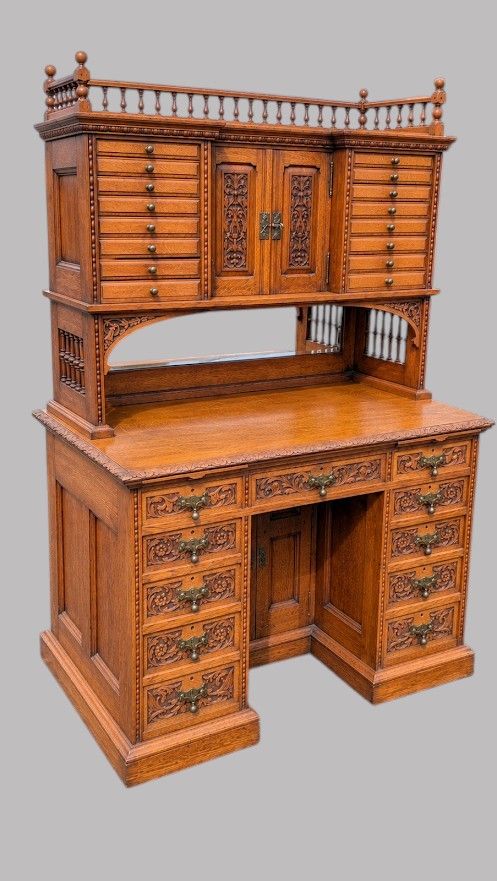
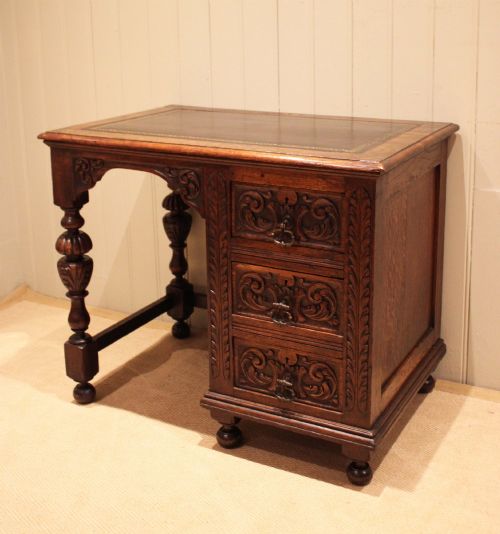
Carving lifts a desk modestly rather than transforming it. "Carved" is in 114 titles, with the Green Man face named in 39 and Gothic styling in 24, both recurring above the midpoint. A leather writing surface counts too: leather is in 54 titles, and the gilt-tooled and green tooled examples sit among the dearer entries. So does a firm's name, stamped or on a label.
Retail Price Guide 2026
Typical UK retail prices for oak desks, calculated from the Sellingantiques database of over a million retail prices indexed since 2003. This retail price guide relies exclusively on Sellingantiques data; no external sources or auction records are used, so the figures do not describe the wider market.
Maple & Co is the name that turns up from the most dealers on Sellingantiques, ahead of Edwards & Roberts.
Maple & Co·Edwards & Roberts·William Angus & Co
The Antique Oak Desks Glossary
- Pedestal
- One of the drawer banks that carries the top. A desk is described as single or twin pedestal depending on how many it has.
- Kneehole
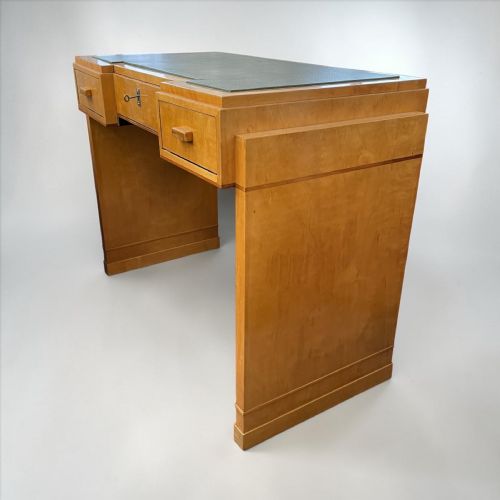
- The open recess between the pedestals where the sitter's legs go. Written both as one word and as 'knee hole' in titles.
- Partners desk
- Double-sided, with drawers or cupboards on both long sides so two people can work facing each other across it.
- Tambour
- The shutter of a roll-top, narrow slats glued to canvas so the whole thing flexes as it runs in its groove.
- Cylinder top
- A rigid quarter-round lid that swings down over the writing surface, rather than a flexible tambour that slides.
- Pollard oak
- Timber from a tree lopped repeatedly for poles, which gives a dense burry figure. Named in 21 titles, and burr oak in 26.
Frequently Asked Questions
What is the most common type of oak desk?
The pedestal desk, by a wide margin. It appears in 529 of 1,339 titles, usually a late Victorian or Edwardian piece with a bank of three drawers each side.
Roll-tops are second at 191 titles. Between them the two shapes account for over half the archive.
How many oak desks come up for sale?
Around 129 are listed on Sellingantiques in a year.
A total of 192 different dealers have handled one, which makes this a form almost every general furniture dealer carries at some point.
Why do so many listings just say 19th Century?
Half the archive is dated only by reign or by a loose phrase. Just 674 of the 1,339 listings commit to a clean year.
The bare "19th Century" bucket runs to 139 listings, and 86 titles contain "19th". That wording covers a hundred-year span and nothing narrower.
What does golden oak mean in a title?
It describes the warm honey-toned finish associated with late Victorian and Edwardian oak. The term appears in 84 titles.
It is a description of colour and period feel rather than a species or a cut of timber.
Are French or other foreign oak desks common?
No. French turns up in 35 titles, and 62 titles say simply "English".
Flemish, Scottish, Danish, Welsh and American each appear only once or twice across the whole sample.
What sits at the cheap end of the range?
Iron-framed school desks, children's desks and clerks' desks dominate the bottom. "Small" appears in 62 titles and clusters there.
The top end is a different animal: Regency and early 19th-century partners desks in burr and pollard oak.