
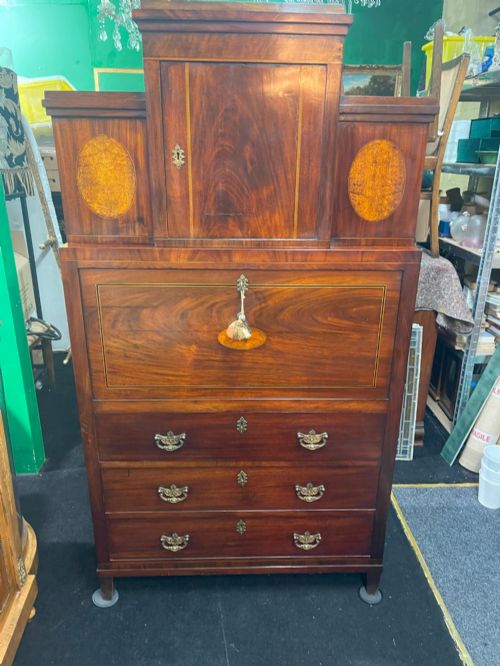
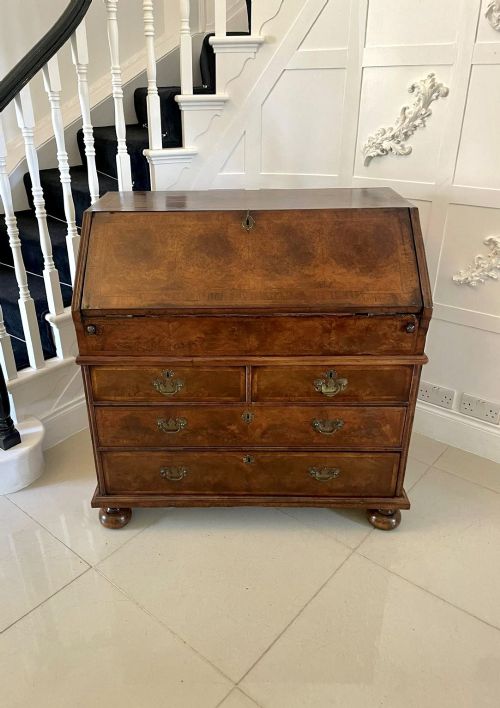
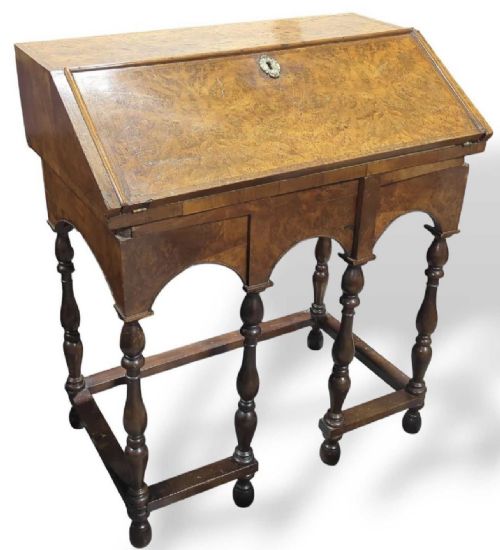
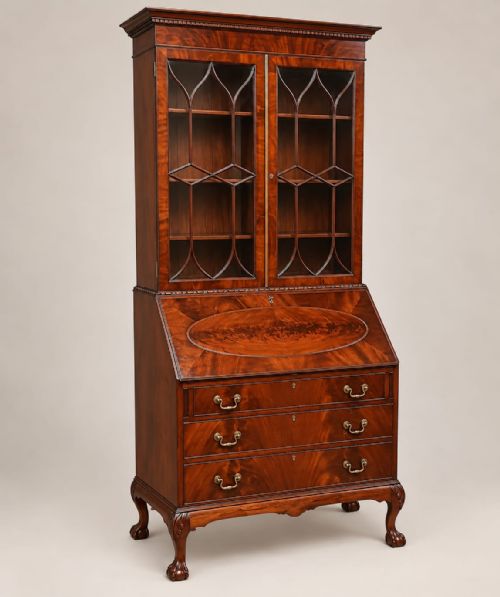
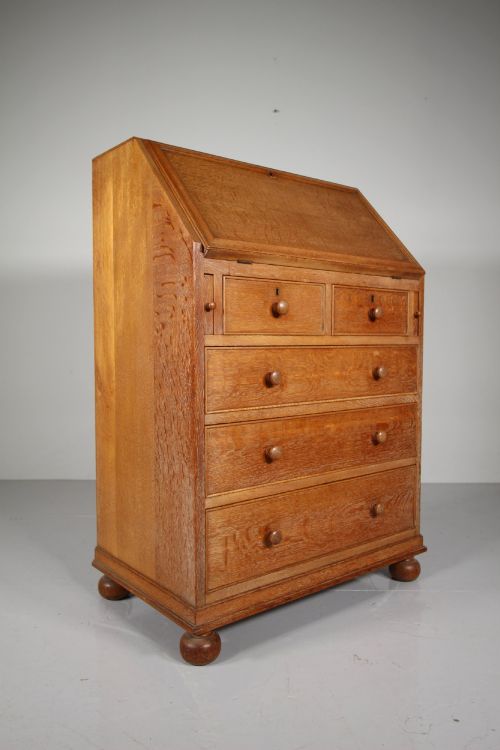
Antique Fall Front Bureau
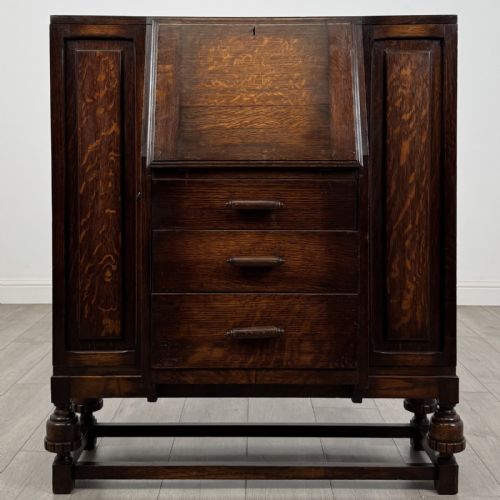
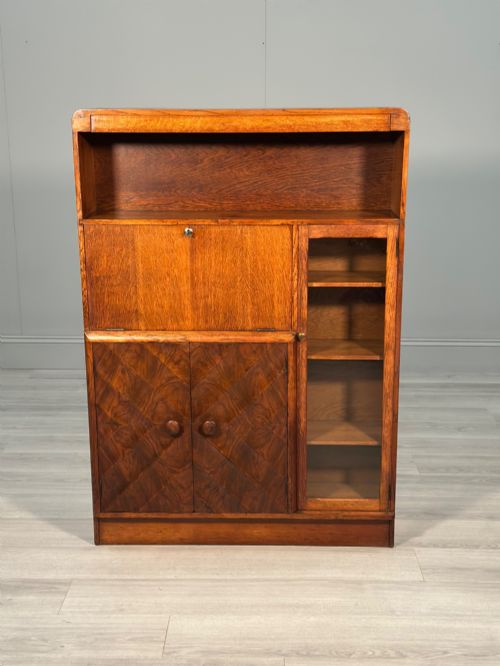
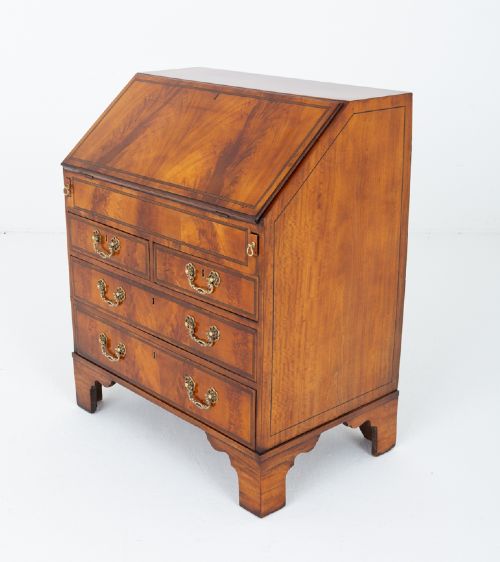
A case piece with a hinged fall that drops to make a writing surface, over drawers or a cupboard, with pigeonholes and small drawers behind it.
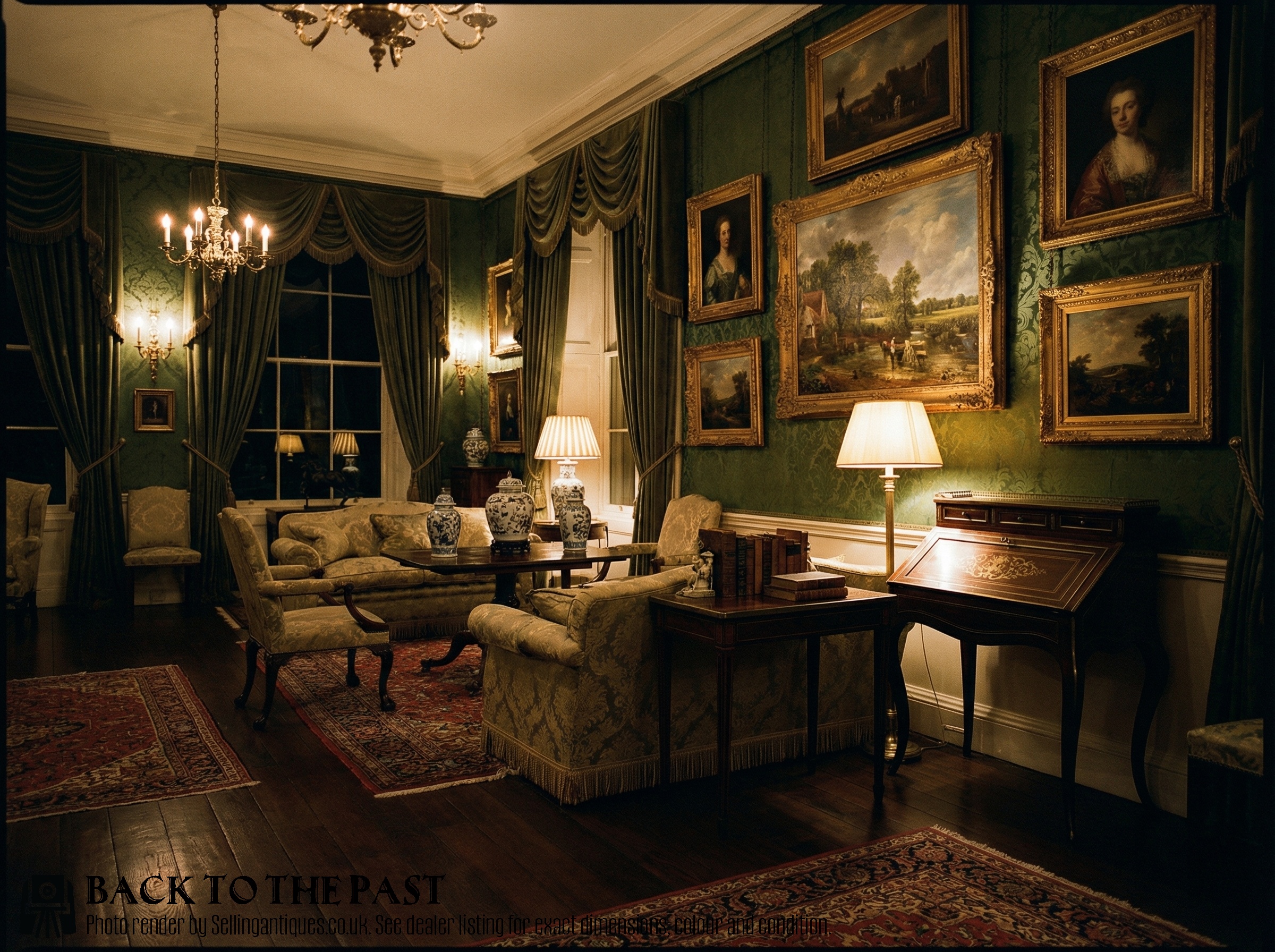
Antique Fall Front Bureau
The fall-front writing cabinet grew up in seventeenth-century Europe and became a standard domestic form in Britain from the late seventeenth century on. It gave a lockable writing surface with compartments for papers, sitting over storage drawers, and it stayed in production and revival right through to the early twentieth century.
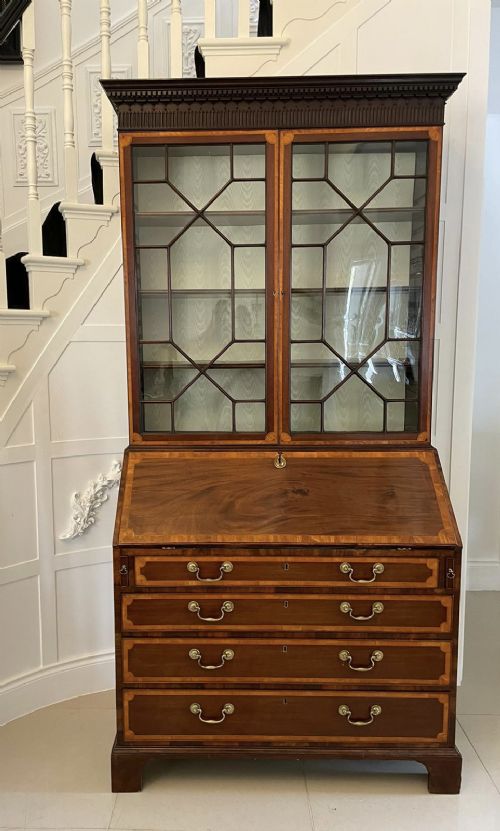
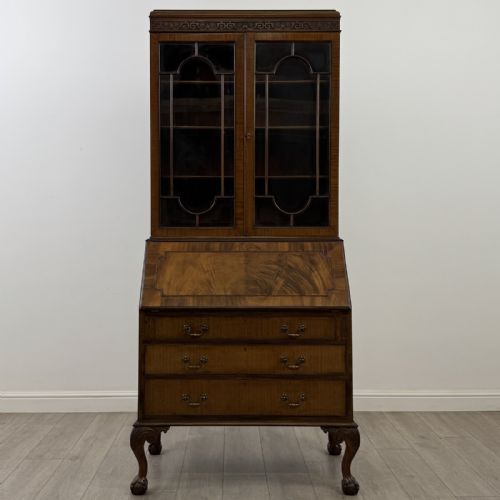
The form you are most likely to meet on Sellingantiques is the English sloping fall bureau on a chest of drawers, in mahogany, oak or walnut, Georgian or Georgian-styled. Mahogany appears in 138 titles and walnut in 126, with oak a distant third at 67. The commonest elaboration is the bureau bookcase: 'bookcase' turns up in 99 titles, so roughly one listing in five is a two-part piece with a glazed or panelled top.
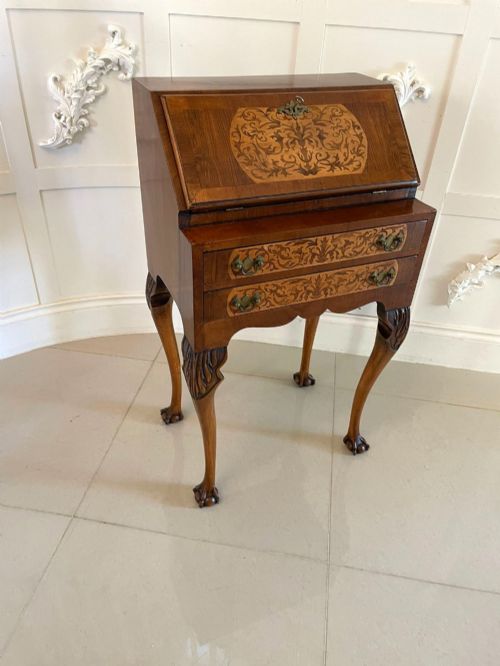
The heading also covers two other physically different things. Vertical-fall pieces are called secretaire (42 titles), escritoire (29) or, for the Continental upright form, secrétaire à abattant (16). Then there is the small ladies' bureau de dame, a distinct group, often French and often in rosewood or marquetry. Dutch, French, Swedish, Italian, Portuguese and Biedermeier examples all turn up.
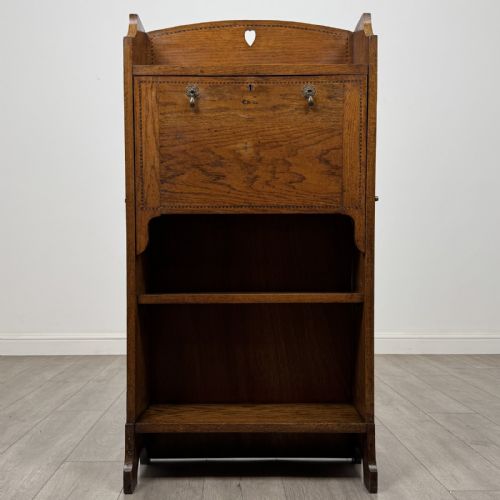
Dating runs from 1700 to 1930, with 141 listings carrying a clean year. Eighteenth-century and Georgian attributions form the largest block by a wide margin, while the 1920s, Edwardian and 1900s entries make a clear early-twentieth-century tail alongside Arts and Crafts and revival bureaux. Bear in mind that titles use period names as style words too, so 'Queen Anne style' or 'Jacobean style' is a look, not a date.
Where The Range Splits
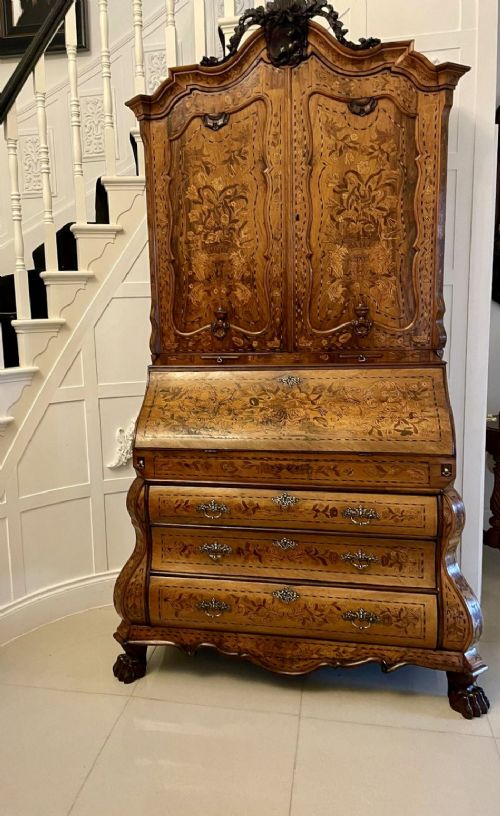
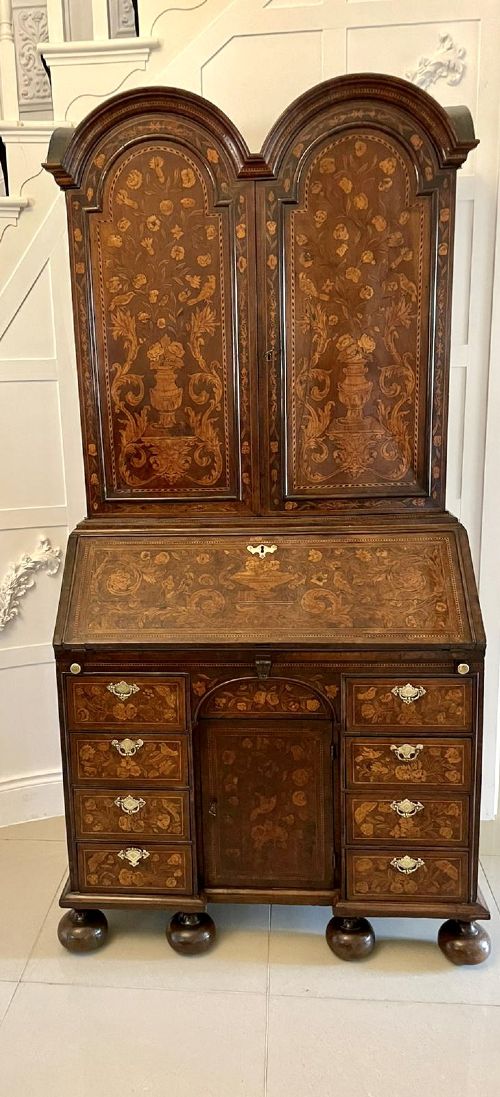
The top of the range is largely a bookcase question. Two-part pieces with cabinet or glazed tops dominate the upper end, and the double-dome walnut bookcase appears only right at the top. Below that sit the plain single-part bureaux on drawers, which is where the bulk of the category lives.
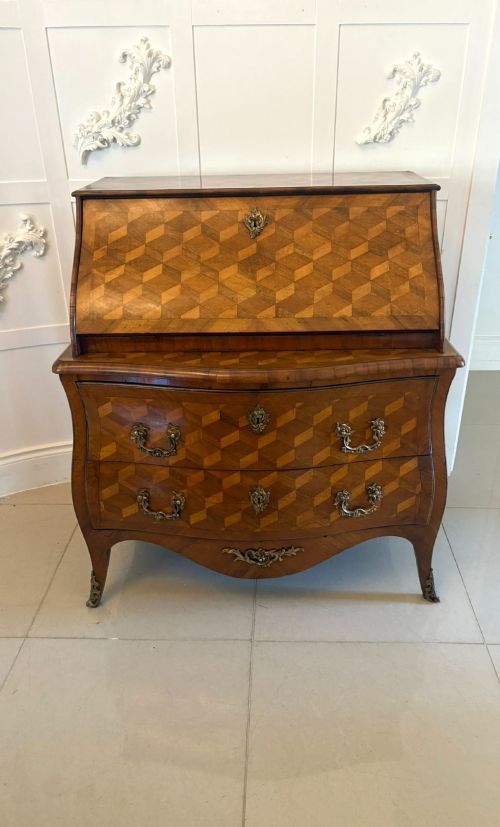
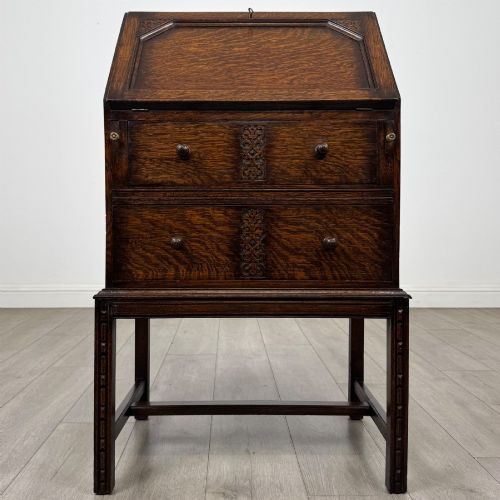
Timber and surface do most of the rest of the work. Burr and figured walnut cluster high, as does decorative inlay: 'inlaid' runs to 46 titles and 'marquetry' to 33, with Dutch floral marquetry examples well up the range. Plain oak bureaux of the 1920s sit at the bottom.
Early date pulls the same direction, with eighteenth-century and Georgian pieces at the upper end and Edwardian and 1920s work at the lower. Size cuts across all of it: 'small' appears in 27 titles, paired with words like neat, diminutive and petite at both ends of the range, so small proportions are prized whatever the piece.
Antique Fall Front Bureau Retail Price Guide 2026
Typical UK retail prices for fall front bureau, calculated from the Sellingantiques database of over a million retail prices indexed since 2003. This retail price guide relies exclusively on Sellingantiques data; no external sources or auction records are used, so the figures do not describe the wider market.
18th Century is the period label used most on Sellingantiques for fall front bureaux, with Georgian next and 19th Century third.
The Antique Fall Front Bureau Glossary
- Fall front
- The hinged flap, sloping or vertical, that drops down to form the writing surface.
- Fitted interior
- The pigeonholes and small drawers behind the fall, sometimes with a stepped centre section.
- Bureau bookcase
- A bureau with a glazed or panelled cabinet top, named in 99 titles.
- Secrétaire à abattant
- The Continental upright secretaire whose fall drops flat from the upper section; 16 titles carry 'abattant'.
- Crossbanded and feather banded
- Contrasting veneer borders run around drawer and fall edges, named in several titles.
- Bureau on stand
- The bureau body raised on legs rather than sitting on a chest of drawers.
Antique Fall Front Bureau: Frequently Asked Questions
What is the difference between a bureau and a secretaire?
In practice the words track the fall. Bureau usually describes the English sloping fall on a chest of drawers; secretaire tends to be used for vertical-fall chest forms, and appears in 42 titles.
The vocabulary is unsettled, though. The same basic object gets called a bureau, a secretaire, an escritoire (29 titles), an abattant (16) or a bureau de dame (12) depending on the dealer writing it up.
Which timbers are most common?
Two carry the category almost between them. Mahogany appears in 138 titles and walnut in 126, with oak third at 67 and rosewood well behind at 14.
Walnut turns up in its figured forms as well: 'burr' is in 24 titles and 'burr walnut' in 20. Mulberry wood surfaces only three times across the sample.
How old are most of these bureaux?
The dated field spans 1700 to 1930. Eighteenth-century and Georgian attributions together are the largest block by a wide margin, and a handful of samples are labelled 17th Century or even 'Before 1700'.
There is also a clear early-twentieth-century tail, with 1920s, Edwardian and 1900s entries, taking in Arts and Crafts and later revival work.
A period name in a title is not always a date. Queen Anne style, William and Mary style and Jacobean style are all used as style descriptions.
Are French and Dutch examples listed?
Yes. 'French' appears in 26 titles and 'Dutch' in 18, with Dutch marquetry named in 12. Continental pieces make up something between a tenth and a fifth of the category.
Samples also throw up Swedish, Italian, Portuguese, South German, Norwegian, Biedermeier and Venetian bureaux, most of those only once or twice.
What does bureau de dame mean?
It is a small lady's writing bureau, lighter in build and more decorated than the standard form. Twelve titles use the term, and another eight say 'ladies'.
These are frequently French, and rosewood or marquetry is a recurring note in the group.
Do unusual variants come up?
They do, roughly one apiece across the sample: a corner bureau, a table-top bureau, an apprentice miniature secretaire cabinet, a seventeenth-century vargueño on stand, a campaign military bureau in padouk and a bureau-form metamorphic drinks cabinet.
Around 48 fall-front bureaux are listed a year on Sellingantiques, and 151 different dealers have offered one, so the odd shapes surface steadily.