22,835  PAGES BROWSED TODAY PAGES TODAY • 35 ANTIQUES UPLOADED TODAYNEW ARRIVALS
GIFTS
35 ITEMS ADDED TODAY
Sort Order
Items Per Page
Browse Categories
Sort order
Relevant Links
Items per page
ID #SA1240619
FOR SALE
£1,570
Email Phone Buy
Save
Fine George I Burr Walnut Bureau with Wonderful Interior C. 1720
For sale by Webberley Antiques
for sale €1,837     $1,994
£1,570
Webberley Antiques

Webberley Antiques

Sellingantiques Verified Since Nov 2008
Browse dealers 84 items
  • About Us
    Specialists in 18th century and earlier furniture for more than 45 years
Id #SA1240619
PDF SHARE
SAVE

Fine George I Burr Walnut Bureau with Wonderful Interior C. 1720

18th century
Description

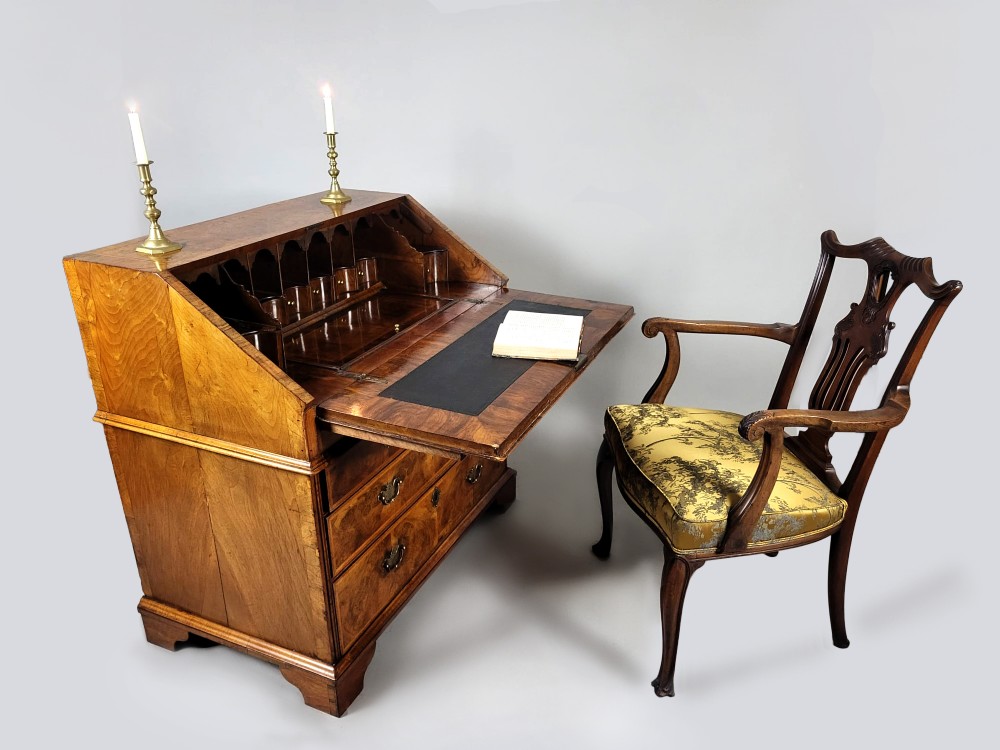
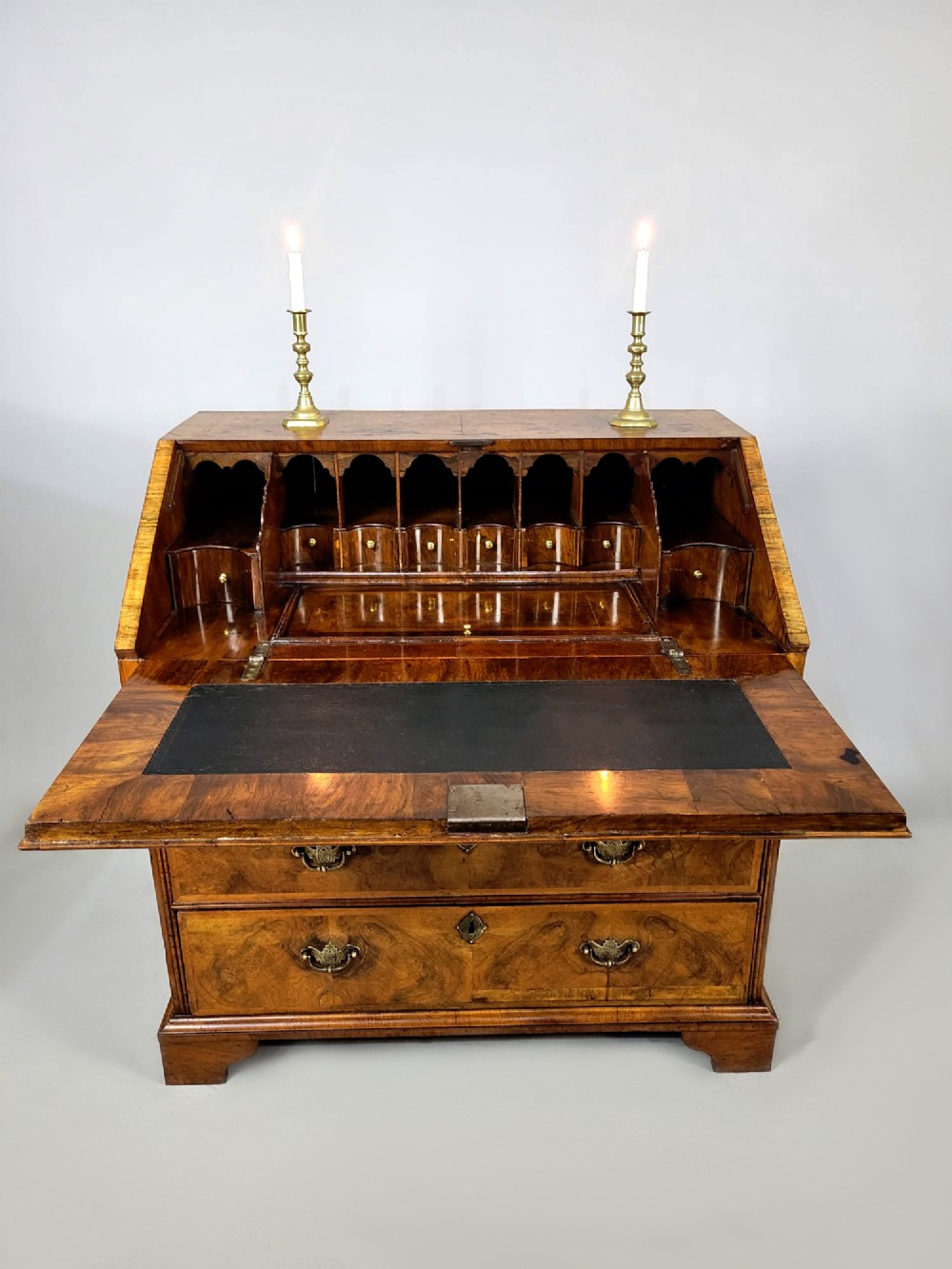
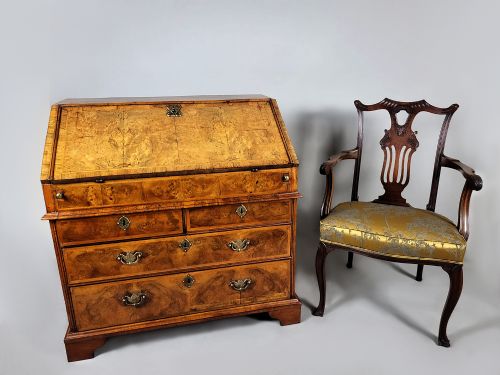
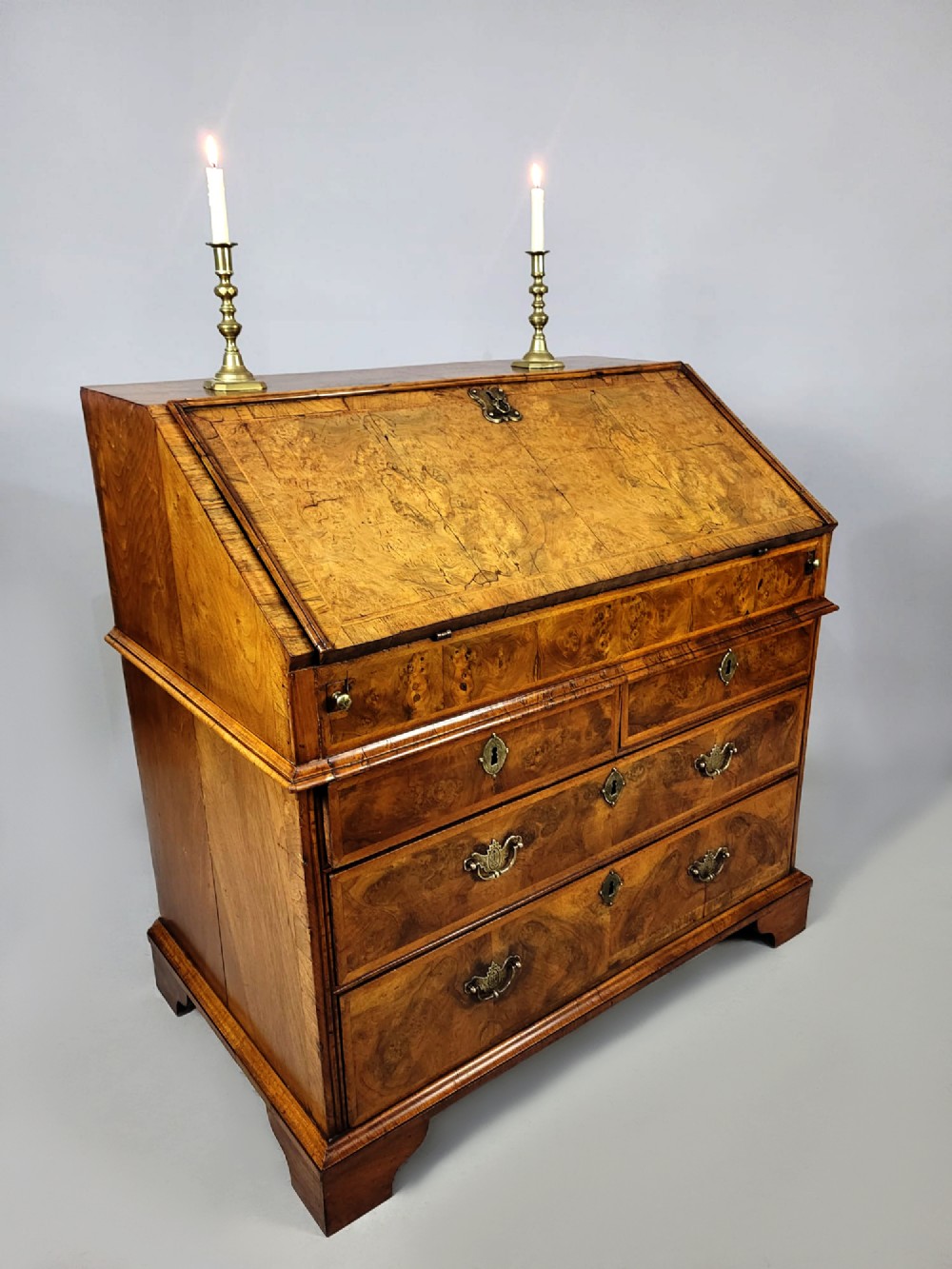
An early George I burr walnut bureau of lovely proportions and made by hand in around 1720.

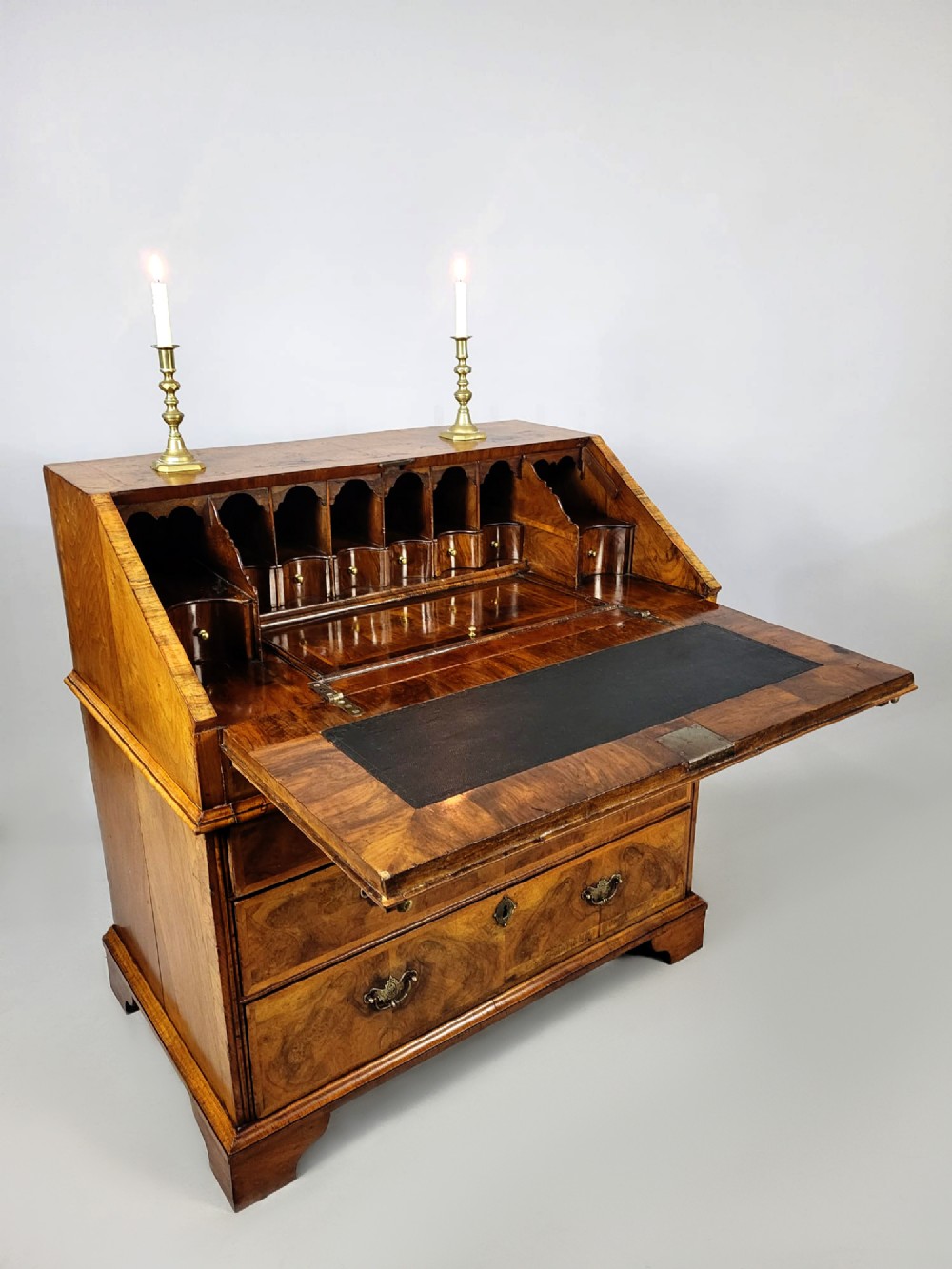
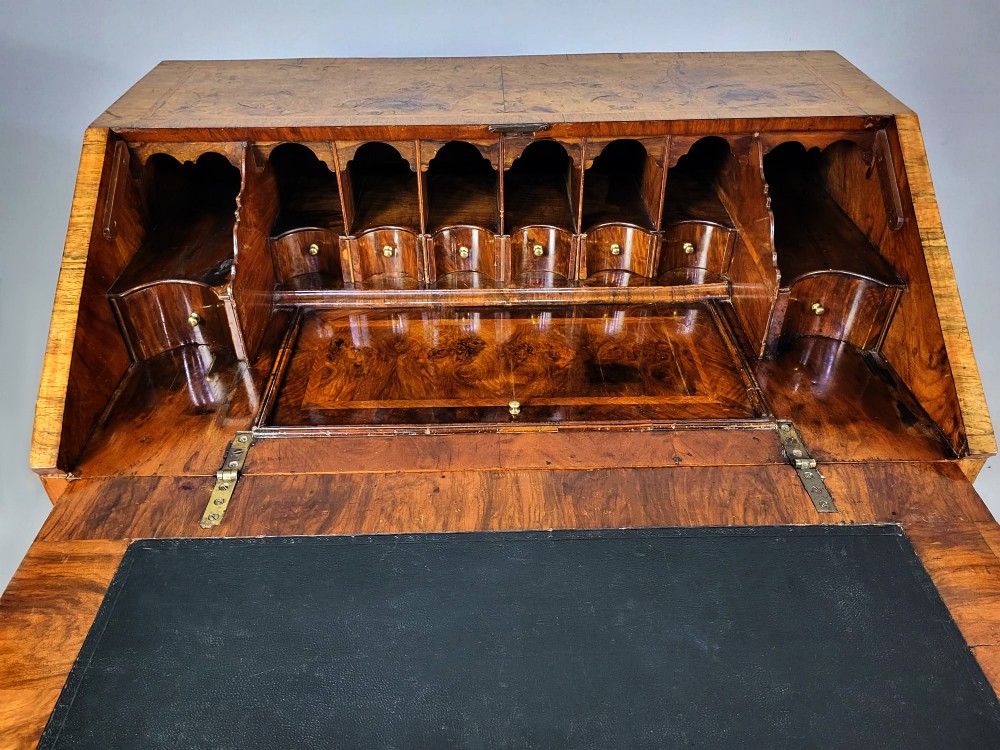
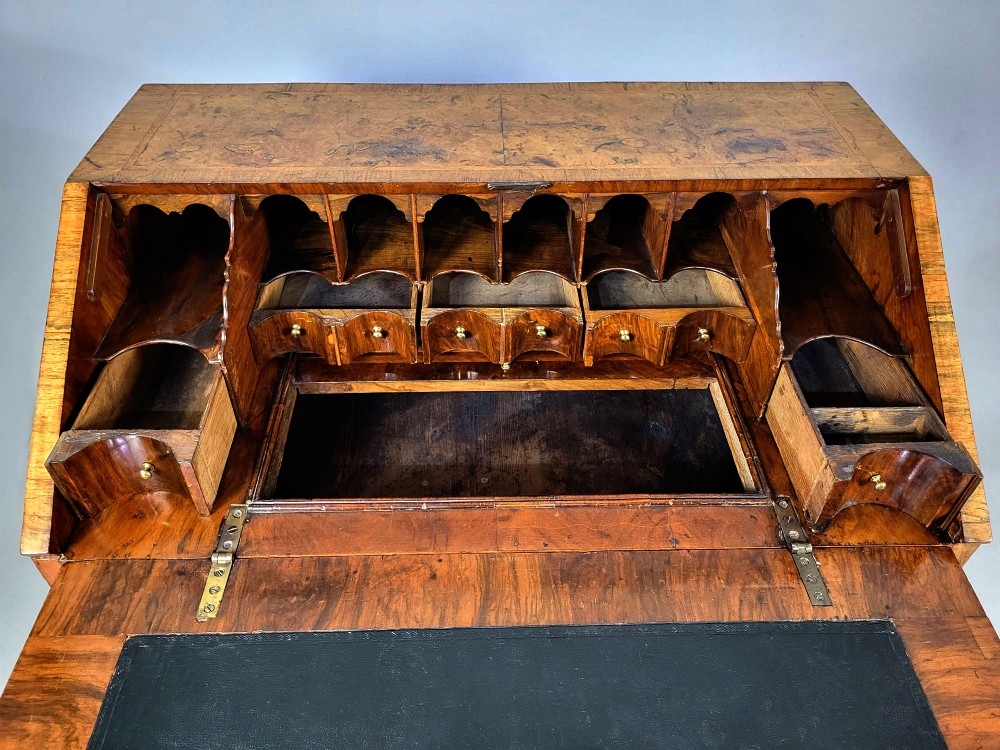
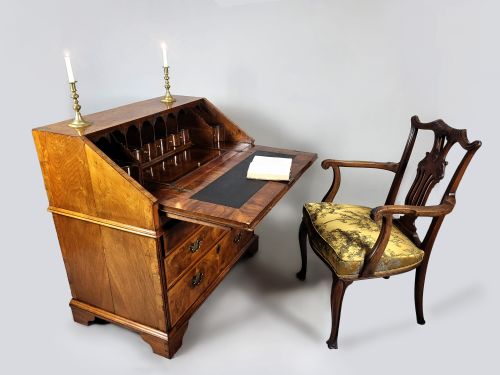
The interior is of particularly high quality. The serpentine shaped drawers with original brass button handles and original sliding well all dressed in superb thickly cut walnut veneers of exceptional colour and patina.
.

The inner drawers all with fine wainscot oak linings and tiny dovetails, retaining the original ink well compartment and with well shaped aprons over the pigeon holes.

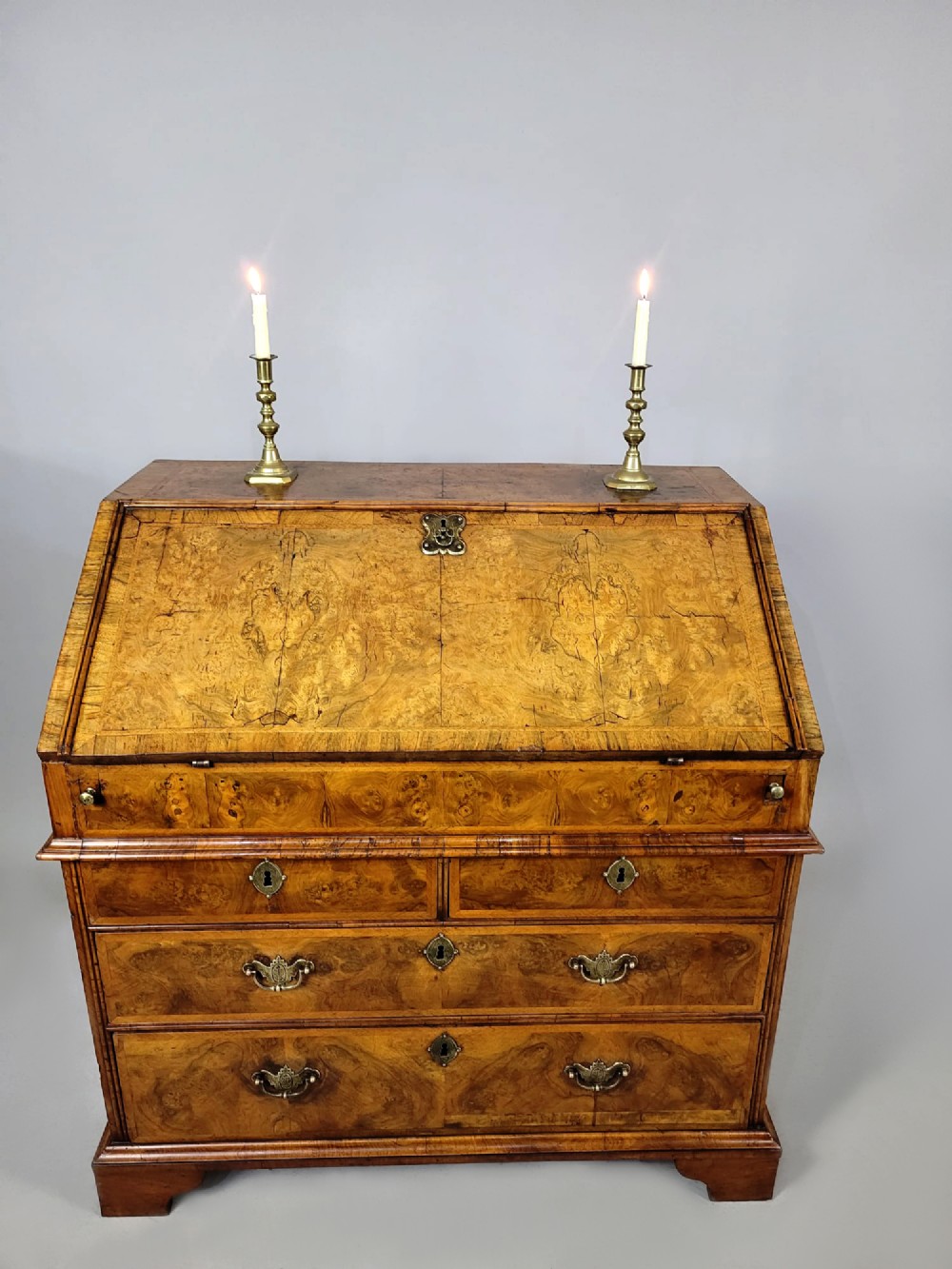
The two over two principal drawers again lined with wainscot oak and with lovely burr walnut veneers and featherbanding outlined with moulded double borders with ogee shaped waist moulding and superb colour throughout.
.

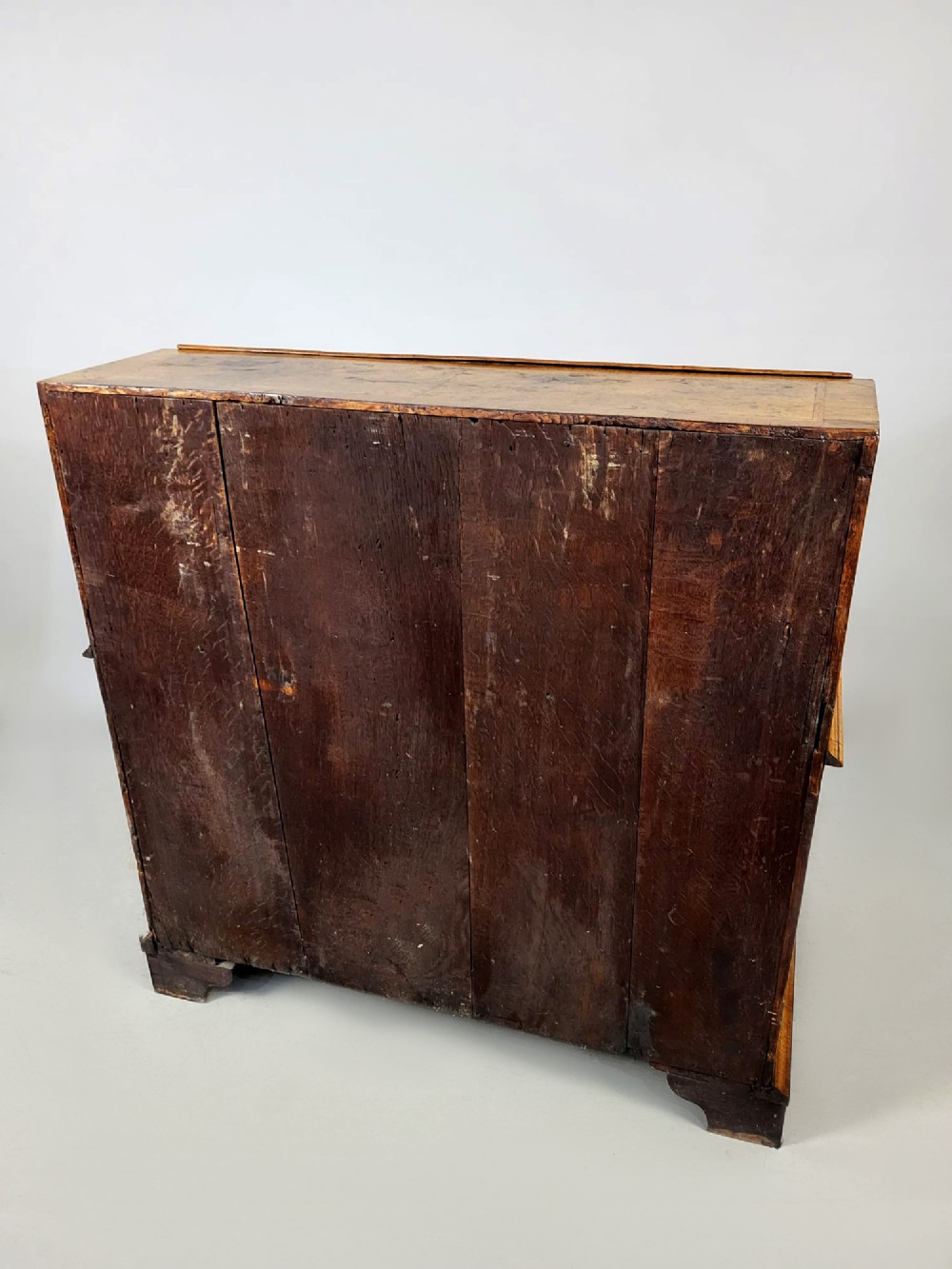
The drawers open and close smoothly and are very robust and solid with dovetailed joints and original timbers.

The handles on the lower drawers are later but are George I period.

.

The fall, which has a featherbanded border outlined with deep crossbanding, lowers smoothly on original and substantial brass hinges and rests level and firm on the slide out lopers.
With wireless technology, these early bureaux are remarkably functional in today’s world as they allow a lot of storage for laptops and printers all in a compact desk. And after work you can “leave the office” by closing the fall and look at a wonderful piece of early Georgian furniture made by skilled hands. Of such quality that it is still as practical and usable today as it was when made 300 years ago.
.

Strongly recommended, a very high quality piece of early Georgian walnut furniture.

.

.

Dimensions are:

.

37.5 inches high, 38 inches wide, 22.5 inches deep. From floor to the fall when lowered is 27.5 inches (providing ample room for chair and knees). The internal (usable) heigh of the drawers are top frieze drawers 3.5 inches, middle drawer 5 inches, lower drawer 7 inches.

Physical Dimensions
Height
93.8cm (36.93")
Width
95cm (37.40")
Depth
56.2cm (22.13")
Declaration

Webberley Antiques has dated this George I Burr Walnut Bureau to the 18th Century.

Reference Numbers
Sellingantiques Reference
SA1240619
Dealers Notes

I describe and photograph my pieces accurately and with the aim that on arrival each will exceed your expectations.

I operate a full refund guarantee and am always happy to give free, honest and friendly advice.

Description
An early George I burr walnut bureau of lovely proportions and made by hand in around 1720.

The interior is of particularly high quality.

“
The serpentine shaped drawers with original brass button handles and original sliding well all dressed in superb thickly cut walnut veneers of exceptional colour and patina.
Webberley Antiques
fig 1. An early 18th-century George I burr walnut bureau featuring a slant-front lid over graduating drawers with brass handles and bracket feet.
fig 1. Fine George I Burr Walnut Bureau with Wonderful Interior C. 1720

The inner drawers all with fine wainscot oak linings and tiny dovetails, retaining the original ink well compartment and with well shaped aprons over the pigeon holes.

The two over two principal drawers again lined with wainscot oak and with lovely burr walnut veneers and featherbanding outlined with moulded double borders with ogee shaped waist moulding and superb colour throughout.

fig 2. An early 18th-century George I burr walnut bureau featuring a slant-front lid over graduating drawers with brass handles and bracket feet.
fig 2. Fine George I Burr Walnut Bureau with Wonderful Interior C. 1720

The drawers open and close smoothly and are very robust and solid with dovetailed joints and original timbers.

The handles on the lower drawers are later but are George I period.

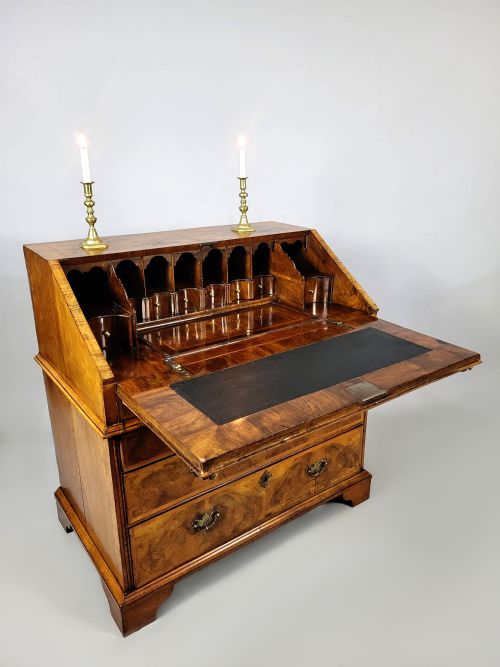
The fall, which has a featherbanded border outlined with deep crossbanding, lowers smoothly on original and substantial brass hinges and rests level and firm on the slide out lopers.

fig 3. An early 18th-century George I burr walnut bureau featuring a slant-front lid over graduating drawers with brass handles and bracket feet.
fig 3. Fine George I Burr Walnut Bureau with Wonderful Interior C. 1720

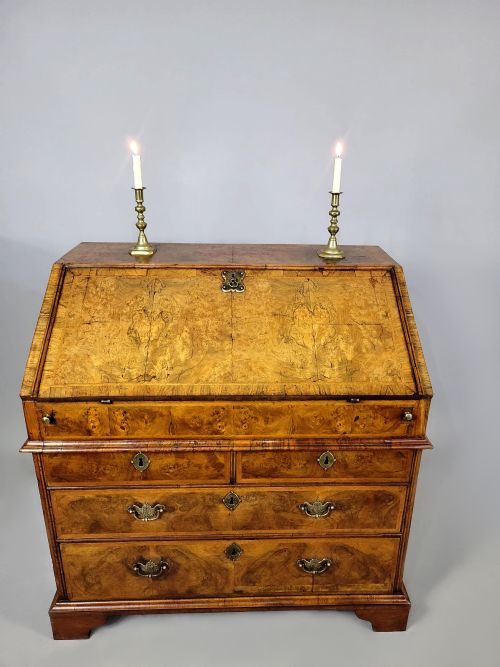
With wireless technology, these early bureaux are remarkably functional in today’s world as they allow a lot of storage for laptops and printers all in a compact desk. And after work you can “leave the office” by closing the fall and look at a wonderful piece of early Georgian furniture made by skilled hands. Of such quality that it is still as practical and usable today as it was when made 300 years ago.

fig 4. An early 18th-century George I burr walnut bureau featuring a slant-front lid over graduating drawers with brass handles and bracket feet.
fig 4. Fine George I Burr Walnut Bureau with Wonderful Interior C. 1720

Strongly recommended, a very high quality piece of early Georgian walnut furniture.

Dimensions are:

37.5 inches high, 38 inches wide, 22.5 inches deep. From floor to the fall when lowered is 27.5 inches (providing ample room for chair and knees). The internal (usable) heigh of the drawers are top frieze drawers 3.5 inches, middle drawer 5 inches, lower drawer 7 inches.

Height
93.8cm (36.93")
Width
95cm (37.40")
Depth
56.2cm (22.13")
Date of Manufacture

Webberley Antiques has dated this George I Burr Walnut Bureau to the 18th Century.

Reference Numbers
Sellingantiques Ref
SA1240619
Webberley Antiques
Webberley Antiques
Sellingantiques verified Since Nov 2008

Specialists in 18th century and earlier furniture for more than 45 years

Dealer Profile

You can view the stock and full dealer information on the Webberley Antiques Profile Page
PDF SHARE
SAVE
An early 18th-century George I burr walnut bureau featuring a slant-front lid over graduating drawers with brass handles and bracket feet.
1 / 9
Archive I An early 18th-century George I burr walnut bureau featuring a slant-front lid over graduating drawers with brass handles and bracket feet.

Fine George I Burr Walnut Bureau with Wonderful Interior C. 1720
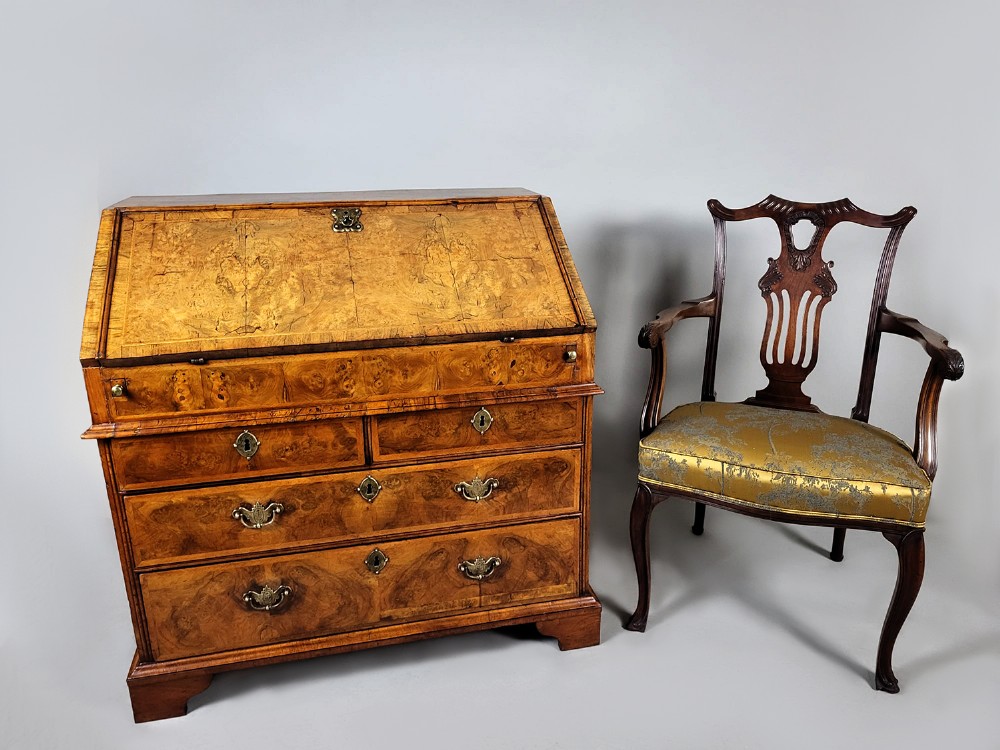
Archive II An early 18th-century George I burr walnut bureau featuring a slant-front lid over graduating drawers with brass handles and bracket feet. View II
Archive III An early 18th-century George I burr walnut bureau featuring a slant-front lid over graduating drawers with brass handles and bracket feet. View III
Archive IV An early 18th-century George I burr walnut bureau featuring a slant-front lid over graduating drawers with brass handles and bracket feet. View IV
Archive V An early 18th-century George I burr walnut bureau featuring a slant-front lid over graduating drawers with brass handles and bracket feet. View V
Archive VI An early 18th-century George I burr walnut bureau featuring a slant-front lid over graduating drawers with brass handles and bracket feet. View VI
Archive VII An early 18th-century George I burr walnut bureau featuring a slant-front lid over graduating drawers with brass handles and bracket feet. View VII
Archive VIII An early 18th-century George I burr walnut bureau featuring a slant-front lid over graduating drawers with brass handles and bracket feet. View VIII
Archive IX An early 18th-century George I burr walnut bureau featuring a slant-front lid over graduating drawers with brass handles and bracket feet. View IX
Enlarged Archival View
Location
East Sussex
United Kingdom

By appointment only.
Verified Since Nov 2008
Items For Sale 84
Items Sold 428
Webberley Antiques
Webberley Antiques
Verified Since Nov 2008
View Dealer Info
Location: East Sussex, United Kingdom, , By appointment only.
Verified
Nov 2008
For Sale
84
Sold
428
An early 18th-century George I burr walnut bureau featuring a slant-front lid over graduating drawers with brass handles and bracket feet.
Fine George I Burr Walnut Bureau with Wonderful Interior c. 1720
Ref: SA1240619
An early 18th-century George I burr walnut bureau featuring a slant-front lid over graduating drawers with brass handles and bracket feet.
Detail View 2
Detail View 3
Detail View 4
Detail View 5
Detail View 6
Detail View 7
Detail View 8
Detail View 9
Archival Detail
Every single antique dealer on our platform is individually approved by our internal team. We verify their professional trade history, ethical standards, and photographic quality to ensure a secure, high-standard buying environment. Upon joining, every dealer agrees to a strict 9-point code of conduct. While issues can occasionally arise, our dealers typically resolve them swiftly and directly with the buyer. In fact, since our founding in 2002, Sellingantiques has only had to step in to help resolve an issue on roughly five occasions—a true testament to the quality of our dealers and their dedication to your happiness.
Our dealers are highly experienced in packing and shipping fragile, high-value antiques. Because you are in direct contact with the dealer, you will be able to easily go through all available shipping and insurance options together to ensure your item arrives safely.
Antiques are the ultimate green purchase. By choosing historical pieces over newly manufactured goods, you completely eliminate the carbon footprint of modern mass production while preserving exceptional, timeless craftsmanship.
Written by Sellingantiques from the dealer’s photographs and listing
  • ObjectBureaux & Writing Desks
  • Period18th century
  • StyleGeorge I
  • MaterialBurr Walnut, Brass, Oak
  • ColourWarm Brown
  • MotifsFall-front lid, burr walnut veneer, brass escutcheons, bracket feet
  • SizeH 93.8 cm (37 in) x W 95 cm (37 in) x D 56.2 cm (22 in)

This George I bureau is an 18th-century writing desk executed in warm brown burr walnut with oak linings and brass hardware, presenting a slant-front fall-front lid over graduating drawers on bracket feet. The visible construction incorporates moulded double borders with an ogee-shaped waist moulding, brass escutcheons, and later George I drop handles on the lower drawers. The piece measures 93.8 cm high, 95 cm wide, and 56.2 cm deep. Suitable for a gentleman's library or study, this desk provides practical storage for laptops and printers while retaining period character. The interior contains a sliding well, an ink well compartment, shaped aprons over pigeon holes, and serpentine drawers featuring thickly cut veneers with featherbanding and crossbanding. The fall-front lid lowers on substantial brass hinges onto slide-out lopers to form a level writing surface, allowing the desk to function as a compact workspace that conceals work equipment when closed.

Originating during the reign of King George I (17141727), burr walnut bureaux marked a high point in English cabinet-making. These writing cabinets featured sloping fall-front tops above graduating drawers, utilizing highly figured burr walnut veneers cut from tree growths to create striking natural geometric patterns.

Early 18th-century bureaux were predominantly constructed with pine or oak carcases covered in thin burr walnut veneers. Craftsmen employed hand-cut dovetail joints, feather-banding or herringbone inlays, and cast brass drop handles with decorative escutcheons.

Authentic period pieces feature hand-sawn drawer linings, hand-cut dovetails, original bracket feet, and lopers (pull-out wooden supports for the desk lid). Look for period-appropriate wear, hand-cast brass hardware with natural oxidisation, and original oak or pine secondary woods inside the drawers.

An antique bureau functions effectively as a compact home workstation or statement hallway feature. Its warm wood tones contrast well against minimalist walls, dark paint palettes, or contemporary art, offering both functional storage and structural presence.

Keep the wood away from direct sunlight, radiators, and extreme humidity changes to prevent veneer lifting or fading. Clean surfaces gently with a soft microfibre cloth and apply a high-grade beeswax polish once or twice a year to preserve the patina.
items
Add keywords to the filter
Price
£100
£250000
Era
Period
Style
Material
Origin
Stock Location
Recently Added
Online Payments
Categories