

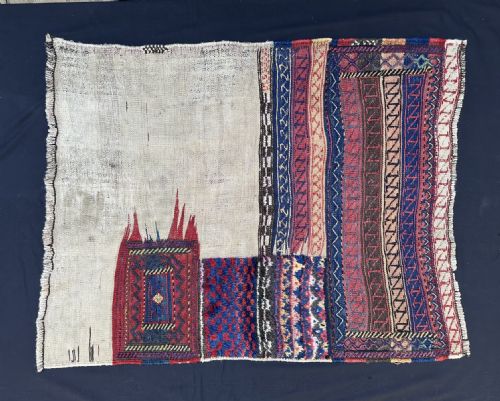
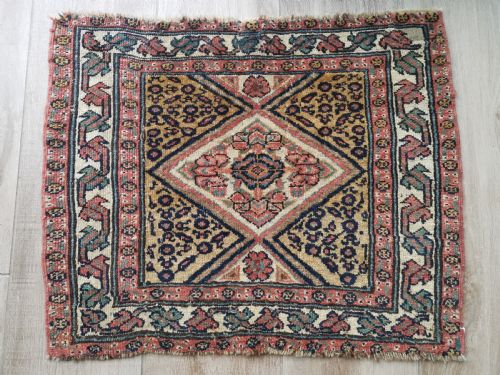

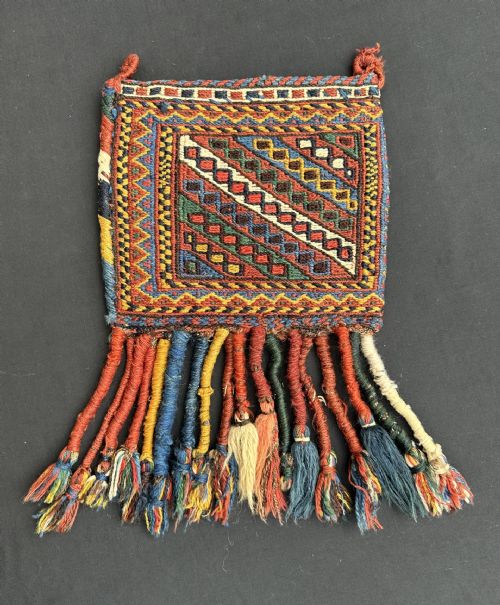


Vintage Tribal Weaving Fragment
These vintage tribal weaving fragment pieces are genuine nomad textiles that bring rich history and texture into a room.
Vintage Tribal Weaving Fragment
A vintage tribal weaving fragment represents part of a larger nomadic textile, such as a bag face, saddlebag, or storage sack. These pieces originate from Persian, Central Asian, and Caucasian tribal groups including the Afshar, Turkmen, and Shahsavan. Buyers search for this phrase to acquire authentic segments of nomadic weaving that display traditional regional patterns on a manageable scale.
The selections available here focus heavily on nineteenth-century and early twentieth-century examples, ranging from the eighteen-fifties to nineteen-twenty. Common formats include torba faces, chuvals, chantehs, and fragmentary panels preserved from utilitarian items. These smaller formats allow collectors to study nomadic design vocabulary without acquiring an entire carpet.
Regional distinctiveness shapes every piece, linking specific motifs to nomadic groups across Western Persia, Central Asia, and the Trans-Caspian steppes. A collector encounters distinct formats like Luri-Bakhtiari wheat-sacks alongside Ersari and Tekke Turkmen torba faces. Each item demonstrates the utilitarian roots of tribal textile art.
Materials and construction
Weavers relied on hand-spun wool and cotton foundations, often incorporating vegetable and natural dyes to achieve deep colour palettes. The use of lustrous wool ensures that pile surfaces retain vitality and depth over decades of handling.
Flatweave techniques such as soumak work alongside knotted pile constructions to create durable utilitarian objects for nomadic life. Structural variations include specialised weaves for grain sacks, storage bags, and personal carry-pouches.
Vintage Tribal Weaving Fragment Retail Price Guide 2026
Typical asking prices for vintage tribal weaving fragment among the pieces listed under this phrase on Sellingantiques today, from the lower quarter to the upper quarter. They describe what is for sale here now, not the wider market.
Listings feature nineteen-century and early twentieth-century pieces utilising wool, cotton, silk, and natural vegetable dyes.
Evaluating craftsmanship
The integrity of the wool and the clarity of natural dye colours dictate the visual impact of each fragment. Superior examples display saturated tones and tight knotting or precise flatweave structure that resists distortion.
Design complexity and the survival of distinct tribal motifs, such as specific gul patterns or bird and dragon forms, distinguish exceptional pieces from standard utilitarian remnants. The precision of the remaining design structure reveals the skill of the original weaver.
The Vintage Tribal Weaving Fragment Glossary
- Torba
- A small Turkmen storage bag used for household items inside a yurt. These wall-hanging bags typically feature rectangular proportions and intricate primary guls.
- Chuval
- A large Turkmen tent storage bag designed for bedding and clothing. Surviving faces show elaborate repeat medallion designs.
- Soumak
- A flatweave technique involving wrapping supplementary weft threads over warp threads. This method creates a sturdy structure with a textured, braided surface.
- Gul
- A primary medallion or repeating floral-derived motif used across Central Asian tribal weaving. Different tribes utilise specific gul designs for identification.
- Chanteh
- A small personal bag or vanity pouch woven by nomadic women. These small pieces often showcase exceptionally fine knotting and dense composition.
Vintage Tribal Weaving Fragment: Frequently Asked Questions
What is a tribal weaving fragment?
A tribal weaving fragment is a surviving portion of a larger nomadic textile, such as a storage bag face or saddlebag. These sections were often separated from their original utilitarian objects due to wear over time.
Collectors prize these remnants because they preserve authentic regional designs and natural dyes within a compact format.
How were these bags used?
Nomadic groups utilised these woven pieces for practical storage inside tents, including grain sacks, bedding bags, and personal carry-pouches. They transported belongings across steppes and mountains while serving as durable household furnishings.
Over generations, intact items broke down, leaving behind individual panels that display the finest sections of the original weaving.
How do I display a fragment?
Many collectors mount these textile pieces on neutral fabric or frame them behind glass to protect the delicate hand-spun wool fibres. Small bag faces also function well as table mats or protected wall hangings.
Keeping them away from direct sunlight preserves the natural and vegetable dyes found in the wool.
How do I identify tribal origins?
Tribal origins appear through specific structural techniques, colour palettes, and repeating motifs such as guls or boteh designs. For instance, Turkmen pieces often feature deep madder reds and geometric medallions, while Afshar or Shahsavan fragments display distinct regional border patterns.
Comparing the weave density and material composition helps link a piece to specific groups like the Yomut or Luri-Bakhtiari.