
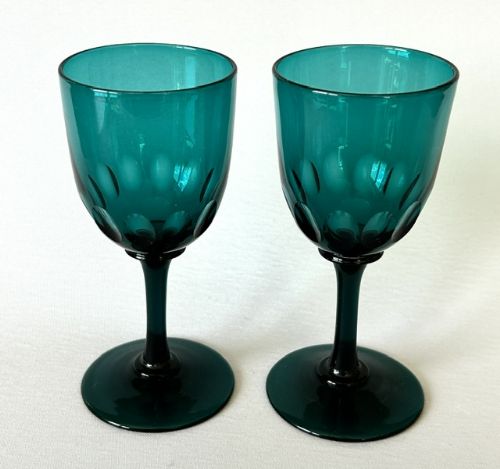


Victorian Green Glass Goblets
These Victorian green glass goblets are robust, richly coloured drinking vessels that bring depth and character to any table.
Victorian Green Glass Goblets
When you search for victorian green glass goblets, you enter a field defined by nineteenth-century glassware, spanning periods from the Georgian era through the Victorian period and into the early twentieth century. The forms range from tall roemers and tulip-shaped vessels to dessert wine glasses and liquor glasses, often appearing in pairs or larger sets.
How they were made
These items are constructed from lead glass, blown glass, and coloured glass, frequently utilising uranium glass or vaseline glass to achieve distinctive optical effects. Artisans shaped the molten material through blowing, while some examples incorporate cut glass techniques to define the bowls and stems.
Decoration on these vessels often includes vitreous enamel and polychrome enamel work, as seen in enamelled armorial designs. The combination of coloured glass formulas and surface enamelling defines the manufacturing methods recorded in the evidence.
Listings on this site feature glass from English and Bohemian workshops, spanning the Georgian, Victorian, and Edwardian periods.
What varies in quality
The standard of a piece depends on the depth and consistency of the green colour, alongside the precision of the glassblowing technique. Finer examples display crisp cutting, balanced proportions, and well-executed enamel detailing rather than uneven thickness or cloudy metal.
Completeness within sets and the sophistication of decorative additions, such as armorial enamelling or complex cutting, separate simpler items from more ambitious nineteenth-century production.
Lobmeyer
The Victorian Green Glass Goblets Glossary
- Roemer
- A traditional Germanic drinking vessel with a large bowl resting on a cylindrical stem decorated with applied prunts. These are typically fashioned from green glass.
- Uranium glass
- Glass tinted with uranium oxide that glows vividly under ultraviolet light. It yields a distinctive yellow-green hue.
- Vitreous enamel
- Glassy powder fused to the surface of the vessel through firing. It creates durable, coloured ornamentation.
- Lead glass
- Heavy glass containing lead oxide that increases brilliance and weight. It provides a resonant quality when struck.
- Armorial
- Bearing a coat of arms or heraldic insignia. This type of decoration often appears on enamelled goblets.
Victorian Green Glass Goblets: Frequently Asked Questions
Are these green goblets safe to drink from?
These historical vessels are generally collected for display, heritage value, and table presentation rather than everyday modern dining.
Some pieces contain trace elements like uranium that react to ultraviolet light, so modern owners often restrict their use to decorative settings.
How do I clean antique green glass?
Wash these items gently by hand in warm water using a mild, non-abrasive detergent. Avoid soaking them or placing them in mechanical dishwashers.
Dry them immediately with a soft, lint-free cloth to protect the surface and any delicate enamel work.
How can I tell the age of these glasses?
Dating relies on examining the weight of the lead glass, the manufacturing technique, and stylistic markers such as Biedermeier cutting or Victorian historicism.
Sets often show consistent wear patterns on the base that correspond to nineteenth-century production methods.