

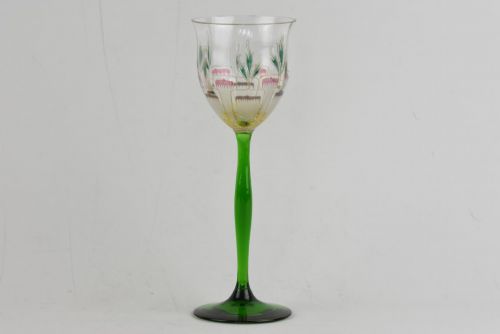


Green Hock Glasses
These green hock glasses bring colour and weight to the table, and collectors prize them for their rich hues and generous bowls.
Green Hock Glasses
Green hock glasses are traditional stemmed vessels designed for German white wines, and the examples gathered here span from the mid-Victorian period through to the nineteen-thirties. You will encounter tall silhouettes, including sets from Victorian workshops, Edwardian makers, and continental European glasshouses.
How they were made
Glassmakers utilised lead glass and crystal as the foundational material, shaping the bowls and stems by hand before applying colour. Many pieces involve cased glass or colour over crystal techniques, where a layer of green glass is fused over clear crystal and subsequently cut away.
Decoration required skilled handwork, such as painting with enamel and applying gold leaf details. Workshops in Bohemia, France, and Britain employed these labour-intensive methods to achieve the ornate floral and geometric patterns seen on the bowls.
These tall green vessels were once expected to stand proudly at dinner parties, ensuring nobody mistook their hock for ordinary table water.
What varies in quality
The distinction between standard tableware and exceptional work lies in the depth of the glass cutting and the precision of the enamel painting. Finer vessels display crisp facets that catch the light, whereas simpler items rely solely on their moulded green tint without additional embellishment.
Uniformity across a matched set also dictates the standing of the pieces. Hand-blown and hand-cut sets with consistent bowl heights and evenly applied gold leaf or enamel show a higher degree of workshop control.
Baccarat Harcourt·Theresienthal·St Louis Massenet
The Green Hock Glasses Glossary
- Hock glass
- A tall-stemmed wine glass traditionally used for hock or other German white wines. These vessels possess capacious bowls that allow the aromas of the wine to develop.
- Cased glass
- A method where a layer of coloured glass is fused over a contrasting body of clear or coloured glass. Craftsmen then cut through the outer layer to reveal the contrasting material beneath.
- Roemer
- A traditional Germanic drinking vessel with a large rounded bowl sitting on a cylindrical stem decorated with applied prunts. These examples often appear in pale green glass.
- Enamel decoration
- The application of fused glass powders mixed with pigment onto the surface of the vessel. Artisans fire the piece to permanently fix the opaque or coloured patterns.
- Lead crystal
- Glass containing a significant proportion of lead oxide, which increases the weight, refractive index, and clarity of the material. This composition permits sharper and deeper cutting.
Green Hock Glasses: Frequently Asked Questions
How do I date a green hock glass?
Dating relies on observing the silhouette, the manufacturing technique, and the style of decoration. Mid-nineteenth-century examples often feature heavier lead glass and simpler proportions, while nineteen-twenties and thirties pieces reflect cleaner lines or specific factory patterns.
Matching the decorative motifs, such as Victorian floral enamel or Edwardian cutting styles, helps narrow the decade of production.
Are these glasses safe to use?
Most antique green hock glasses are structurally sound for occasional dining use if handled with care. Hand washing in warm, gentle water is essential to preserve the delicate enamel and gold leaf decorations.
Harsh detergents and mechanical dishwashers should be strictly avoided to protect the historic glass surface and prevent clouding.
Why is the glass green?
The green colour results from metal oxides, such as iron or copper, introduced into the molten glass batch during production. Victorian and continental makers produced various shades ranging from pale pistachio to deep Bristol green and forest tones.
Some pieces achieve their hue through cased glass techniques, layering green over clear crystal.