
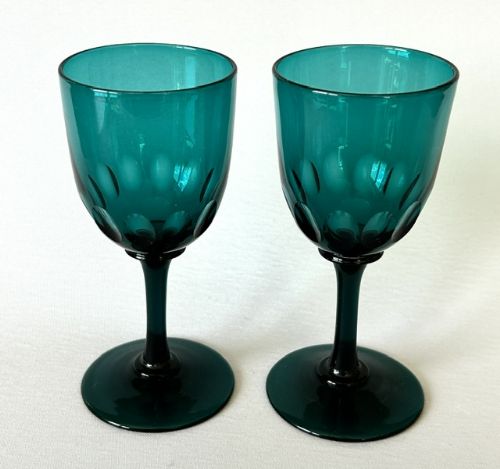


Victorian Green Stemware
Victorian green stemware brings vibrant colour to a table, offering charming antique glass drinking vessels that collectors prize for their rich hues.
Victorian Green Stemware
Victorian green stemware comprises antique drinking vessels produced during the nineteenth century, featuring distinct green glass bowls and stems designed for wine or liquor. These items include matched pairs and larger sets intended for dining and entertaining.
The pieces on this page span the Victorian era alongside adjacent periods, showing influences such as Biedermeier and late Victorian styling. Collectors encounter various forms, from tulip-shaped bowls to cut glass designs.
Originating from English and continental workshops, these glasses showcase the nineteenth-century fascination with deeply coloured table glass. They range from translucent aqua tones to vivid emerald and vaseline glass.
How these pieces were made
Makers utilised lead glass and coloured glass formulations, incorporating metallic oxides to achieve vibrant green and aqua shades. Some pieces display the distinct fluorescence characteristic of uranium or vaseline glass.
Craftsmen shaped the vessels while hot, applying techniques such as glass cutting to create faceted bowls and stems. Sets often exhibit hand-finished details that distinguish individual items within a suite.
Vaseline glass got its unusual nickname because its yellowish-green hue resembled petroleum jelly popular in the nineteenth century.
What varies in quality
Quality rests in the depth and consistency of the green colour across a set, alongside the precision of any cut facets. Superior examples display crisp lines and uniform thickness throughout the bowl and stem.
The completeness of a matched set strongly influences desirability, as finding six or eight matching antique wine glasses remains challenging. The clarity of the glass and the smoothness of the pontil mark also distinguish finer pieces.
The Victorian Green Stemware Glossary
- Stemware
- Drinking vessels raised on a stem above a foot. This category covers wine glasses and liquor glasses.
- Vaseline glass
- Pressed or blown glass containing uranium dioxide, which gives it a transparent yellowish-green colour. It glows brightly under ultraviolet light.
- Bristol green
- A dark, strong green glass traditionally associated with the English port of Bristol. Makers utilised it extensively for nineteenth-century wine bottles and stemware.
- Pontil mark
- The scar left on the base of a blown glass vessel where the pontil rod was attached during manufacture. Its presence indicates traditional hand-blown production methods.
- Biedermeier
- A central European style spanning the mid-nineteenth century, known for clean lines and functional elegance. Pieces in this style often feature geometric cut decoration.
Victorian Green Stemware: Frequently Asked Questions
Are these glasses safe to use?
Most nineteenth-century drinking glasses can handle careful hand washing and occasional use for dining. Owners should avoid sudden temperature changes to protect the antique material.
Vaseline glass contains trace uranium, which emits very low levels of radiation. Collectors generally display these pieces or use them cautiously.
How do I date Victorian stemware?
Examine the form, weight, and manufacturing marks on the base of the glass. Pontil scars and hand-cut facets often point to mid-nineteenth-century production.
Compare the shade of green and the silhouette against documented examples from the Victorian and Georgian eras. Subtle variations in colour density suggest earlier hand-mixed batches.
Why do sets vary in shade?
Nineteenth-century glasshouses produced coloured glass in small batches using raw materials that varied slightly from pot to pot. This resulted in subtle tonal differences across matched sets.
Hand-blown production meant no two vessels emerged identical, adding character to sets assembled during the period.