


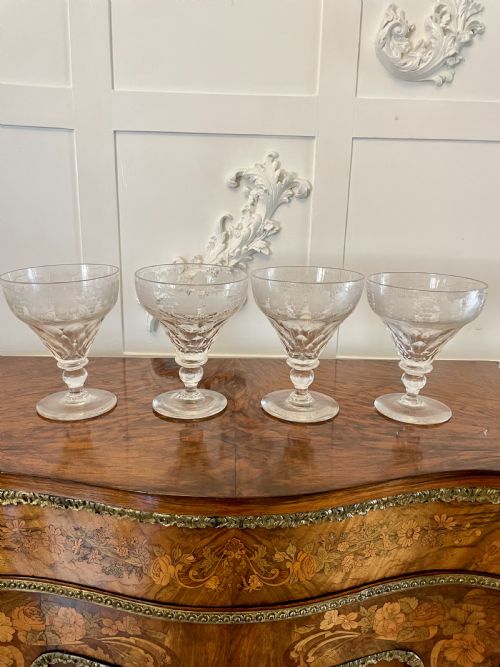


Victorian Champagne Glasses
These Victorian champagne glasses bring nineteenth-century weight and cut sparkle to any table, offering distinct flutes, coupes, and hollow stems for collectors.
Victorian Champagne Glasses
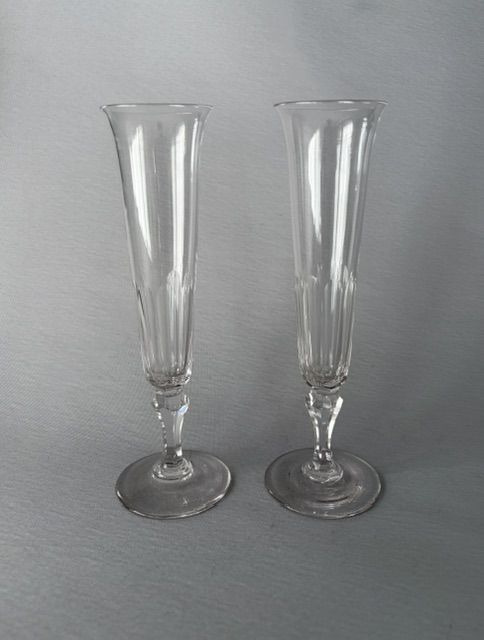
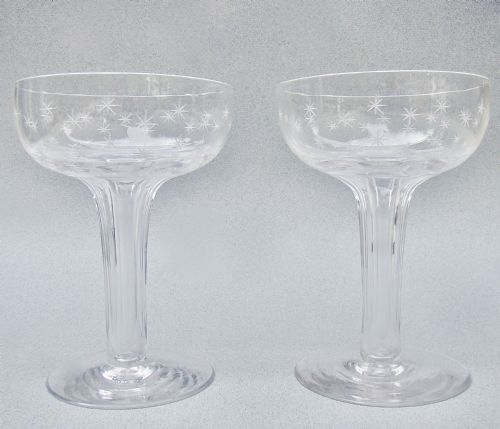
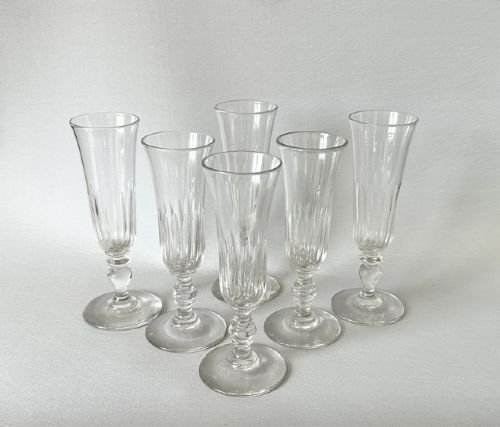
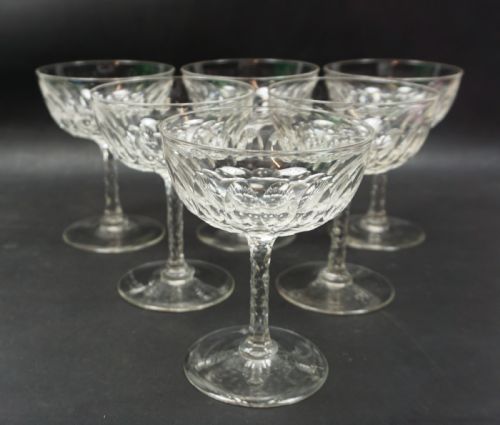
When searching for victorian champagne glasses, collectors encounter diverse forms including hollow stems, flutes, and wide coupes designed for nineteenth-century dining. These pieces emerge predominantly from English and continental workshops spanning the mid to late nineteenth century.
The inventory on this page relies heavily on matching sets and pairs of champagne glasses, alongside related service pieces like jugs, decanters, and ice buckets. Hollow stem variations and star-etched bowls appear frequently among the surviving glassware.
Materials and production
Makers utilised heavy lead crystal and standard glass, applying techniques such as deep cutting, facet cutting, and wheel engraving to render floral and decorative motifs. Coloured glass variants, including cranberry, green vaseline, uranium, and amber, received surface cutting or enamel work.
Specialised decorative methods include latticinio threads embedded in jugs and meticulous star-etching or engraving upon bowls and hollow stems. These procedures demanded skilled hand manipulation of hot metal and cold-work finishing.
Keep an eye out for novelty champagne bottle decanters disguised as the real bubbly.
Assessing quality
Quality rests upon the crispness of the wheel engraving and the depth of the facet cutting, where sharper, cleaner lines indicate superior execution by the glasscutter. The clarity and weight of the lead crystal also separate standard production from finer work.
Uniformity across a matched set or harmonious harlequin grouping dictates desirability, alongside unusual structural forms such as hollow stems or air twists. The precision of the applied decoration, whether enamel or engraved foliage, governs the overall merit of the piece.
Richardsons·Fritz Heckert
The Victorian Champagne Glasses Glossary
- Hollow stem
- A glass stem configured with an internal channel running down into the base. This historic form allowed bubbles to rise continuously through the drink.
- Champagne coupe
- A shallow, broad-bowled glass designed for sparkling wine during the nineteenth century. Its wide brim encourages the rapid release of effervescence.
- Lead crystal
- Glass containing substantial metallic oxide to increase refractive index and heft. This material produces a clear, resonant ring when struck gently.
- Latticinio
- Opaque white or coloured glass threads twisted within clear glass. Makers applied this technique primarily to jugs and pitchers.
- Star-cut
- A decorative motif ground into the underside of a foot or the side of a bowl. The intersecting cuts create a geometric star pattern that catches candlelight.
Victorian Champagne Glasses: Frequently Asked Questions
How do I clean antique glassware?
Wash these pieces by hand in warm water using mild soap, avoiding abrasive scrubbers or modern dishwashers.
Dry them immediately with a soft lint-free cloth to prevent water spots and protect the historic glass surface.
Can I use these for modern drinks?
These historical glasses accommodate modern sparkling wines and champagne, though their capacities and bowl shapes differ from contemporary flutes.
Handle them with care during gatherings, keeping in mind their age and delicate hand-finished stems.
What caused the hollow stem design?
Hollow stems were engineered during the nineteenth century to encourage continuous bubble formation in sparkling wines. The internal cavity allowed carbonation to release steadily from the base of the bowl.
This specific form remains a primary indicator of period champagne glassware.
How do I identify coloured glass types?
Cranberry glass achieves its distinct pinkish-red hue through gold chloride added to the molten batch. Uranium and vaseline glass glow under ultraviolet light due to the presence of uranium oxide.
Examining the tone and weight under natural light helps separate genuine nineteenth-century coloured pieces from later reproductions.