


Antique Glassware Set of 6
When you search for an antique glassware set of 6, you seek matching vessels for the table produced across the Georgian, Victorian, and Edwardian eras.
Antique Glassware Set of 6
An antique glassware set of 6 comprises matched drinking vessels or serving pieces intended for the table, spanning periods from the Georgian era through to the early twentieth century. Buyers searching this phrase commonly find sets of wine glasses, champagne coupes, tumblers, and cordials originating from English, French, and German makers.
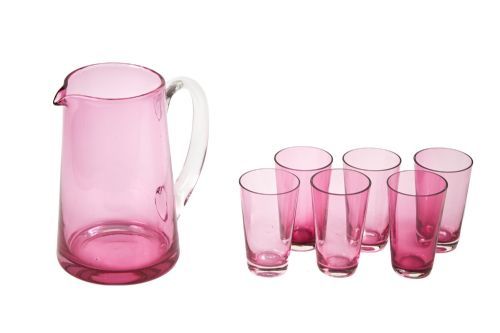
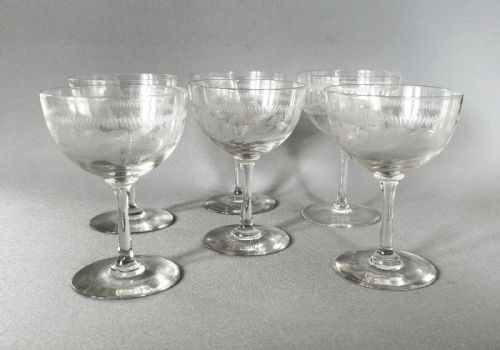
The forms range from heavy lead crystal rummers with square lemon squeezer feet to delicate hand-blown cranberry glass stemware and cut glass champagne bowls. These groupings reflect the formal dining habits of the nineteenth and early twentieth centuries, where uniformity in glassware service became desirable for hosts.
Sets often survive from the Victorian and Edwardian periods, alongside earlier Georgian specimens that demonstrate faceted bowls and wide foot bases. Each collection presents uniform characteristics in colour, cutting, or engraving, marking them out as intended for coordinated service rather than piecemeal use.
How they were made
Makers utilised lead glass and clear glass, alongside coloured varieties such as cranberry, Bristol green, and peacock blue, shaped through hand-blowing and optical moulding techniques. Artisans achieved decorative enrichment via wheel-cutting, acid-etching, intaglio engraving, and surface enamelling with gold leaf or heraldic motifs.
Many pieces display faceted stems and thumb-cut bowls produced by skilled glass cutters working in established centres like English and European glasshouses. Applied elements, such as silver mounts or silver-plated stands, frequently accompanied high-status decanter sets and cordial glasses during the late nineteenth and Edwardian decades.
Victorian diners enjoyed iced custard from small glass cups, proving that dessert customs involved distinct vessels for every sweet.
What varies in quality
The distinction between ordinary production and finer work rests on the clarity of the metal, the crispness of the wheel-cut or acid-etched decoration, and the uniformity across all six pieces. Superior sets exhibit precise symmetry in stem thickness and bowl capacity, indicating high skill in the glasshouse.
Provenance and ornamentation elevate certain groups, particularly where makers applied detailed enamel work, over-laid portraits, or paired the glassware with hallmarked silver mounts. Matched completeness over time remains a key determinant, as genuine surviving sets of six maintain consistent wear patterns and identical tonal qualities in the glass.
William Comyns·Theresienthal·Webb Corbett·James Powell
The Antique Glassware Set of 6 Glossary
- Lead glass
- Glass containing lead oxide, which increases brilliance, weight, and resonance when struck. This material allowed deeper and sharper wheel-cutting.
- Rummer
- A large, sturdy drinking glass popular in the Georgian and Victorian periods, typically featuring a short stem and a capacious bowl used for ale or wine.
- Roemer
- A traditional Germanic drinking glass, often of green glass, featuring a large spherical bowl resting on a cylindrical stem applied with raspberry prunts.
- Lemon squeezer foot
- A square, moulded glass base with sloping sides resembling a kitchen lemon squeezer, characteristic of Georgian and early nineteenth-century drinking vessels.
- Cranberry glass
- Transparent red-pink glassware produced by adding gold chloride to the molten batch, highly favoured by Victorian makers for tableware and decorative sets.
Antique Glassware Set of 6: Frequently Asked Questions
What drinks were served in antique glass sets?
These sets served specific beverages according to their form, including port, sherry, wine, champagne, and whisky. Rummers handled ale or heavy wines, whilst smaller cordial glasses held liqueurs after dinner.
Dining customs of the Georgian and Victorian eras required distinct vessel shapes for each course. Tableware grew more specialised as the nineteenth century progressed, leading to dedicated sets for champagne, hock, and spirits.
How can I tell Georgian glass from Victorian pieces?
Georgian glass often displays darker metal with natural impurities, heavy pontil marks on the base, and simpler, robust forms like rummers and Bristol blue decanters. The cutting on Georgian pieces tends to be softer and less uniform than later production.
Victorian glass benefits from industrial advancements, showing brighter clarity in lead crystal and more intricate machinery-assisted cutting, alongside vibrant colours such as cranberry and amber. Victorian sets also display greater standardisation across all six matching components.
Were these sets originally sold with six pieces?
Makers and retailers packaged tableware in various quantities, often matching the seating capacity of dining tables or service trays. Sets of six emerged commonly alongside larger suites for wine, port, and cordials.
Survival as an intact group of six depends on careful stewardship through generations. Many historical table services faced attrition, making verified matched sets desirable for collectors.