





Green Bowl Glasses
Green bowl glasses bring together striking colour and historic craftsmanship, spanning delicate Victorian champagne coupes and vibrant Art Deco vessels.
Green Bowl Glasses
Green bowl glasses encompass a diverse selection of antique drinking vessels, decorative bowls, and table pieces drawn from the nineteenth and twentieth centuries. Buyers searching this phrase encounter everything from Victorian champagne coupes and Georgian wine glasses to ornate Art Nouveau centrepieces fitted with glass liners.
The material origins trace through several distinct periods, showing strong representation from Victorian, Edwardian, and Art Deco eras. Pieces span utilitarian table items to high-end decorative glass from French, Belgian, and Scottish studios.
Materials and manufacture
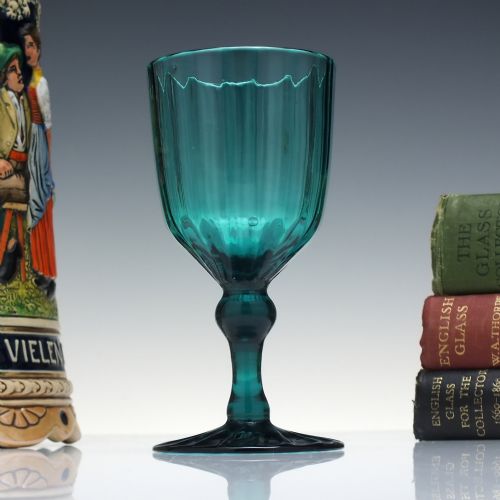
The pieces rely primarily on lead crystal, blown glass, and specialised coloured matrices such as uranium and vaseline glass, often enhanced with enamel, gold leaf, or aventurine inclusions. Makers utilised techniques like rib moulding, latticinio decoration, and pâte de verre crystal casting to achieve depth and texture within the green body.
Metalwork plays a structural role in many items, pairing the glass components with sterling silver, silver-plated frames, and gilt edges. Factory production combined free-blowing methods with press-moulding and overlay techniques, particularly in Bohemian and French workshops.
Listings feature green bowl glasses spanning the Georgian, Victorian, Edwardian, and Art Deco periods, executed in glass, silver plate, and sterling silver.
Assessing quality
Quality rests upon the purity and depth of the glass colour, the precision of optical effects like rib moulding or peacock eyes, and the crispness of any applied decoration or gilt edging. Superior examples demonstrate a careful balance between the glass vessel and its metal mount, such as sterling silver or silver-plated frames.
Artistic execution distinguishes standard production items from masterworks produced by renowned factories or individual designers. The presence of clear factory marks, original mounts, and undamaged surface details elevates a piece within its period.
Whitefriars·Aldridge and Green·Daum France·WMF·Salviati Venice·Monart·Joseph Simon·Val St. Lambert·Viners·Stuart·Liberty·René Lalique·Loetz
The Green Bowl Glasses Glossary
- Vaseline glass
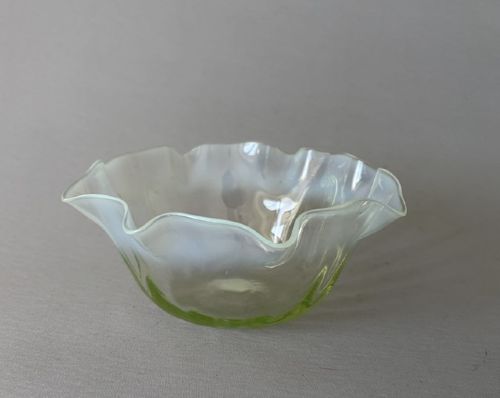
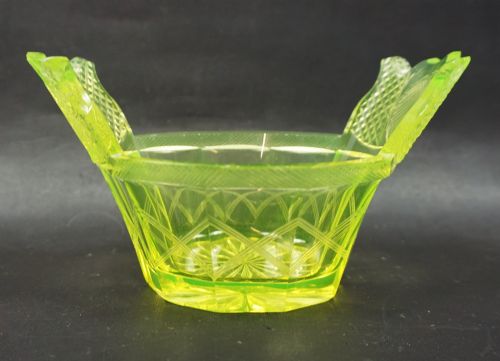
- A type of glass coloured with uranium oxide that exhibits a distinct yellow-green fluorescence under ultraviolet light. It gained popularity during the nineteenth century for decorative tableware and ornamental bowls.
- Latticinio
- A decorative glass technique involving opaque white or coloured glass threads embedded within clear glass. This method creates intricate lace-like patterns across the body of the vessel.
- Pâte de verre
- A method of glass casting where finely crushed glass is mixed with a binder and fired in a kiln. This produces dense, textured objects with subtle gradations of colour.
- Aventurine glass
- Glass containing suspended metallic crystals, typically copper, which create a glittering or shimmering effect. It was frequently utilised in Venetian and nineteenth-century decorative arts.
- Champagne coupe
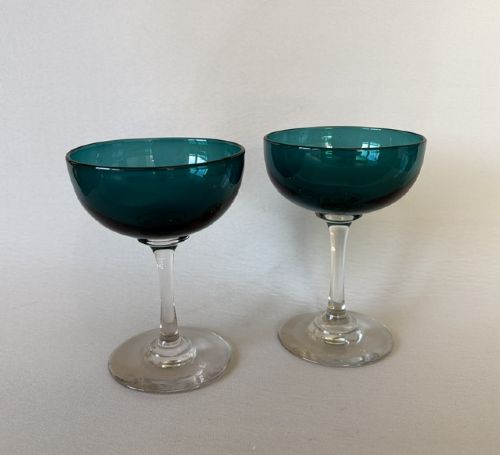
- A shallow, broad-bowled stemmed glass designed originally for sparkling wines. Victorian examples often feature hand-blown green bowls paired with slender stems.
Green Bowl Glasses: Frequently Asked Questions
How do I identify uranium glass?
Uranium glass typically exhibits a transparent yellow-green hue under natural light and produces a bright green glow when exposed to ultraviolet light. The uranium content was added to the glass batch as a colouring agent during manufacturing.
Most pieces date from the nineteenth and early twentieth centuries, appearing in forms ranging from small dishes to large decorative bowls.
Are these glass pieces safe to use?
Many antique green bowl glasses and decorative dishes were intended for display or specialised dining purposes rather than everyday modern use. Items featuring silver-plated mounts, delicate enamel, or historic glass formulations require gentle hand washing.
Collectors generally treat these vessels as decorative art objects or preserve them for occasional display rather than heavy daily service.
How should I clean antique glass?
Cleaning requires warm water and mild soap, avoiding harsh abrasives that might scratch the surface or damage gilt edges and silver mounts. Extreme temperature changes should be avoided to prevent thermal shock in older glass.
Careful drying with a soft cloth helps maintain the clarity and finish of delicate nineteenth-century crystal and opaline surfaces.
What is the difference between opaline and vaseline glass?
Opaline glass is an opaque or translucent glass developed in France during the nineteenth century, often found in pastel or vibrant green shades with gilt highlights. Vaseline glass is semi-transparent and relies on uranium content for its characteristic yellow-green colour.
Both materials were utilised for decorative bowls and tableware, but they differ significantly in transparency and chemical composition.