

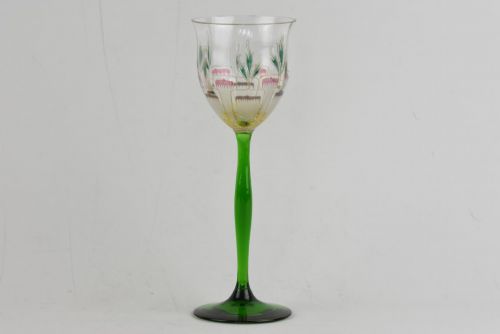


Green Glass Hock Goblets
These green glass hock goblets bring rich colour and distinctive presence to the table, offering a striking way to serve traditional white wines.
Green Glass Hock Goblets
Green glass hock goblets encompass tall drinking vessels designed for hock and white wines, originating across various European glassmaking centres during the nineteenth and early twentieth centuries. The selection includes tall roemers from Bohemia alongside delicate French glassware from makers such as Baccarat and St Louis Massenet.
The pieces on this page span several decades, ranging from early Victorian examples dated around eighteen-fifty to later Edwardian and Art Deco productions. Collectors encounter distinct regional forms, from the heavily enamelled Bavarian styles of Theresienthal to classic Bristol green wine glasses associated with the late Victorian era.
Forms vary from robust cased glass constructions to slender lead crystal goblets featuring elaborate cut and gilt decoration. These vessels serve as both functional glassware and decorative objects reflecting the shifting aesthetic tastes of the nineteenth and twentieth centuries.
Manufacturing and materials
Makers utilised lead crystal and standard green glass as the foundational material for these goblets, often employing cased glass techniques to create layered colour effects. Skilled artisans shaped the molten material by hand, producing the characteristic tall stems and generous bowls required for hock wine.
Decoration involved intricate surface work including gold leaf application, floral enamel painting, and precise cutting into overlay glass. Bohemian and French workshops applied these techniques to achieve both vibrant colour saturation and crisp optical clarity.
The listings on this page span the Victorian, Edwardian, and Art Deco periods, featuring materials such as lead crystal, enamel, and gold leaf.
Assessing quality and craftsmanship
Quality rests upon the precision of the glass cutting, the depth and consistency of the green coloration, and the refinement of any applied enamel or gold leaf. Superior examples demonstrate a balanced weight, a clean pontil mark where applicable, and exceptional clarity within the crystal layers.
The execution of hand-painted floral enamelling distinguishes finer factory output from standard production pieces, requiring steady brushwork and secure firing. Matching sets exhibit uniform height and hue across every goblet, indicating careful selection during the original manufacturing process.
Baccarat·Theresienthal·St Louis Massenet
The Green Glass Hock Goblets Glossary
- Hock glass
- A tall-stemmed wine glass traditionally used for German Rhine wines. The generous bowl allows the aromas of white wine to develop fully.
- Roemer
- A traditional Germanic drinking vessel featuring a wide bowl resting on a cylindrical stem decorated with applied prunts. These pieces are frequently rendered in rich green glass.
- Cased glass
- A method where a layer of coloured glass is fused over a clear or contrasting inner layer. Artisans then cut through the outer layer to reveal the contrasting colour beneath.
- Enamel decoration
- An opaque glassy substance applied to the glass surface in patterns and fired in a kiln. This technique adds raised texture and polychrome detail to the vessel.
- Pontil mark
- A scar left on the base of a blown glass vessel where the punty rod was attached during manufacture. Its presence indicates traditional hand-blown methods.
Green Glass Hock Goblets: Frequently Asked Questions
What is a hock goblet?
A hock goblet is a traditional tall-stemmed drinking vessel specifically shaped for serving hock and other aromatic white wines.
The extended stem keeps the hand away from the bowl, preventing the wine from warming too quickly during a meal.
How do I date green glass?
Dating relies on examining the manufacturing techniques, stylistic motifs, and the specific shade of green employed by the workshop.
Early Victorian pieces often display heavier proportions, whilst Edwardian and Art Deco examples favour sleeker profiles and refined surface cutting.
Can I use these for wine?
These antique goblets can certainly be used for serving wine during special occasions, provided they receive careful handling.
Hand washing in lukewarm water is essential to preserve delicate gold leaf and enamel decorations from damage.
What makes Bristol green distinctive?
Bristol green refers to a deep, characteristic hue associated with glasshouses operating in the Bristol region during the nineteenth century.
The intense colour results from specific mineral oxides added to the batch during the melting process.