
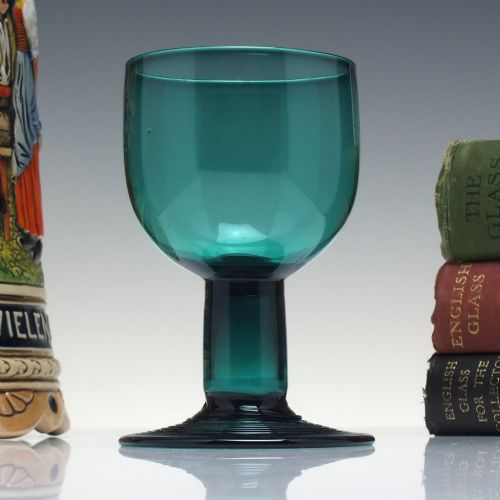


Green Roemer Glasses
These green roemer glasses are heavy drinking vessels with hollow stems, tracing periods from the eighteenth century through the Victorian era.
Green Roemer Glasses
When you search for green roemer glasses, you encounter distinctive drinking vessels defined by characteristic hollow stems and deep forest or pale green hues. The selection ranges from eighteenth-century English export forms to Victorian pairs and continental examples from the nineteenth and twentieth centuries.
Most pieces on this page appear as wine glasses, goblets, or cordial glasses. The forms span Georgian export pieces, Victorian tall stems, and later continental glassware reflecting Biedermeier, Art Nouveau, and Jugendstil aesthetics.
Origins vary across England, Bohemia, France, and Germany. Buyers encounter single items, pairs, and sets of six or eight drinking vessels spanning periods from seventeen-fifty up to nineteen-twenty.
How they were made
Makers shaped these items using green glass, coloured glass, and cut crystal through blown and hand-blown techniques. The molten material was worked into heavy bowls atop hollow stems that required careful thermal control during cooling.
Decoration often involved polychrome enamel and hand-enamelling applied to the exterior surfaces. Some pieces incorporate cut crystal patterns or gilt detailing to contrast against the coloured body.
The hollow stem of a roemer was originally shaped so diners with greasy fingers could maintain a firm grip on the wine.
What varies in quality
Quality differences emerge in the weight and clarity of the glass itself, alongside the precision of the hollow stem formation. Heavier vessels with balanced proportions and crisp cut crystal facets sit at the upper end of the range.
Enamelling technique distinguishes standard production from finer work, particularly where polychrome enamel or gilt decoration is applied by hand. The crispness of historical Bohemian and French workshop output contrasts with simpler regional glassware.
St Louis Massenet·Lobmeyer·Theresienthal·Frits Hechert·Moser
The Green Roemer Glasses Glossary
- Roemer
- A traditional Germanic drinking vessel featuring a large spherical bowl, a cylindrical hollow stem, and a wide foot formed from coiled glass. They typically appear in shades of green.
- Hollow Stem
- A tubular stem construction characteristic of roemers, allowing the bowl to connect openly to the interior of the foot.
- Polychrome Enamel
- Glass decoration utilising multiple fired-on coloured enamel paints to create surface patterns or heraldic motifs.
- Cut Crystal
- Glassware shaped and patterned through abrasive wheel cutting, creating sharp facets that catch the light.
- Biedermeier
- A Central European style spanning the mid-nineteenth century, known for clean lines and domestic utility.
- Export Glass
- Goods produced specifically for overseas markets, frequently recorded in eighteenth-century trade.
Green Roemer Glasses: Frequently Asked Questions
What is a roemer glass?
A roemer is a traditional Germanic drinking vessel designed with a wide bowl atop a hollow, cylindrical stem. The form evolved to provide a secure grip during communal feasts.
Most examples utilise green glass and rest on a wound glass foot. They serve primarily for white wine or hock.
How old are these green glasses?
The pieces span several centuries, beginning with eighteenth-century Georgian examples up to twentieth-century items from nineteen-twenty. Victorian and Edwardian periods are heavily represented.
Dates are determined by manufacturing techniques, stem construction, and stylistic ornamentation.
Were they used for wine?
Historical records and vessel forms confirm they served principally for drinking wine and cordials. The generous bowl sizes accommodated various table beverages of the period.
Smaller cordial versions were used for concentrated liqueurs after meals.
How do I care for antique glass?
Antique green roemer glasses require gentle hand washing in warm water using mild soap. Avoid thermal shock by keeping water temperatures consistent.
Store them upright on stable surfaces to protect the hollow stems and delicate foot rims.