
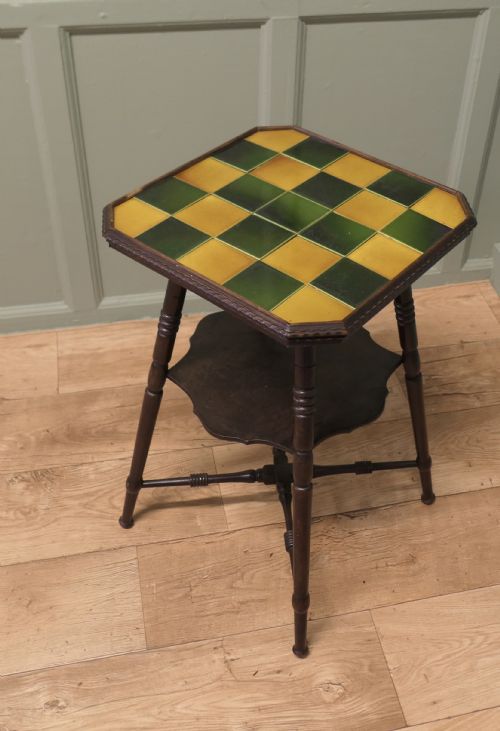
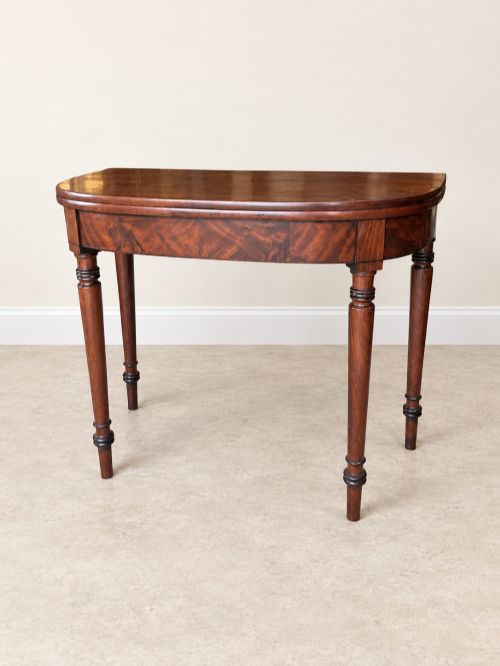
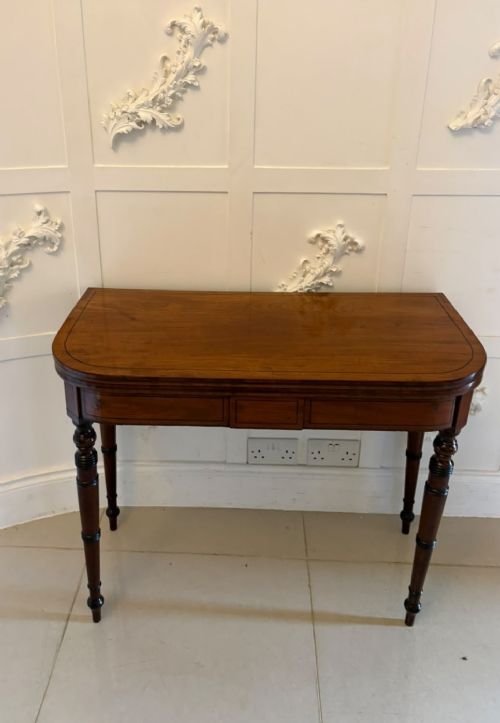
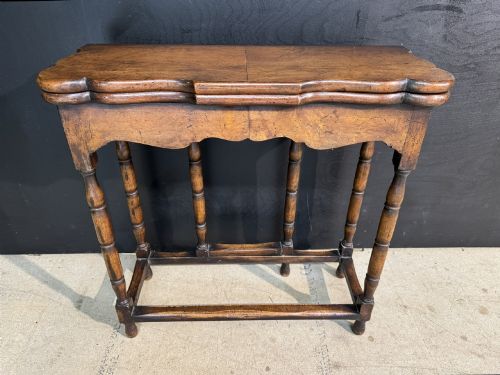
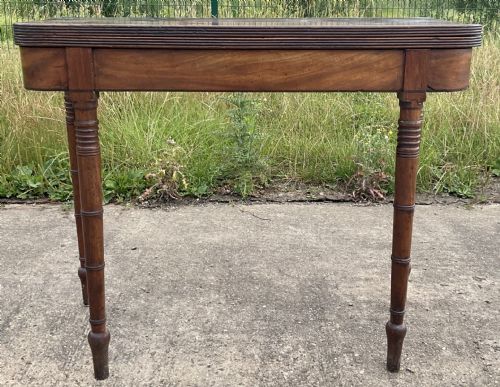


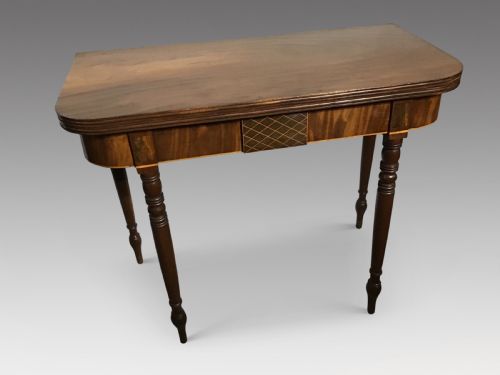

Turned Leg Games Table
A turned leg games table brings dual-purpose folding surfaces and rich timber grain to a drawing room.
Turned Leg Games Table
A turned leg games table offers a versatile surface designed for card playing, dining or tea, adapting easily to the needs of the room. When you search for a turned leg games table, you encounter folding, pivoting or turn-over leaves supported by sturdy, lathe-turned timber legs.
The pieces on this page span several key historical eras, including the Georgian, Regency, and Victorian periods, alongside later Arts and Crafts examples. You will frequently find mahogany, walnut, and rosewood forms designed to sit neatly against a wall when closed.
Many examples double as card tables, tea tables, or console tables, demonstrating the multifunctional nature of domestic furniture from the eighteenth to the early twentieth century. The turned supports provide structural stability beneath elaborate folding tops lined with baize or plain timber.
How they were made
Cabinet makers utilised dense hardwoods such as mahogany, walnut, and oak to construct the frames and folding leaves of these tables. Turnery lathes shaped the solid timber legs into cylindrical, reeded, or spiralled profiles, ensuring robust support for the expanding top.
Inlaid details often incorporate ebony, boxwood, satinwood, and brass to decorate the friezes and borders of the playing surfaces. Secondary woods provide internal framework strength, while specialised brass hinges allow the folding tops to pivot smoothly.
A triangular Thonet bentwood card table waits here, proving that even Victorian gamblers appreciated radical steam-bent geometry.
What varies in quality
The choice of primary timber and the crispness of the turning dictate the initial grade of the piece, with finely figured mahogany and burr walnut commanding attention. Superior workshops employed tighter grain patterns and more complex inlay work using ebony or satinwood.
Mechanism precision separates standard items from exceptional ones, particularly how securely the pivoting top locks when open. The proportion between the turned legs and the frieze reflects the skill of the maker.
Shapland & Petter·Thonet·Gillows·S&H Jewell·Gregory and Co·W.F. Greenwood & Sons York
The Turned Leg Games Table Glossary
- Turned leg
- A support shaped on a lathe by rotating the timber against cutting tools. This creates cylindrical, fluted, or spool-shaped profiles common on tables.
- Fold over
- A hinged table top that opens out to double the surface area. It often conceals a hidden compartment or a baize-lined playing surface.
- Tunbridge ware
- Small decorative wooden mosaics applied to furniture surfaces. It originates from Tunbridge Wells and uses tiny coloured wood blocks to form geometric patterns.
- Baize
- A coarse woolen material resembling felt. It lines the interior surfaces of card tables to provide a soft playing area.
- Frieze
- The horizontal band situated directly beneath the table top. It frequently houses drawers or receives decorative inlay.
- Demi-lune
- A half-moon shape used for table tops and consoles. These fit flush against walls when closed.
Turned Leg Games Table: Frequently Asked Questions
What is a turned leg games table?
A turned leg games table is a piece of antique furniture featuring a folding or pivoting top supported by lathe-turned wooden legs. These tables were built to save space while offering a stable surface for cards, board games, or tea.
Most examples allow the top to fold flat against the wall when not in use, hiding any gaming felt inside. The turned supports provide both structural strength and decorative detail.
How were games tables used historically?
In period homes, these tables remained against a drawing room wall holding decorative items until guests arrived. Hosts opened the leaves to reveal baize-lined surfaces for evening card games.
They also served dual purposes for serving tea or general writing tasks. This versatility made them essential furnishings for entertaining during the Georgian and Victorian eras.
How do I date a games table?
Dating relies on observing the timber choice, leg style, and construction methods used in the frame. Georgian tables often feature rich mahogany with straightforward turned or tapered legs, while Victorian versions frequently use figured walnut with heavier turnery.
Cabinet-making techniques, such as the type of hinges and joint construction, also help narrow down the decade of production. Maker stamps provide the most precise indication of origin.
How do I care for a wood games table?
Maintain these tables by keeping them away from direct sunlight and sudden temperature changes that cause timber to warp. Regular dusting with a dry, soft cloth preserves the polish without stripping the finish.
Avoid placing damp items directly onto the wood or old baize surfaces. Apply a quality wax occasionally to nourish antique hardwood grains.