
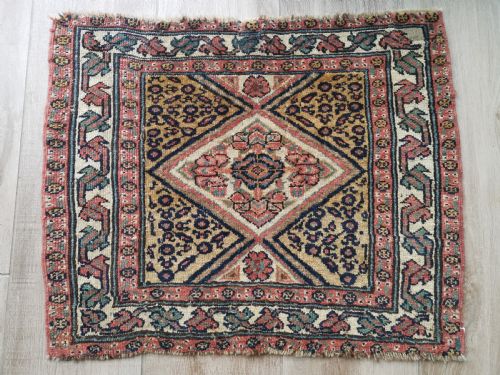


Terracotta Woven Rug Face
A terracotta woven rug face brings nomadic heritage into modern interiors through rich earthen tones and intricate tribal geometry.
Terracotta Woven Rug Face
A terracotta woven rug face represents the surviving front panel of a larger nomadic container, such as a saddlebag or storage pouch. These textiles originate from nineteenth and early twentieth century tribal groups including Persian, Kurdish, Shahsavan, and various Turkmen confederations.
Most examples on this page are fragments or repurposed cushion faces rather than complete carrier systems. They display concentrated tribal motifs like guls, medallions, and banded flatweave patterns within a warm palette governed by terracotta and red hues.
Materials and construction
Weavers constructed these pieces using hand-spun wool for the pile and foundation yarns, often supplemented by cotton details. Natural dyes provided the deep terracotta and secondary shades that developed varied patination over decades of use.
Techniques range from standard hand-knotted pile to flatwoven soumak work and banded structures. The sturdy structural weave protected the contents of the original transport sacks during nomadic migrations.
Current listings feature hand-spun wool and natural dyes across nineteenth and early twentieth century nomadic pieces from Persian and Turkmen makers.
Assessing quality in tribal textile panels
Knot density and structural fineness dictate the clarity of the intricate geometric motifs. Pieces featuring exceptionally tight knotting and precise pattern execution sit at the upper end of the range.
The integrity of the wool, stability of the natural dyes, and completeness of the original design boundaries influence the visual impact of each textile face.
The Terracotta Woven Rug Face Glossary
- Torba
- A small Turkmen storage bag used inside a nomadic tent. These rectangular containers frequently survive as decorative rug faces.
- Gul
- A primary repeating medallion motif found across Turkmen and Central Asian tribal weaving traditions. Each design often identifies a specific tribe or clan.
- Khorjin
- A traditional double-sided saddlebag utilised for transport on animals. Many surviving examples are separated into individual bag faces.
- Soumak
- A flatweaving technique that wraps supplementary weft threads around the warp to create a textured surface. This method appears frequently on Shahsavan storage pieces.
- Mafrash
- A large rectangular storage bale or chest panel produced by nomadic groups for bedding and household goods. They often exhibit bold banded designs.
Terracotta Woven Rug Face: Frequently Asked Questions
What is a rug face?
A rug face is the decorative front panel of a nomadic storage bag or saddlebag that survived after the plain backing wore away or was separated.
These panels functioned as durable containers for household goods before collectors repurposed them as small decorative wall hangings or cushion covers.
How were these bags used?
Nomadic groups utilised these woven containers for storing personal belongings, bedding, and provisions inside tents or during animal transport.
Each specific bag shape, from torbas to mafrashes, served a distinct storage or transport purpose within the daily life of the tribe.
How do I style a bag face at home?
These compact textiles work well mounted as flat art on walls or utilised as small decorative cushion covers on seating.
Their rich terracotta tones and geometric patterns complement both traditional interiors and modern minimalist spaces without overwhelming the room.
How can I tell different tribal designs apart?
Tribal attribution relies on specific structural formats, colour palettes, and characteristic medallion patterns such as Yomut kepse guls or Shahsavan soumak birds.
Comparing the specific knotting technique and secondary borders helps distinguish between Persian nomadic groups and Turkmen traditions.