
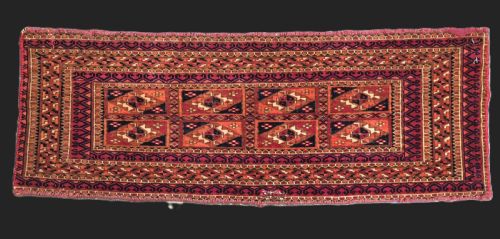
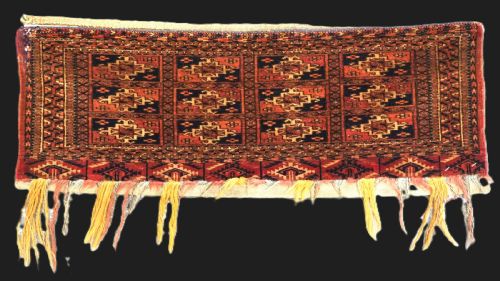


Tekke Guls Woven Textile
When seeking a tekke guls woven textile, collectors find Central Asian nomadic weavings distinguished by repeated geometric medallions and deep wool pile.
Tekke Guls Woven Textile
A tekke guls woven textile comprises antique Turkmen tribal pieces produced across the nineteenth century, most frequently taking the form of torba faces, chuval faces, and complete rug bags with plain weave backs. These items originated as functional dowry pieces and tent furnishings created by nomadic and semi-nomadic weavers in Central Asia.
The objects on this page span from the middle decades of the nineteenth century up to around nineteen hundred, representing styles such as Turkmen Tribal and Central Asian Nomadic. Buyers encounter both fragmentary examples and complete pieces retaining original hanging loops or flat woven details.
Variations in Quality
Quality in these nomadic textiles rests upon the fineness of the weave and the precision of the drawing within the main medallions and secondary ornaments. Pieces demonstrating exceptionally tight knotting and clear, vibrant natural dye palettes sit at the upper end of the range.
The survival of original structural components, including plain weave backs and hanging loops, marks out superior examples from fragments or heavily restored specimens.
Listings span the nineteenth century, with pieces dated across the 1850s, 1860s, 1870s, 1880s, and 1900.
The Tekke Guls Woven Textile Glossary
- Gul
- A primary medallion motif repeated across Turkmen carpets and tribal weavings. Each tribe utilised distinct configurations to signal identity and heritage.
- Chuval
- A large tent bag used for storing household goods, typically featuring multiple guls arranged in systematic rows. Complete examples retain their reverse sides.
- Mafrash
- A rectangular storage container or face utilised for bedding and clothing within the nomadic camp. They share construction methods with torbas.
- Natural Dyes
- Organic colourants derived from plants and insects used to dye wool before weaving. These materials produce the nuanced, deep tones seen in nineteenth century pieces.
Tekke Guls Woven Textile: Frequently Asked Questions
What is a tekke guls woven textile?
These items are nineteenth century tribal weavings originating from Central Asian nomadic groups, specifically associated with Turkmen makers. They typically manifest as bag faces or complete storage sacks intended for domestic use in tents.
The primary visual characteristic is the repeated gul motif, arranged in structured rows across a deep wool pile background created using natural dyes.
How were these bags used?
Nomadic families utilised these textiles primarily for storing household possessions, bedding, and dowry goods inside traditional dwellings. Smaller torbas and larger chuvals hung against tent walls or served practical transport functions.
Over time, many of these functional pieces were separated from their plain weave backs, leaving only the decorative face for display.
How do I care for a wool textile?
Protect antique wool pile pieces from direct sunlight to prevent natural dye fading, and maintain stable indoor humidity levels. Gentle vacuuming without a beater bar removes surface dust safely.
Professional textile conservators should handle any significant cleaning or structural stabilization required for nineteenth century examples.
How do I date a Turkmen weaving?
Dating relies on assessing the wool quality, the chemical composition of the natural dyes, and the density of the weave. Earlier nineteenth century pieces often display finer knotting and specific drawing styles in the guls.
The presence of intact plain weave backs and structural wear patterns also provides clues regarding the age of the piece.