


Sloping Front Knife Box
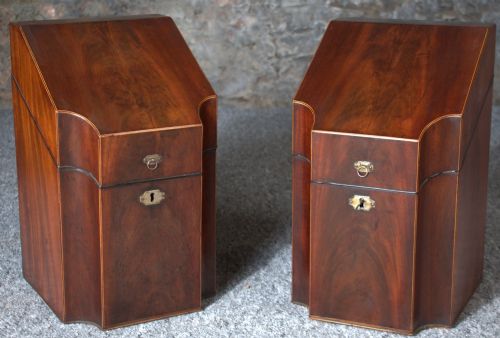
These sloping front knife box examples are refined Georgian pieces designed to hold cutlery or stationery with elegance on a sideboard.
Sloping Front Knife Box
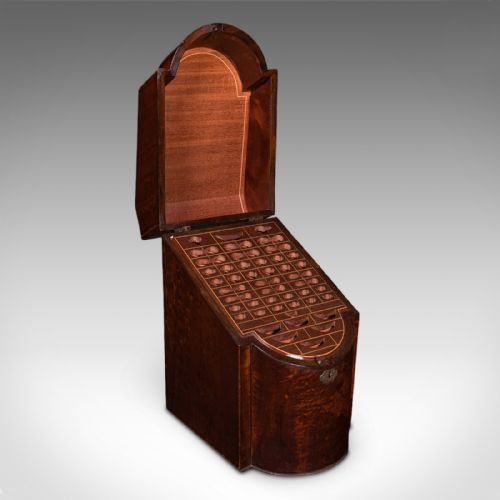
A sloping front knife box is a distinctive storage form originating in the eighteenth century, specifically during the Georgian period. These pieces present a steeply angled lid above a tapering body, traditionally built to house table knives and forks.
Most examples encountered here date from the George III era, featuring the characteristic serpentine or straight frontal profile. While originally intended for dining room cutlery, many survivors serve equally well as stationery boxes or letter holders today.
How they were made
Cabinet makers constructed these boxes primarily in solid or figured mahogany, often selecting timber with rich grain patterns. Workshops enhanced the primary wood using delicate boxwood and satinwood inlay to define the sloping lids and escutcheons.
Functional metal elements such as brass fittings, hinges, and carrying handles were incorporated to withstand daily use. Interiors frequently retained fitted compartments lined to secure individual cutlery items or papers.
This site's listings show mahogany as the primary wood, frequently enhanced with boxwood and satinwood inlay across eighteenth-century Georgian forms.
What varies in quality
The distinction between standard and superior pieces rests on the choice of timber figure and the precision of the inlay. Boxes displaying highly figured mahogany and intricate contrasting stringing command greater appreciation among collectors.
Proportion and silhouette also dictate standing, with serpentine fronts offering a more sophisticated visual rhythm than plain rectilinear designs. The preservation of original brass hardware and fitted internal compartments further elevates the status of an individual box.
The Sloping Front Knife Box Glossary
- Serpentine front
- A curved shape curving outward in the centre and inward at the sides, often seen on finer Georgian boxes. This contour requires skilled carpentry to execute cleanly.
- Stringing
- A narrow line of contrasting inlay, typically boxwood or satinwood, used to edge panels and lids. It adds subtle linear decoration to mahogany surfaces.
- Escutcheon
- A protective plate surrounding the keyhole, usually fashioned from brass. On these boxes, it serves both a functional and an ornamental purpose.
- Canteen
- A fitted container or chest designed to hold a set of cutlery. These boxes often functioned as portable canteens in large dining rooms.
Sloping Front Knife Box: Frequently Asked Questions
What is a sloping front knife box?
A sloping front knife box is an eighteenth-century wooden chest designed with an angled lid to store dining cutlery on a sideboard. These pieces belonged to formal dining arrangements in wealthy homes.
Over time, many of these boxes transitioned into general storage or letter holders while retaining their distinctive Georgian silhouette.
How were these boxes used originally?
Servants used them in dining rooms to keep handled cutlery neat and ready for the table. The fitted interior compartments separated knives and forks to protect the blades.
When the meal finished, the locking lid secured the silver or steel cutlery until the next gathering.
How do I tell a Georgian box apart?
Georgian boxes display specific characteristics such as mahogany construction, dovetail joinery, and period brass hardware. The presence of boxwood inlay points directly to late eighteenth-century craftsmanship.
Proportions remain slender and upright, distinguishing them from later Victorian stationery boxes.
Can I use one for stationery?
Yes, many of these boxes adapt easily to holding letters, envelopes, and desk accessories. Their internal partitions suit paper storage just as well as cutlery.
Placing them on a desk or side table offers a practical way to enjoy eighteenth-century woodwork daily.