

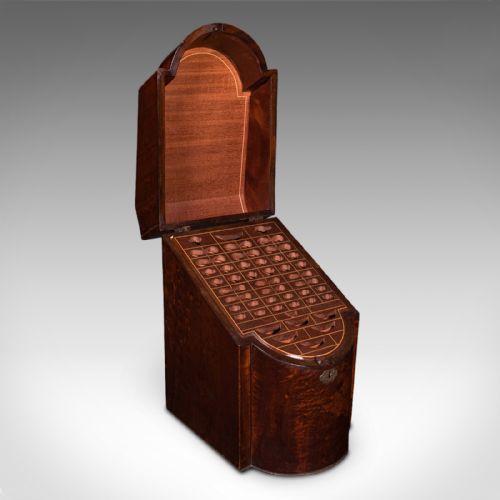


Slope Front Knife Box
A slope front knife box is a clever Georgian desk-form container built to hold cutlery, offering distinct sloping lids and fitted interiors.
Slope Front Knife Box
When you search for a slope front knife box, you encounter Georgian dining room receptacles designed to house cutlery upright or on stepped internal slots. These pieces date principally from the eighteenth century and the year 1800, aligning with the George III period.
Most examples on this page are formed from mahogany, sometimes featuring serpentine fronts or straight vertical sides beneath the characteristic angled lid. Makers also shaped them for secondary purposes such as stationery boxes, letter holders, and general storage boxes.
The typical profile relies on a tapering slope that lifts on brass hinges, frequently ornamented with delicate wood inlay or contrasting stringing. They sit on sideboards or serving tables, bringing architectural presence and practical organisation to period dining spaces.
How they were made
Cabinetmakers constructed these boxes primarily from solid and veneered mahogany, selecting figured timber for the main visible surfaces. They often added boxwood and satinwood inlay to accent the sloping lid and outline the geometric form.
Functional hardware played a structural role, utilising cast brass fittings such as carrying handles, escutcheons, and hinges. Artisans occasionally integrated bone details into the internal fittings and arranged specialised partitions to secure individual cutlery pieces.
Slope Front Knife Box Retail Price Guide 2026
Typical asking prices for slope front knife box among the pieces listed under this phrase on Sellingantiques today, from the lower quarter to the upper quarter. They describe what is for sale here now, not the wider market.
Current listings feature mahogany construction almost exclusively, paired with Georgian styling and brass hardware.
What varies in quality
The distinction between ordinary and superior boxes rests largely in the choice of timber figure and the crispness of the serpentine contour. Finely figured mahogany and balanced proportions elevate an individual piece far above a plain, straight-sided counterpart.
Attention to decorative detail also marks the upper tier, seen in precise boxwood and satinwood inlay rather than rudimentary line work. Original brass fittings and intact internal partitions preserve the integrity of the design and contribute to a more substantial presence.
The Slope Front Knife Box Glossary
- Serpentine front
- A furniture shape featuring a double-curved front that dips inward at the centre and swells outward at the sides. This contour requires skilled woodworking to achieve fluid lines on a small scale.
- George III
- The stylistic period spanning the reign of the third king of that name, associated with refined proportions and classical detail. Pieces from this era often display polished mahogany surfaces and restrained inlay.
- Boxwood
- A dense, pale wood utilised extensively for fine stringing and contrasting inlay work on Georgian furniture. It provides a sharp visual border against darker timbers like mahogany.
- Satinwood
- A lustrous, yellow-toned timber employed by period cabinetmakers for decorative panels and banded borders. Its golden sheen catches the light differently depending on the grain orientation.
- Escutcheon
- A protective metal plate surrounding a keyhole, usually cast in brass on these boxes. It serves both a functional purpose and a decorative role on the sloping lid or front panel.
Slope Front Knife Box: Frequently Asked Questions
What did they hold?
These boxes were originally manufactured to store dining knives, forks, and spoons before fitted canteens became common.
Interior slots and partitions kept the steel blades and bone or wooden handles separated and protected from damage.
How do I date them?
Dating relies on observing construction methods, timber choice, and stylistic cues associated with the Georgian era.
Eighteenth-century examples typically show hand-cut dovetails, secondary woods like pine or oak, and characteristic brass hardware styles.
Can I use them for letters?
Many surviving pieces function effectively as stationery boxes or letter holders on a desk or table.
The sloping interior depth accommodates modern papers and envelopes just as easily as traditional dining utensils.
Are pairs common?
Matching pairs occasionally appear because wealthy dining rooms of the period utilised symmetric sideboards.
One box held knives while the matching companion housed forks or spoons for large dinner parties.