

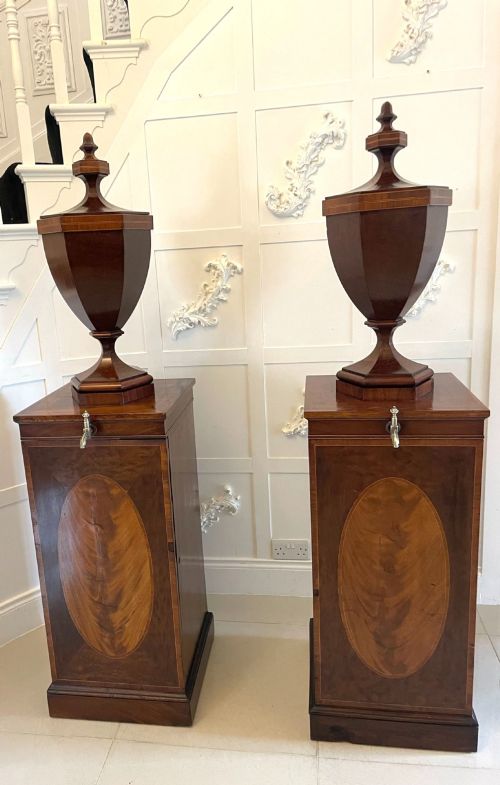


George III Knife Box
These George III knife boxes are elegant dining room requisites fashioned from rich timbers to house silver cutlery.
George III Knife Box
A george iii knife box is a specialised container designed to hold dining cutlery upright or flat within a fitted interior, originating in the eighteenth century. Most examples found on this page date to the georgian era and are constructed from dense woods.
The standard form presents a sloping slanted lid above a tapering body, occasionally featuring a serpentine or bow front profile. These pieces were typically kept on sideboards in grand dining rooms to store formal table knives.
Makers produced both single items and matched pairs, whilst some variations adapted the internal partitions for stationery or incorporated locking mechanisms. Surviving pieces demonstrate the domestic habits of elite households during the late eighteenth century.
Factors of quality
The distinction between standard examples and the finest pieces rests upon timber selection and surface patination. Rich, deep colour and highly figured grain patterns elevate a box, whilst dry or heavily restored surfaces diminish visual appeal.
Internal completeness plays a significant role in assessment, particularly the survival of original fitted wooden compartments designed for knife handles and blades. The crispness of inlaid stringing and the quality of brass or silver hardware further separate ordinary workshop output from master cabinetwork.
George III Knife Box Retail Price Guide 2026
Typical asking prices for george iii knife box among the pieces listed under this phrase on Sellingantiques today, from the lower quarter to the upper quarter. They describe what is for sale here now, not the wider market.
Surviving examples span the eighteenth century and the broader georgian period.
The George III Knife Box Glossary
- Serpentine
- A front profile curving inward centrally and outward at the sides. This contour requires precise carpentry and signals a more expensive commission.
- Bow front
- A convex, outwardly curved front elevation. It softens the strict geometric lines typical of standard dining furniture.
- Stringing
- Thin inlaid lines of contrasting wood set flush into the surface. This technique frames panels and highlights the structural edges of the box.
- Escutcheon
- A protective metal plate surrounding the keyhole. On these pieces, they are frequently cast in brass or formed from bone.
- Patina
- The surface sheen and mellow tone developed through age and handling. A deep patina indicates decades of careful maintenance.
George III Knife Box: Frequently Asked Questions
What were knife boxes used for?
These boxes stored prized steel and silver table knives securely when not in service on the dining table. They protected delicate blades from humidity and dust in wealthy eighteenth-century households.
Servants placed them on sideboards or side tables during dinner parties to display the host's refined silver service. Over time, many surviving examples were adapted to hold stationery or letters instead of cutlery.
How do I identify a Georgian knife box?
Look for a distinctive sloped lid, a tapering upright body, and dense mahogany timber characteristic of the eighteenth century. Original pieces often retain interior partitions and pigeonholes sized specifically for period cutlery.
Check for period construction methods such as hand-cut dovetails and traditional brass hardware. True examples from this era possess a distinct Georgian proportion and architectural dignity.
Where were they placed in the room?
They stood proudly on mahogany sideboards or dedicated side tables in the formal dining room. Pairs were frequently arranged symmetrically to frame a central urn or plate pail.
Their placement signaled the status of the dining room and allowed servants easy access during large meals. Today, collectors display them on similar side tables or desks as decorative focal points.
Can I store modern cutlery in them?
Most modern table knives feature wider blades and longer handles than eighteenth-century cutlery. Consequently, contemporary sets often fail to fit the tight, dedicated internal wooden slots.
Collectors generally use them for display rather than daily service to preserve the fragile interior fittings. If you wish to store items inside, smaller desk accessories or letters fit comfortably within the partitions.