
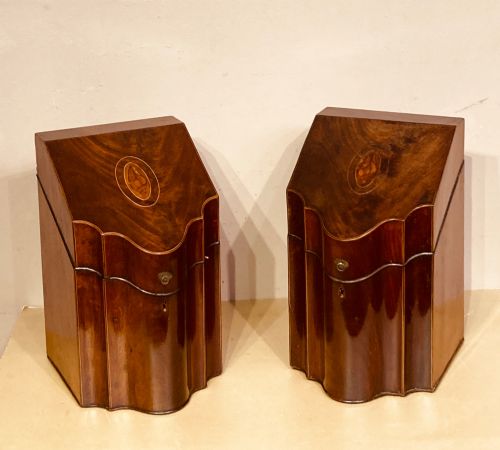


Marquetry Knife Box
A marquetry knife box is a shaped timber receptacle for tableware, bringing rich inlay and period character straight to a desk or sideboard.
Marquetry Knife Box
When you search for a marquetry knife box, you are looking at domestic containers built to hold cutlery in eighteenth and nineteenth-century dining rooms. The pieces appearing here span the eighteenth century, the Georgian era, and the nineteenth century, including country iterations in oak alongside finer urban examples.
Most entries take the traditional serpentine or sloping form designed to stand on a sideboard, while others function as hanging boxes or stationery cabinets. You will frequently encounter matched pairs or single specimens fashioned with inlaid wood and brass fittings.
The materials and construction reflect the domestic requirements of their period, shifting from formal mahogany and satinwood to sturdy oak in provincial workshops. These boxes survived by transitioning from dining room service to general storage for letters and papers.
How they were made
Cabinetmakers constructed these boxes using solid timbers and veneers, predominantly employing mahogany, walnut, and oak as the foundational structure. Artisans then applied decorative wood inlay, utilising lighter contrasting elements such as boxwood and satinwood to create geometric or floral patterns.
Functional metal components played a vital role in construction, with brass hinges, escutcheons, and catches fitted to secure the sloping lids and internal compartments. Fitted interiors were integrated to hold cutlery securely, though some examples later adapted into letter holders or stationery cabinets.
Some boxes spent centuries shifting from knife storage to holding love letters, proving that good joinery outlives changing dining habits.
What varies in quality
The distinction between standard examples and superior pieces rests in the crispness of the timber inlay and the precision of the cabinetwork. Finer boxes display meticulous attention to the grain of the mahogany or walnut, paired with finely executed satinwood and boxwood banding.
Proportion and structural integrity also dictate the standing of a piece, particularly in the shaping of sloping lids and serpentine fronts. Original brass hardware and well-preserved fitted interiors elevate an object above those altered or stripped of their internal fittings over time.
The Marquetry Knife Box Glossary
- Mahogany
- A durable tropical hardwood prized by eighteenth-century cabinetmakers for its rich dark reddish-brown tone and stability. It forms the primary body for the majority of these boxes.
- Inlay
- A decorative technique where pieces of contrasting wood, such as boxwood and satinwood, are inserted into recessed portions of a timber base to form patterns. This method defines the surface decoration.
- Escutcheon
- A protective brass plate surrounding a keyhole, designed to prevent the surrounding wood from splintering during use. It serves both a structural and decorative function on the front of the lid.
- Serpentine
- A distinct curved outline featuring a convex centre flanked by concave sides, frequently employed in the front profile of Georgian case furniture. This shape adds visual movement to the box.
Marquetry Knife Box: Frequently Asked Questions
What were knife boxes originally used for?
These containers stood on sideboards in grand dining rooms to hold silver-handled cutlery upright when not in use. Households kept them locked to protect valuable tableware.
Over time, many lost their internal fittings and transitioned into letter holders, stationery cabinets, or general decorative storage boxes in other rooms of the house.
How do I date a Georgian knife box?
Dating relies on examining the timber species, the style of the brass hardware, and the complexity of the internal configuration. Eighteenth-century examples often feature solid mahogany with delicate satinwood inlay and serpentine fronts.
Nineteenth-century country pieces tend to use simpler timbers like oak and exhibit less complex joinery. Comparing the construction methods to known period styles confirms the decade of manufacture.
Are these boxes waterproof inside?
No, the internal compartments consist of bare wood and sometimes remnants of old lining paper rather than waterproof barriers. Cutlery had to be fully dried before being placed back inside the box.
Introducing moisture can warp the delicate wood veneers and stain the internal dividers, so modern owners avoid storing damp items.
How should I clean the wood surface?
Maintenance requires gentle dusting with a soft, dry cloth to remove particles without disturbing the aged surface. Avoid modern silicone sprays and harsh chemical polishes that can degrade the old finish.
Applying a traditional beeswax sparingly helps nourish the timber and preserves the sheen of the mahogany and inlaid details.